• About Me Card

Max Hemingway

~ Musings as I work through life, career and everything.

Max Hemingway

Category Archives: Development

Raspberry Pi and Amazon Alexa Voice Service

25 Friday Mar 2016

Posted by Max Hemingway in Development, Programming, Raspberry Pi

≈ 5 Comments

Tags

Development, Programming, RaspberryPI

Amazon have released a step through guide that allows you to access the Alex Voice Service using a Raspberry Pi.

This project demonstrates how to access and test the Alexa Voice Service using a Java client (running on a Raspberry Pi), and a Node.js server. You will be using the Node.js server to get a Login with Amazon authorization code by visiting a website using your computer’s (Raspberry Pi in this case) web browser.

This guide provides step-by-step instructions for obtaining the sample code, the dependencies, and the hardware you need to get the reference implementation running on your Pi.

Github Repository: https://github.com/amzn/alexa-avs-raspberry-pi

Hardware you need

  • Raspberry Pi 2 (Model B)
  • Micro-USB power cable for Raspberry Pi (included with Raspberry Pi)
  • Micro SD Card – To get started with Raspberry Pi you need an operating system. NOOBS (New Out Of the Box Software) is an easy-to-use operating system install manager for the Raspberry Pi. The simplest way to get NOOBS is to buy an SD card with NOOBS preinstalled – Raspberry Pi 8GB Preloaded (NOOBS) Micro SD Card
    An Ethernet cable
  • USB 2.0 Mini Microphone – Raspberry Pi does not have a built-in microphone; to interact with Alexa you’ll need an external one to plug in
  • A USB Keyboard & Mouse, and an external HDMI Monitor
  • WiFi Wireless Adapter (Optional)

Skills you needPI

  • Basic programming experience
  • Familiarity with shell

One for my list to try on my Raspberry Pi.


Share this:

  • Click to share on Facebook (Opens in new window) Facebook
  • Click to share on LinkedIn (Opens in new window) LinkedIn
  • Click to email a link to a friend (Opens in new window) Email
  • Click to share on Pinterest (Opens in new window) Pinterest
  • Click to share on Reddit (Opens in new window) Reddit
  • Click to share on Tumblr (Opens in new window) Tumblr
  • Click to share on Pocket (Opens in new window) Pocket
  • Click to share on Telegram (Opens in new window) Telegram
  • Click to share on Threads (Opens in new window) Threads
  • Click to share on WhatsApp (Opens in new window) WhatsApp
  • Click to share on Mastodon (Opens in new window) Mastodon
  • Click to share on X (Opens in new window) X
  • Click to share on Bluesky (Opens in new window) Bluesky
Like Loading...

Early view of the Raspberry Pi3

27 Saturday Feb 2016

Posted by Max Hemingway in Development, IoT, Programming, Raspberry Pi, Uncategorized

≈ 1 Comment

Tags

Development, IoT, Programming, RaspberryPI

PIThe Register has an article on the new Raspberry Pi3 which is currently going through FCC testing and certification.

The Pi 3 Model B otherwise looks pretty much like 2015’s quad-core 32-bit ARM Cortex-A7-based Raspberry Pi 2: it sports a familiar Broadcom system-on-chip, HDMI port, SD card slot, wired Ethernet socket, and 40 general-purpose IO pins, all in a credit-card form factor. – Source The Register

Not much is know from the rest of the submission about its features, however Wifi and Bluetooth onboard it will be interesting to see what other things have been built in as the details of this version are released by RaspberryPi.


Share this:

  • Click to share on Facebook (Opens in new window) Facebook
  • Click to share on LinkedIn (Opens in new window) LinkedIn
  • Click to email a link to a friend (Opens in new window) Email
  • Click to share on Pinterest (Opens in new window) Pinterest
  • Click to share on Reddit (Opens in new window) Reddit
  • Click to share on Tumblr (Opens in new window) Tumblr
  • Click to share on Pocket (Opens in new window) Pocket
  • Click to share on Telegram (Opens in new window) Telegram
  • Click to share on Threads (Opens in new window) Threads
  • Click to share on WhatsApp (Opens in new window) WhatsApp
  • Click to share on Mastodon (Opens in new window) Mastodon
  • Click to share on X (Opens in new window) X
  • Click to share on Bluesky (Opens in new window) Bluesky
Like Loading...

PI Zero Stock & Project Competition

06 Saturday Feb 2016

Posted by Max Hemingway in Development, IoT, Open Source, Programming, Raspberry Pi, Uncategorized

≈ Leave a comment

Tags

Coding, Development, IoT, Programming, RaspberryPI

PISince its launch the Raspberry PI Zero seems to be in high demand with its low price of under £5.00 for the base module. The official suppliers are still out of stock with no view as to when they may receive their next shipment. They fly out as soon as they come in

This makes the PI Zero Stock literally Zero!

The unofficial supply chain of place such as Ebay are now up as high as £42.00 with sellers caching in on what is supposed to be a cheap computing platform.

Hopefully the stock levels will come back to a level to stem/curb the high prices coming in.

But why so popular – this is mainly due to the cheap price of the computing module and has captured the imagination of hackers, developers and hobbyists.

There are a wide range of interesting projects appearing on the net such as:

  • Pi Zero Synth
  • Pi Zero Projects

Hackaday and Adafruit have joined up to create a new competition looking for the best Raspberry PI Zero project.

The platform is ideal for IoT development of small modules, sensors and other projects. The other forms of the Raspberry PI is already being used for IoT projects such as a Home Heating Control Device.

It will be interesting to see what comes out of the competition and the next innovation. One competition I shall be watching with interest.


Like Loading...

Digital Scouting

25 Monday Jan 2016

Posted by Max Hemingway in Development, Innovation, Programming, Tools

≈ 3 Comments

Tags

Development, Innovation, learning, Programming

digitalThere have been a series of new badges introduced by the Scouting movement. Two of these replace the traditional IT Staged Badge with a Digital Citizen and Digital Maker staged badge. These are aimed at giving young people skills in the digital age and help with STEM education.

These badges also teach young people to follow the Scouts digital manifesto:

The Scouts’ Digital Manifesto

  1. Use digital to learn and embrace new skills
  2. Share your adventures digitally and inspire others
  3. Know when to switch off, balancing screen time with outdoor activities
  4. Use digital skills to support your family and community
  5. Use digital to be creative
  6. Stay safe online and know the risks

Each of the badges provides 4/5 stages and builds on each stage. The badges can be earn’t from Beavers, through Cubs, Scouts and Explorers (ages 6 up to 18) so start with the basics, then build into writing apps.

These are a set of badges that I am looking forward to helping the local Scout Group out with. All I need to find for my local Scout Group is some spare Laptops or some Raspberry Pi’s…….Any offers welcome.

Perhaps there is a Scout group near you where you can help volunteer your skills with these badges.

Badge requirements

(Source: https://members.scouts.org.uk/supportresources/4282/digital-citizen-staged-activity-badge)

Digital Citizen – stage 1

How to earn your badge
Complete every task to achieve Stage 1, showing that you have thought about the potential risks and how to stay safe for each activity.

  1. Show that you can:
    • turn on and log into a computer
    • use a piece of software, for example email or a game
    • name the main parts of a computer system
    • connect a peripheral (for example a scanner or printer) to your computer and use it.
  2. Create a piece of digital media. It could be artwork, a photograph, music or animation.
  3. Use the internet for research:
    • decide on an area of interest
    • find three websites with content that matches your area of interest
    • collect relevant information by printing or saving as files.

Digital Citizen – stage 2

How to earn your badge
Complete every task to achieve Stage 2, showing that you have thought about the potential risks and how to stay safe for each activity.

  1. Plan and then create a piece of digital media. It could be artwork
    or a photograph that you alter using creative tools, music, animation, CAD (Computer Aided Design) or a 3D sculpture.
  2. Show that you can:
    • send or reply to someone with a short email and include an attachment
    • download photos or other media from a camera or smart card
    • open and save a document then share it using a cloud service (like Google Docs or Microsoft Sharepoint) or a USB stick
    • create a document that includes media that you’ve downloaded or copied from another source.
  3. Use the internet for research:
    • decide on an area of interest
    • use two different search engines to find three websites you think are reliable
    • collect information by printing the pages or saving  as PDF documents
    • select relevant information by copying text or an image and pasting into a document
    • display your findings as a poster or a short report.

Digital Citizen – stage 3

How to earn your badge
Complete every task to achieve Stage 3, showing that you have thought about the potential risks and how to stay safe for each activity.

  1. Plan, make, edit and share a piece of digital media. It could be
    artwork or a photograph that you alter using creative tools, music, animation, CAD (Computer Aided Design) or a 3D sculpture.
  2. Explore social networking sites that are appropriate for your age, then create an example of a good social network profile. Show that you know how to:
    • use anti-virus software
    • set up or adjust settings for accessibility
    • recover from a frozen programme or screen.
  3. Use the internet for research:
    • decide on a specific area of interest
    • use at least two different search engines, using operators like AND, NOT and OR in the search box
    • collect information by using bookmarks or favourites. Save URLs or use a social bookmarking tool like Diigo, Reddit, StumbleUpon, del.icio.us or digg.
    • select specific, reliable information relevant to your area of research
    • create a structured display of the information you have gathered. You could do this in a document, on a website or using a social tool such as Pinterest.
    • share your research with other people, for example by email, on the web, by MMS or social media.

Digital Citizen – stage 4

How to earn your badge
Complete every task to achieve Stage 4, showing that you have thought about the potential risks and how to stay safe for each activity.

  1. Create a portfolio of digital media. It might include artwork or a
    photograph that you alter using creative tools, music, animation, CAD (Computer Aided Design) or 3D sculpture.
  2. Create a film, video, stop-motion animation or podcast and share it using a suitable media sharing tool.
  3. Create a social network profile for your section, a band, local interest group or something similar. Alternatively you could make a small
    website that can host content, like the film you made in step 2, photos, poetry or information about your local area.
  4. Use the internet for research:
    • Choose a local, national, community or Scouting issue, or something from the news or current affairs.
    • Collect information from different sources, such as spreadsheets, databases, online news services and ‘open access’ data sources.
    • Put your information together in a structured way, for example grouping similar information. Make sure you know where each
      piece of information comes from.
    • Select the information you think is most appropriate and reliable.
    • Create a multi-page website with your information and make it public. Present your information in a variety of ways – you could
      use infographics, images or graphs.
    • Share your website with a wide audience.
    • Explain your sources of information and why you picked out what you did.
    • Get some feedback on what you have done and make changes to
      improve your website based on that feedback.

(Source: https://members.scouts.org.uk/supportresources/4283/digital-maker-staged-activity-badge)

Digital Maker – stage 1

How to earn your badge

  1. Connect computer peripherals or accessories, such as a screen and
    keyboard, and explain what job they do.
  2. Design a game:
    • Use role play to act out how your digital game would work. Play the game with a group of friends and change the rules.
    • Using paper, prototype a game and explain to someone how it works. You could video your explanation.
    • Evaluate and share your idea.
  3. Edit an existing website. You could change the design using a paper printout or software.
  4. Play a game with a friend where one of you acts the part of a robot and the other sends the robot commands. Record on paper what sort of commands worked best and which were hard for the ‘robot’ to follow.

Digital Maker – stage 2

How to earn your badge

  1. Connect two devices and exchange data between them using WiFi,
    Bluetooth or a cable.
  2. Show that you can use two different platforms or operating systems. They could be systems that run different devices such as computers,  tablets, phones or games consoles.
  3. Design a game:
    • Make a cartoon, animation or video of a game using a video camera or other equipment.
    • Create some pseudo code to explain how some parts of your game will work. Pseudo code is an instruction for the computer to follow, but is not written in a specific language.
    • Design a sequence of a game, like a whole level or an in-game puzzle.
  4. Design a single page website. You can use a design tool but writing HTML code would be fine too.
  5. Create a set of instructions for a programmable Robot, turtle or toy to
    follow. Games like Minecraft can help you do this.

Digital Maker – stage 3

How to earn your badge

  1. Show how to troubleshoot problems with computing equipment, such as hardware  devices and software updates.
  2. Make a prototype of a game using a suitable tool. It must include:
    • event conditions (when your game reacts to something that happens)
    • user movement controls
    • iteration (when your code or instructions are repeated)
    • variables (for scoring, health or counting things within the game).
  3. Build, design and publish a multipage website with working hyperlinks for navigation between the pages.
  4. Make a robot using prebuilt components.

Digital Maker – stage 4

How to earn your badge

  1. Set up a home network and connect it to the internet.
  2. Install or run an alternative operating system on a computer. Alternatively,  use a ‘Live DVD’ or USB stick.
  3. Design a game:
    • Build a game that includes progression and is fun and interesting to play.
    • Get someone else to play and evaluate it.
  4. Create a fully functioning website including linking to a database.
  5. Make a robot using a kit with components that respond to sensor input (for example, a robot that backs away from an object in its path).

Digital Maker – stage 5

How to earn your badge

  1. Install the software to run a web server and host a webpage on a  computer or other device. Tools like LAMP, WAMP or Google’s Webserver project for the Raspberry  Pi could help you. You can find these for free online.
  2. Make a game or app that serves a purpose. It should:
    • have a clear objective
    • be challenging for the user
    • have a clear sense of progression
    • keep a score
    • offer a reward to the user for playing (for example the score could unlock levels or icons).
  3. Make a website that serves a purpose, provides a good experience for the user and meets any legal requirements.
  4. Use off-the-shelf components to make your own robot that responds to the environment (for example a robot that reacts to light, its proximity to other objects or sound).


Share this:

  • Click to share on Facebook (Opens in new window) Facebook
  • Click to share on LinkedIn (Opens in new window) LinkedIn
  • Click to email a link to a friend (Opens in new window) Email
  • Click to share on Pinterest (Opens in new window) Pinterest
  • Click to share on Reddit (Opens in new window) Reddit
  • Click to share on Tumblr (Opens in new window) Tumblr
  • Click to share on Pocket (Opens in new window) Pocket
  • Click to share on Telegram (Opens in new window) Telegram
  • Click to share on Threads (Opens in new window) Threads
  • Click to share on WhatsApp (Opens in new window) WhatsApp
  • Click to share on Mastodon (Opens in new window) Mastodon
  • Click to share on X (Opens in new window) X
  • Click to share on Bluesky (Opens in new window) Bluesky
Like Loading...

Installing the Docker Toolbox – Exit Status 255 and 1

18 Monday Jan 2016

Posted by Max Hemingway in Development, DevOps/OpsDev, Open Source

≈ Leave a comment

Tags

Development, DevOps, Docker, Open Source, OpsDev

I installed docker using the docker toolbox v1.9.1 application download and executable onto a Windows laptop.

Available at https://github.com/docker/toolbox/releases

The docker toolbox installs a number of components including:

  • dockerdocker 1.9.1
  • docker-machine 0.5.6
  • docker-compose 1.5.2
  • Kitematic 0.9.5.1
  • Boot2Docker ISO 1.9.1
  • VirtualBox 5.0.12

The first installation I did resulted in an issue with the IP addressing on the virtual adapters.

Docker IP


I tried fixing this in docker and VirtualBox, but did not have much success, so decided to go back to basics and remove and reinstall.

I did the reinstall as for some reason VirtualBox hung on the suggestion of removing the default vm and recreating it . First command below:

$ docker-machine rm default
$ docker-machine create --driver virtualbox default

This fix has worked for others though. I went slightly drastic with the reinstall but could’nt find why VirtualBox was not behaving.

Useful links/discussion on Exit Status 255:

  • https://github.com/docker/toolbox/issues/317
  • https://github.com/docker/machine/issues/1801#issuecomment-147101937

Having reinstalled the applications rebooted and started the docker VM I was faced with an error message that something went wrong – exit status 1.

docker 2

Thankfully these days putting error messages into Google finds help as well as RTM (Read The Manual).

Having read a number of posts on the subject and trying some of the recommendations, I ended up upgrading VirtualBox to the latest test build v5.0.13. This resolved the issue and docker started correctly.

Useful links/discussion on Exit Status 1:

  • https://github.com/docker/machine/issues/1716).

Testbuilds of VirtualBox available at:

  • https://www.virtualbox.org/wiki/Testbuilds

Now fixed I can use docker on this laptop.

docker3


Share this:

  • Click to share on Facebook (Opens in new window) Facebook
  • Click to share on LinkedIn (Opens in new window) LinkedIn
  • Click to email a link to a friend (Opens in new window) Email
  • Click to share on Pinterest (Opens in new window) Pinterest
  • Click to share on Reddit (Opens in new window) Reddit
  • Click to share on Tumblr (Opens in new window) Tumblr
  • Click to share on Pocket (Opens in new window) Pocket
  • Click to share on Telegram (Opens in new window) Telegram
  • Click to share on Threads (Opens in new window) Threads
  • Click to share on WhatsApp (Opens in new window) WhatsApp
  • Click to share on Mastodon (Opens in new window) Mastodon
  • Click to share on X (Opens in new window) X
  • Click to share on Bluesky (Opens in new window) Bluesky
Like Loading...

Learning to Program

14 Thursday Jan 2016

Posted by Max Hemingway in Development, Programming, Uncategorized

≈ 3 Comments

Tags

Coding, DevOps, learning, Programming

CodeIf one of your new years resolutions is to learn how to program? If not why should you consider to learn to program and add it to your list? As businesses become more focused on  Cloud, DevOps/OpsDev, aaS (as a Service) or SDnn (Software Defined) a knowledge of programming and a language will help you understand these advancements, services and technologies, as well as allowing you to participate in their delivery.

Here are some good resources to help you:

A good book resource on how to program can be found on Gthub at https://github.com/braydie/HowToBeAProgrammer

The site covers the following topics:

Contents

  1. Beginner
    • Personal Skills
      • Learn to Debug
      • How to Debug by Splitting the Problem Space
      • How to Remove an Error
      • How to Debug Using a Log
      • How to Understand Performance Problems
      • How to Fix Performance Problems
      • How to Optimize Loops
      • How to Deal with I/O Expense
      • How to Manage Memory
      • How to Deal with Intermittent Bugs
      • How to Learn Design Skills
      • How to Conduct Experiments
    • Team Skills
      • Why Estimation is Important
      • How to Estimate Programming Time
      • How to Find Out Information
      • How to Utilize People as Information Sources
      • How to Document Wisely
      • How to Work with Poor Code
      • How to Use Source Code Control
      • How to Unit Test
      • Take Breaks when Stumped
      • How to Recognize When to Go Home
      • How to Deal with Difficult People
  2. Intermediate
    • Personal Skills
      • How to Stay Motivated
      • How to be Widely Trusted
      • How to Tradeoff Time vs. Space
      • How to Stress Test
      • How to Balance Brevity and Abstraction
      • How to Learn New Skills
      • Learn to Type
      • How to Do Integration Testing
      • Communication Languages
      • Heavy Tools
      • How to analyze data
    • Team Skills
      • How to Manage Development Time
      • How to Manage Third-Party Software Risks
      • How to Manage Consultants
      • How to Communicate the Right Amount
      • How to Disagree Honestly and Get Away with It
    • Judgment
      • How to Tradeoff Quality Against Development Time
      • How to Manage Software System Dependence
      • How to Decide if Software is Too Immature
      • How to Make a Buy vs. Build Decision
      • How to Grow Professionally
      • How to Evaluate Interviewees
      • How to Know When to Apply Fancy Computer Science
      • How to Talk to Non-Engineers
  3. Advanced
    • Technological Judgment
      • How to Tell the Hard From the Impossible
      • How to Utilize Embedded Languages
      • Choosing Languages
    • Compromising Wisely
      • How to Fight Schedule Pressure
      • How to Understand the User
      • How to Get a Promotion
    • Serving Your Team
      • How to Develop Talent
      • How to Choose What to Work On
      • How to Get the Most From Your Team-mates
      • How to Divide Problems Up
      • How to Handle Boring Tasks
      • How to Gather Support for a Project
      • How to Grow a System
      • How to Communicate Well
      • How to Tell People Things They Don’t Want to Hear
      • How to Deal with Managerial Myths
      • How to Deal with Organizational Chaos


List of useful books on GitHub on programming:

  • https://github.com/vhf/free-programming-books/blob/master/free-programming-books.md

If you are now wondering which language to base your learning on this post may help

  • https://maxhemingway.com/2015/01/08/learn-a-programming-language-but-which-one/

There are lots of online courses available to help you learn – alot are free

  • http://thenextweb.com/dd/2012/10/21/so-you-want-to-be-a-programmer-huh-heres-25-ways-to-learn-online/#gref

Share this:

  • Click to share on Facebook (Opens in new window) Facebook
  • Click to share on LinkedIn (Opens in new window) LinkedIn
  • Click to email a link to a friend (Opens in new window) Email
  • Click to share on Pinterest (Opens in new window) Pinterest
  • Click to share on Reddit (Opens in new window) Reddit
  • Click to share on Tumblr (Opens in new window) Tumblr
  • Click to share on Pocket (Opens in new window) Pocket
  • Click to share on Telegram (Opens in new window) Telegram
  • Click to share on Threads (Opens in new window) Threads
  • Click to share on WhatsApp (Opens in new window) WhatsApp
  • Click to share on Mastodon (Opens in new window) Mastodon
  • Click to share on X (Opens in new window) X
  • Click to share on Bluesky (Opens in new window) Bluesky
Like Loading...

8 Free “For Dummies” books you should read in 2016

12 Tuesday Jan 2016

Posted by Max Hemingway in Architecture, Cloud, Development, DevOps/OpsDev, Enterprise Architecture, Innovation, Programming, Security

≈ Leave a comment

Tags

Architecture, Development, DevOps, Knowledge, OpsDev, Productivity, Programming, Security, Tools

There has been a lot of the free smaller versions of the “For Dummies” books published recently. These are normally sponsored by a company to help promote a way of thinking/product/etc, however they do contain useful overviews and information on the subject that they are presenting on.

Here are my top 8 of these which should be on your reading list for the start of 2016. All are downloadable in PDF format*.

Agile for Dummies

API for Dummies

DevOps for Dummies

Micro-segmentation for Dummies

Next Generation Endpoint Security for Dummies

Software Defined Data Centres for Dummies

Software Defined Networking for Dummies

Software Defined Storage for Dummies

*You may need to sign up to receive some of these books.

Share this:

  • Click to share on Facebook (Opens in new window) Facebook
  • Click to share on LinkedIn (Opens in new window) LinkedIn
  • Click to email a link to a friend (Opens in new window) Email
  • Click to share on Pinterest (Opens in new window) Pinterest
  • Click to share on Reddit (Opens in new window) Reddit
  • Click to share on Tumblr (Opens in new window) Tumblr
  • Click to share on Pocket (Opens in new window) Pocket
  • Click to share on Telegram (Opens in new window) Telegram
  • Click to share on Threads (Opens in new window) Threads
  • Click to share on WhatsApp (Opens in new window) WhatsApp
  • Click to share on Mastodon (Opens in new window) Mastodon
  • Click to share on X (Opens in new window) X
  • Click to share on Bluesky (Opens in new window) Bluesky
Like Loading...

Manual tasks of today should be the Automated tasks of tomorrow

11 Monday Jan 2016

Posted by Max Hemingway in Architecture, Development, DevOps/OpsDev, Innovation, Open Source, Productivity, Programming, Tools

≈ 10 Comments

Tags

Architecture, Development, DevOps, Open Source, Productivity, Tools

“Manual tasks of today should be the Automated tasks of tomorrow”.

CogsThere are lots of Automation tools available to people and businesses today to automate tasks that are carried out in a manual way. The pace at which this is happening is varying based on Habits and Patterns that we use on a daily basis. Also because change is involved which sometimes causes its own set of anxieties and issues.

Back in 2012 Bruno Oliveir published a graph on G+ on Geeks and repetitive tasks, which, shows a view of time vs task and how as geek vs non geek might approach automation.

geeks-vs-nongeeks-repetitive-tasks

An alternative view was published by Jon Udell in 2012 – Another way to think about geeks and repetitive tasks which shows an alternative view adding in more steps to show repetition.

alternate-view-of-automation

xkcd has an interesting view on the subject that does ring true in some cases where something does not exist and needs to be created in order to Automate.

automation

You need to be careful that in spending lots of time in trying to automate a task, that you don’t may spend more time in developing automation than could have been spent actually doing the task.

To get over this an element that is missing from these graphs is reuse and blueprints/patterns. The chances are that someone else has had a go at doing what your about to automate so there may be something to reuse rather than developing something yourself.

There are lots of tools and code repositories available today with more being developed. It will depend upon what you are automating as what to use.

Some of the tools available include;

  • Chef
  • Docker
  • Github
  • Jenkins
  • Jira
  • Powershell
  • Puppet

There are too many to list – lots of others available.

Using an Agile approach as well may reduce the length of the task size line on the graph as you do not need to boil the ocean to automate. Break up tasks into their components and you may find it easier to automate.

These tools are also bringing the geek and non geek lines together as Application’s and API’s make it easier for automation to be implemented. The plot of the graph changes into a repeatable process and in effect becomes a loop for both the geeks and non geeks.

Automate

So what will you automate today?


Share this:

  • Click to share on Facebook (Opens in new window) Facebook
  • Click to share on LinkedIn (Opens in new window) LinkedIn
  • Click to email a link to a friend (Opens in new window) Email
  • Click to share on Pinterest (Opens in new window) Pinterest
  • Click to share on Reddit (Opens in new window) Reddit
  • Click to share on Tumblr (Opens in new window) Tumblr
  • Click to share on Pocket (Opens in new window) Pocket
  • Click to share on Telegram (Opens in new window) Telegram
  • Click to share on Threads (Opens in new window) Threads
  • Click to share on WhatsApp (Opens in new window) WhatsApp
  • Click to share on Mastodon (Opens in new window) Mastodon
  • Click to share on X (Opens in new window) X
  • Click to share on Bluesky (Opens in new window) Bluesky
Like Loading...

An A-Z Guide to being an Architect

07 Thursday Jan 2016

Posted by Max Hemingway in Architecture, Big Data, Cloud, Development, DevOps/OpsDev, Enterprise Architecture, Governance, Innovation, IoT, Open Source, Productivity, Programming, Security, Social Media, Tools

≈ Leave a comment

Tags

Architecture, Cloud, CPD, Data, Development, DevOps, Innovation, IoT, Knowledge, learning, Open Source, OpsDev, Productivity, Programming, Social Media

Back in 2008 Microsoft published An A-Z Guide to ABCBeing an Architect in their Architecture Journals.

Here is my take on an updated A to Z Guide to being an Architect. A couple of these may be similar.

A – Architect

Having the right level of skills as an Architect or engaging an Architect with the right level of skills will depend on the work needing to be undertaken. There are several types of Architect with some specialising in certain areas and others being multi domain skilled. The list below covers some of the different types of Architect- this is not an exhaustive list:

  • Enterprise Architect
  • Information Architect
  • Solutions Architect
  • Software Architect
  • Systems Architect

B – Blueprints

Following Blueprints and Patterns either published by vendors (such as the Microsoft Blueprints) or developed internally around your products and services will ensure repeat-ability and cost control around the design process.

Some examples showing different pattern types can be found at Architecture Patterns

C – Contextual Web Era

The up and coming 4th Platform area is the Contextual Web Era

  • 1st Platform – Mainframe Era
  • 2nd Platform – Client Server Era
  • 3rd Platform – Cloud Era
  • 4th Platform – Contextual Web Era

This is an up and coming era with lots of new innovation and developments. Keeping up with developments is key going forward for any architect to understand designs/solutions, art of the possible now and future, innovation and for developing roadmaps for solutions.

D – DevOps

To quote Wikipedia – “DevOps (a clipped compound of “development” and “operations”) is a culture, movement or practice that emphasizes the collaboration and communication of both software developers and other information-technology (IT) professionals while automating the process of software delivery and infrastructure changes”. Having knowledge of DevOps, OpsDev and Agile assist with Architecting a solution for a business understanding their practices and modes of interacting with technology to meet business requirements. A Good book on the subject of DevOps is “The Phoenix Project” by Gene Kim.

E – Enterprise Architecture

EA (Enterprise Architecture) is a blueprint that defines how a business can meet its objectives and strategy. This is achieved by conducting analysis, design, planning, recommendations and implementations through an Enterprise Architecture Framework

Enterprise Architecture Wikibook

F – Four Two Zero One Zero

42010 is the ISO Standard that most frameworks adhere to. Working to a Framework brings structure to your designs and life cycles.

There are a number of frame works available such as:

  • DoDAF
  • MoDAF
  • TOGAF
  • Zachman
  • Other Frameworks are available

Enterprise Architecture Wikipedia Book

G – Governance

Governance is an important part of architecture as it

  • Ensures Conformance
  • Controls Variance
  • Maintains Vitality
  • Enables Communication
  • Sets Direction
  • Issue Resolution
  • Provides Guidance and Prioritisation
  • Promotes Best Practise
  • Minimises Risk
  • Protects IT environments from tactical IT changes, project solutions, and strategic proposals that are not in an organisations global best interest
  • Controlling Technical Diversity, Over-Engineering and Unnecessary Complexity
  • Ensures projects can proceed quickly & efficiently
  • Control over IT spend
  • Quality Standards
  • Efficient and optimal use of resources and increase the effectiveness of IT processes

H – Hands On

It is important to be current and understand the technologies you are architecting. There are lots of options available to get your hands dirty using technology from using Cloud Servers to virtual machines on your compute device. There are other computing devices such as the Raspberry PI that provide a cheap alternative to standing up small farms to learn on.

I – IoT

IoT (Internet of Things) is where physical things are connected by the internet using embedded sensors, software, networks and electronics. This allows the items to be managed, controlled and reported on. My blog posts on IoT Device Security Considerations and Security Layers goes into more detail on this subject.

J – Juxtaposition

Juxtaposition is something an architect should be doing to compare things/items/artefacts etc.
noun;
1. an act or instance of placing close together or side by side, especially for comparison or contrast.
2.the state of being close together or side by side.

Source:http://dictionary.reference.com/browse/juxtaposition

K – Knowledge

I would class Skills with Knowledge. It is important as an Architect to ensure that your skills/knowledge are up to date and where you are unsure of a technology, you have a plan to address and skill up. Build a good CPD (Continuing Professional Development) plan and work towards completing it.

L – Language

With the move to cloud it is important to ensure your scripting skills are up to date as most cloud platforms use scripting to assist with the deployment of environments. This is also true of other DevOps/OpsDev applications. If you are unsure on what to learn this guide may help you – Learn a Programming Language – But which one?

M -Micro Segmentation

Micro Segmentation allows a business to use Networks, Compute and Storage to automate and deliver complex solutions by carving up and using the infrastructure. This segments part of the infrastructures to specific functions/tasks. It can also be used in a security context to segment networks, firewalls, compute and storage to increase security and reduce cyber attacks.  VMware have produced a book “Micro Segmentation for Dummies” that can be downloaded from here.

N – Next Generation

Next Generation refers to the next stage or development to something such as a new release of hardware or software. Next Generation is becoming a common term now to define products and artefacts, an example being Next Generation Firewalls.

O – Open Source

Open Source has been available for a long time with software such a Linux, however there is a bigger shift towards using Open Source and acceptance by businesses. Some examples of Open Source that is now mainstream within business include;

  • Ansible
  • Chef
  • Docker
  • Puppet

P – Performance

Performance can cover people as well as solutions / systems. Performance metrics should be set out at the inception of an engagement then monitored and reported on. This will be a factor in driving Continuous Improvement going forward as well as forecasting / planning for future upgrades and expansion.

Q – Quality

Quality is a huge subject and has a lot if standards governing it and how it affects all aspects of business and architecture. Knowing which standards and how they affect a solution will assist in the whole architecture lifecycle. There are also a number of tools available to help you;

  • Architecture Frameworks
  • ITIL
  • Six Sigma

There is also a level of pride and satisfaction in producing a quality solution and system achieving the objectives and requirements set out by the business.

R- Roadmap

Any architecture/solution should have a roadmap to set out its future. Roadmaps should include items such as:

  • Current state
  • Future state
  • Innovation
  • Upgrades / Releases
  • New Features / Functions
  • End of Life / Replacement

S – SMAC

SMAC stands for Social, Mobile, Analytics, Cloud. SMAC is an acronym that covers the areas and concepts when these four technologies are brought together to drive innovation in business. A good description of SMAC written by a colleague can be found here Acronyms SMAC.

T – Transformation

The majority, if not all systems will undergo a form of transformation. This may be in the form of a simple upgrade or to a complex redesign and migration to something else.

U – UX

UX (User eXperience) affects how people interact with your architecture / design and how they feel about it (emotions and attitudes). With the boom in apps and the nearing Contextual Web Era, UX is one of the most important factors to getting an architecture used. If your users don’t like the system they may find something else to use that they like.

V – Vision

Understanding the vision of your customer and their business is the driving factor for any architecture.

On working with your customer you should look to become a Trusted Advisor and also with your colleagues. A great book on the subject is The Trusted Advisor by David Maister. The book covers 3 main areas which discusses perspectives on trust, the structure of trust building and putting trust to work.

W – WWW

The internet is a key delivery mechanism for systems. Knowing how this works and key components to the internet should be understood such as:

  • IPV4 – IPV6
  • DNS
  • Routing
  • Connectivity
  • Security

X – X86

X86 – is a standard that every knows as its one of the most common platform types available.

Y – Year

Year is for the longevity of the solution you are designing. How many years are your expecting it to last What are the Business Requirements, statutory obligations, depreciation etc that need to be planned in. Consider things like End of Life, Maintenance and Upgrades on hardware and software from a solution point of view.

Z – Zero Defects

The best solution is the one with zero defects, but reaching this goal can be a challenge and can also consume a lot of expense. The best way to ensure Zero Defects is to use:

  • Best Practice
  • Reference Architectures
  • Blueprints/Patterns
  • Checklists
  • Reuse
  • Lessons Learnt

This is my current A to Z and some of the entries may be different in your version so “What is in your A to Z of being an Architect?”

I will look to write some further blog posts on the areas listed in this A to Z

Share this:

  • Click to share on Facebook (Opens in new window) Facebook
  • Click to share on LinkedIn (Opens in new window) LinkedIn
  • Click to email a link to a friend (Opens in new window) Email
  • Click to share on Pinterest (Opens in new window) Pinterest
  • Click to share on Reddit (Opens in new window) Reddit
  • Click to share on Tumblr (Opens in new window) Tumblr
  • Click to share on Pocket (Opens in new window) Pocket
  • Click to share on Telegram (Opens in new window) Telegram
  • Click to share on Threads (Opens in new window) Threads
  • Click to share on WhatsApp (Opens in new window) WhatsApp
  • Click to share on Mastodon (Opens in new window) Mastodon
  • Click to share on X (Opens in new window) X
  • Click to share on Bluesky (Opens in new window) Bluesky
Like Loading...

Q. What does Dr Who and Star Wars have in common? A. Teaching young people to code.

09 Monday Nov 2015

Posted by Max Hemingway in Development, Programming

≈ Leave a comment

Tags

Coding, Knowledge, learning, Programming

Earlier this year I wrote a blog post on how the BBC were using their DR Who characters to help teach young people how to code whilst playing a game to get a Dalek through a series of puzzles. Doctor Who: Friendly Dalek teaches you to code

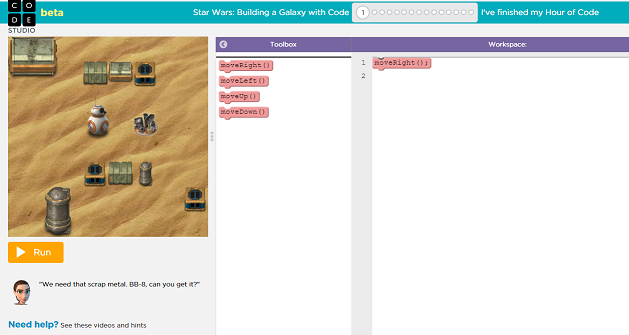
Now Disney and Code.org have joined in, to engage young people to move from playing games to creating games.

This time instead of controlling a Dalek you can control BB8 around some puzzles.

These interactive tutorials will appeal to anyone looking to learn coding and a great way to introduce young people into learning whilst gaming.

There are some similarities between then the two versions and moving a character around the screen. The Dr Who version uses the Characters of the show to explain what you need to do whilst the Star Wars version uses videos of one of the films developers to talk through what the tasks involve.

Screenshot of the interface to control BB8 – source/credit: Code.org/Disney

bb8

Screenshot of the interface to control a Dalek – source/credit: BBC

Dr Who Game Screeshot 1

Which Sci-Fi universe will you choose to help you learn?

All we need now is a Star Trek version…….

Share this:

  • Click to share on Facebook (Opens in new window) Facebook
  • Click to share on LinkedIn (Opens in new window) LinkedIn
  • Click to email a link to a friend (Opens in new window) Email
  • Click to share on Pinterest (Opens in new window) Pinterest
  • Click to share on Reddit (Opens in new window) Reddit
  • Click to share on Tumblr (Opens in new window) Tumblr
  • Click to share on Pocket (Opens in new window) Pocket
  • Click to share on Telegram (Opens in new window) Telegram
  • Click to share on Threads (Opens in new window) Threads
  • Click to share on WhatsApp (Opens in new window) WhatsApp
  • Click to share on Mastodon (Opens in new window) Mastodon
  • Click to share on X (Opens in new window) X
  • Click to share on Bluesky (Opens in new window) Bluesky
Like Loading...
← Older posts
Newer posts →

RSS Feed

RSS Feed RSS - Posts

Other Publications I contribute to

https://sparrowhawkbushcraft.com/

Recent Posts

  • Graceful Speech & Timeless Tales: Mastering the Art of Gesture
  • Graceful Speech & Timeless Tales: The Power of Pitch
  • Graceful Speech & Timeless Tales: Modulation
  • Graceful Speech & Timeless Tales: Harnessing Inflection
  • Adventure Games: Open Sourced Zork

Categories

  • 21st Century Human
  • 3D Printing
  • AI
  • Applications
  • ArchiMate
  • Architecture
  • Arduino
  • Automation
  • BCS
  • Big Data
  • Certification
  • Climate Change
  • Cloud
  • Cobotics
  • Connected Home
  • Data
  • Data Fellowship
  • Data Science
  • Development
  • DevOps/OpsDev
  • Digital
  • DigitalFit
  • Drone
  • Enterprise Architecture
  • F-TAG
  • Governance
  • Health
  • Innovation
  • IoT
  • Machine Learning
  • Metaverse
  • Micro:Bit
  • Mindset
  • Mobiles
  • Networks
  • Open Source
  • Podcasts
  • Productivity
  • Programming
  • Quantum
  • Raspberry Pi
  • Robotics
  • Scouting
  • Scouts
  • Security
  • Smart Home
  • Social Media
  • Space
  • STEM
  • Story Telling
  • Technologists Toolkit
  • Tools
  • Uncategorized
  • Wearable Tech
  • Windows
  • xR

Archives

Reading Shelf

Archives

Recent Posts

  • Graceful Speech & Timeless Tales: Mastering the Art of Gesture
  • Graceful Speech & Timeless Tales: The Power of Pitch
  • Graceful Speech & Timeless Tales: Modulation
  • Graceful Speech & Timeless Tales: Harnessing Inflection
  • Adventure Games: Open Sourced Zork

Top Posts & Pages

  • Graceful Speech & Timeless Tales: The Art of Articulation
  • Graceful Speech & Timeless Tales: Mastering the Art of Gesture
  • Mastering the CPD Cycle for Professional Growth
  • Adventure Games: Open Sourced Zork
  • 20 Informative Podcasts for 2025: Boost Your PKMS
  • Understanding ISO/IEC 42001: A Course Review
  • Building Cyber Resilience: Enterprise Architecture and ArchiMate for Strategic Security
  • Graceful Speech & Timeless Tales: Modulation
  • Graceful Speech & Timeless Tales: The Power of Pitch

Category Cloud

21st Century Human Architecture Automation Big Data Cloud Data Data Science Development DevOps/OpsDev Digital DigitalFit Enterprise Architecture Innovation IoT Machine Learning Mindset Open Source Podcasts Productivity Programming Raspberry Pi Robotics Security Social Media STEM Story Telling Technologists Toolkit Tools Uncategorized Wearable Tech

Tags

3D Printing 21st Century Human AI Applications Architecture artificial-intelligence Automation BCS Big Data Blockchain business Certification Cloud Cobot Cobotics Coding Communication Connected Home CPD creativity cybersecurity Data Data Fellowship Data Science Delivery Development DevOps Digital DigitalFit Digital Human Drone Email Enterprise Architecture GTD Infographic Information Theory Innovation IoT Journal Knowledge learning Machine Learning Metaverse MicroLearning Mindset Mixed Reality Networks Open Source OpsDev PKMS Podcasts Productivity Programming Proving It Quantum R RaspberryPI Robot Robotics Scouts Security Smart Home Social Media STEM Story Telling Technologists Toolkit technology Technology Couch Podcast Thinking Tools Training Visualisation Voice Wearable Tech xR

License

Creative Commons Licence
This work is licensed under a Creative Commons Attribution-NonCommercial-ShareAlike 4.0 International License.

Meta

  • Create account
  • Log in
  • Entries feed
  • Comments feed
  • WordPress.com

Blog at WordPress.com.

  • Subscribe Subscribed
    • Max Hemingway
    • Join 82 other subscribers
    • Already have a WordPress.com account? Log in now.
    • Max Hemingway
    • Subscribe Subscribed
    • Sign up
    • Log in
    • Report this content
    • View site in Reader
    • Manage subscriptions
    • Collapse this bar
 

Loading Comments...
 

    %d