• About Me Card

Max Hemingway

~ Musings as I work through life, career and everything.

Max Hemingway

Category Archives: Story Telling

Graceful Speech & Timeless Tales: Breathing

07 Wednesday Jan 2026

Posted by Max Hemingway in 21st Century Human, Story Telling

≈ 3 Comments

Tags

21st Century Human, Story Telling

Effective communication, whether you’re commanding a stage, weaving a story or pitching a big idea depend not only on your words, but on how you breathe.

Below, you’ll find an excerpt from my grandmother’s notebook, which, when seen through a contemporary lens, offers valuable lessons for present-day presenters and storytellers alike.

Notes on Breathing from the Notebook

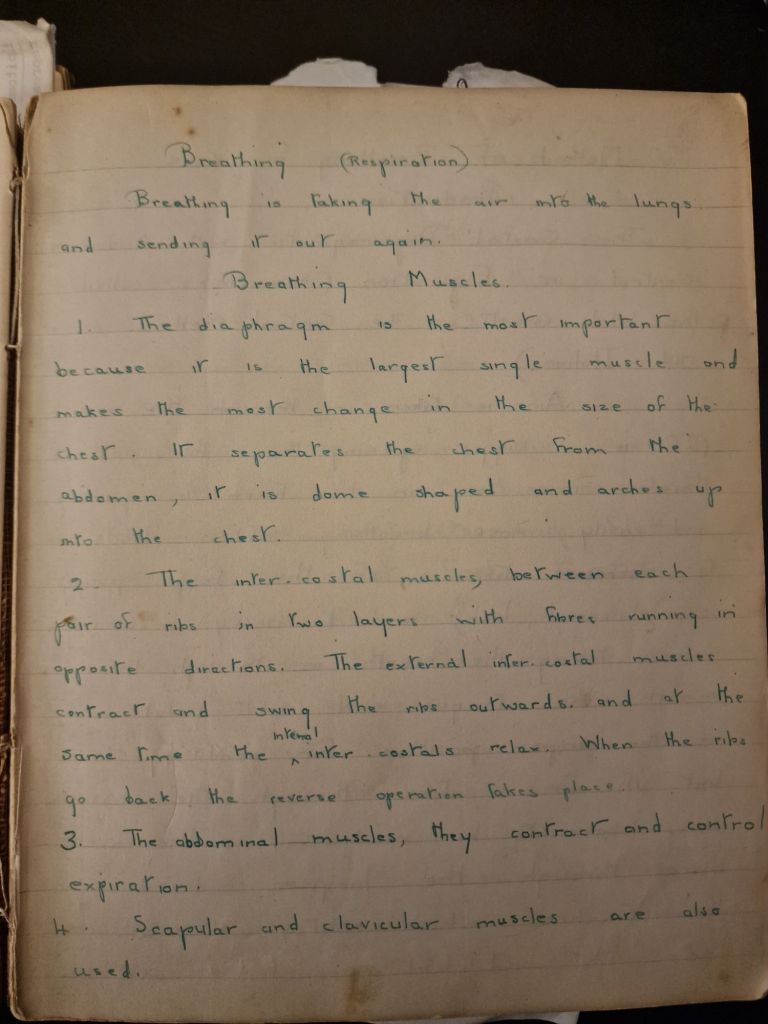
Breathing is taking the air into the lungs and sending it out again.

Breathing Muscles

  1. The diaphragm is the most important because it is the largest single muscle and makes the most change in the size of the chest. It separates the chest from the abdomen, it is dome shaped and arches up into the chest.
  2. The inter costal muscles, between each pair of ribs in two layers with fibres running in opposite directions. The external inter costal muscles contract and swing the ribs outwards and at the same time the internal inter costals relax. When the ribs go back the reverse operation takes place.
  3. The abdominal muscles, they contract and control expiration.
  4. Scapular and clavicular muscles are also used.

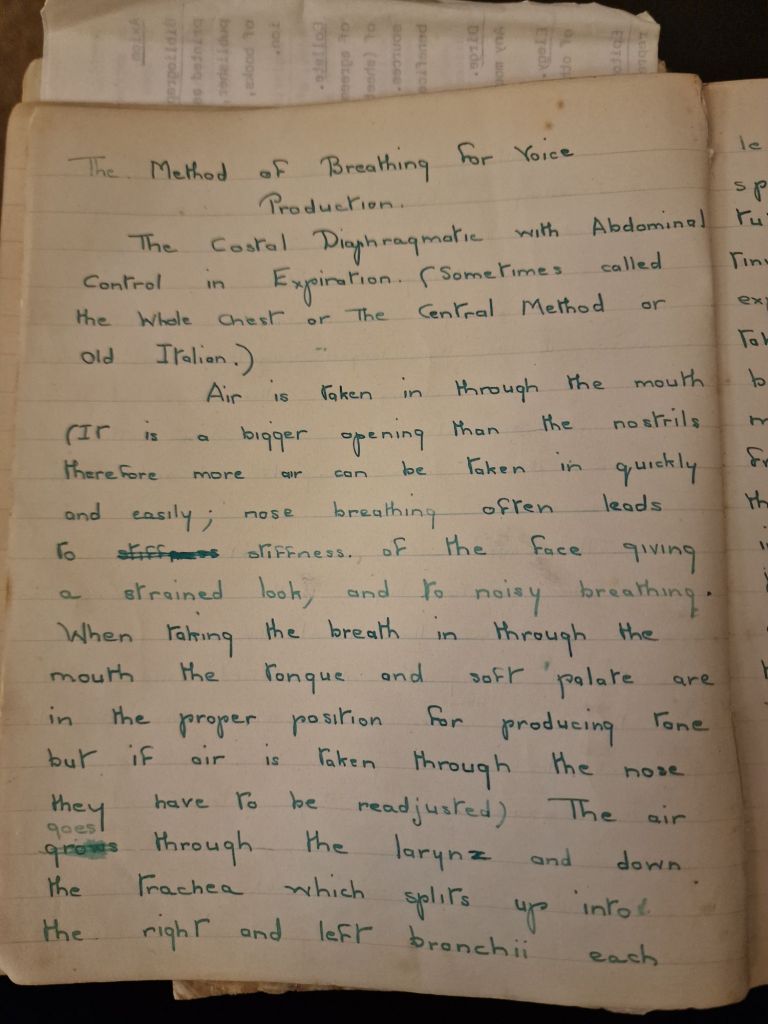
The Method of Breathing for you Production

The Costal Diaphragmatic with Abdominal Control in Expiration (sometimes called the Whole  Chest or the Central Method or Old Italian).

Air is taken in through the mouth (it is a bigger opening than the nostrils therefore more air can be taken in quickly and easily;  nose breathing often leads to stiffness of the face giving a strained look and to noisy breathing.

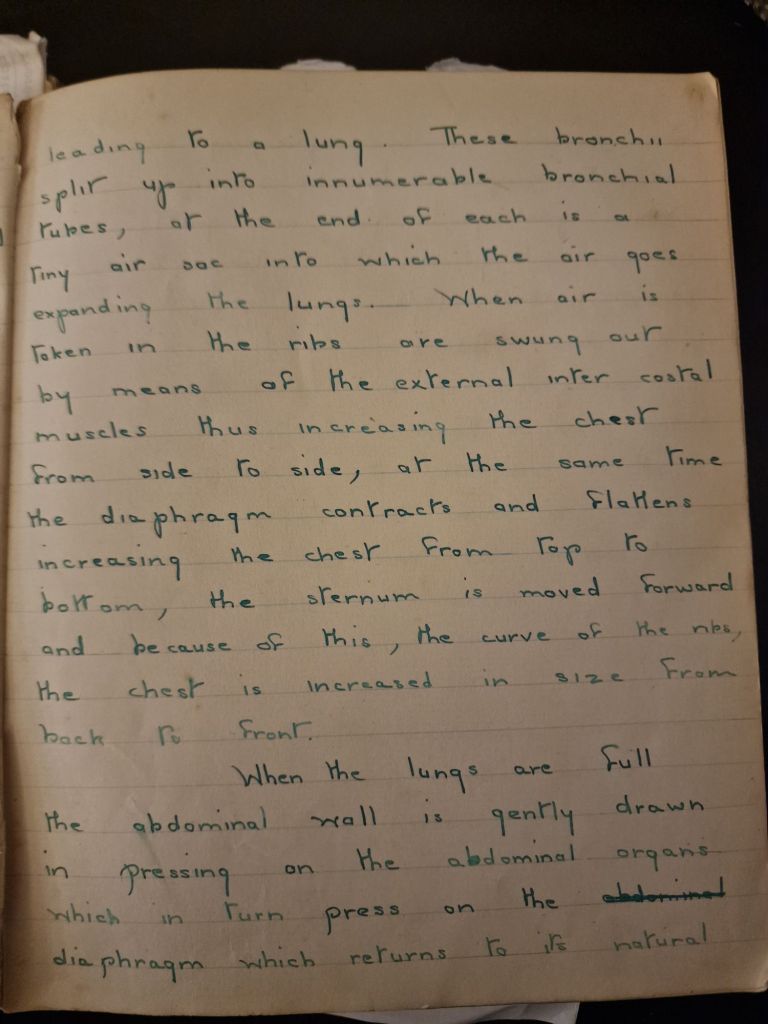
When taking the breath in through the mouth the tongue and soft palate are in the proper position for producing tone but if air is taken through the nose they have to be readjusted. The air goes through the larynx and down the trachea which splits up into the right and left branchii each leading to a lung. These branchii split up into innumerable bronchial tubes, at the ends of each is a tiny air sac into which the air goes expanding the lungs. When air is taken in the ribs are swung out by means of the external inter costal muscles thus increasing the chest from side to side, at the same time the diaphragm contracts and flattens increasing the chest from top to bottom, the sternum is moved forward and because of this, the curve of the ribs, the chest is increased in size from back to front.

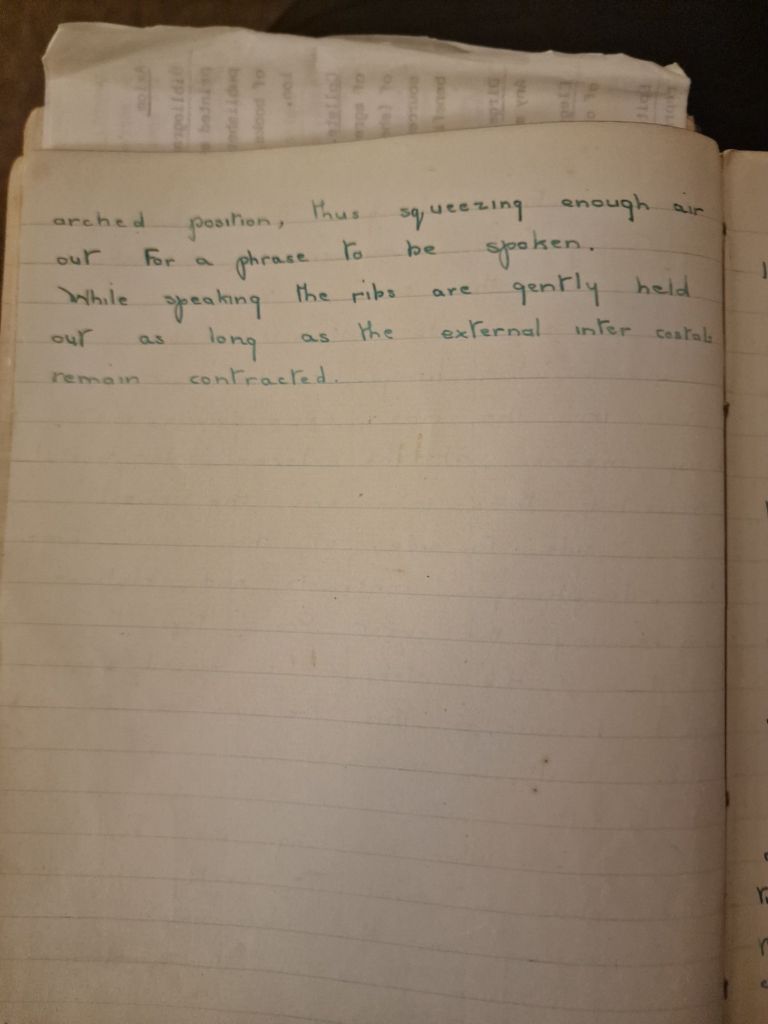
When the lungs are full the abdominal wall is gently drawn in pressing on the abdominal wall is gently drawn in pressing on the abdominal organs which in turn press on the diaphragm which returns to its natural arched position, thus squeezing enough air out for a phrase to be spoken.

While speaking the ribs are gently held out as long as the external inter costal remains contracted.

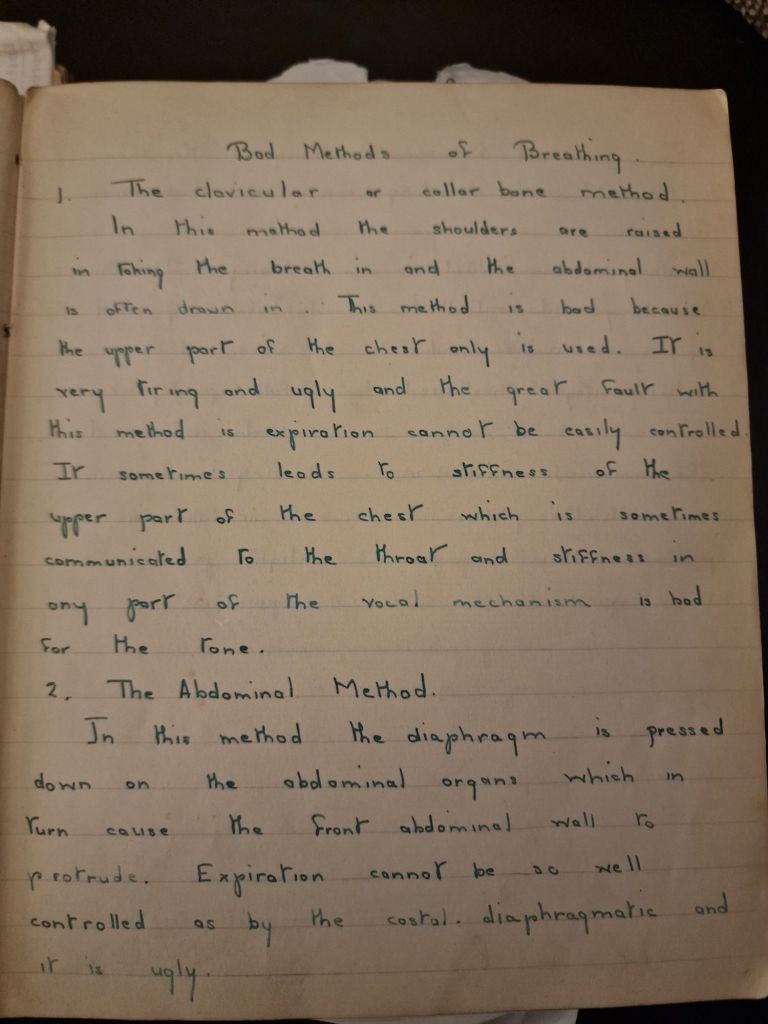
Bad Methods of Breathing

  1. The clavicular or collar bone method. In this method the shoulders are raised in taking the breath in and the abdominal wall is often drawn in. This method is bad because the upper part of the chest is used. It is very tiring and ugly and the great fault with this method is expiration cannot be easily controlled. It sometimes leads to stiffness of the upper part of the chest which is sometimes communicated to the throat and stiffness in any part of the vocal mechanism is bad for the tone.
  2. The abdominal method. In this method the diaphragm is pressed down on the abdominal organs which in turn cause the front abdominal wall to protrude. Expiration cannot be so well controlled as by the costal diaphragmatic and it is ugly.

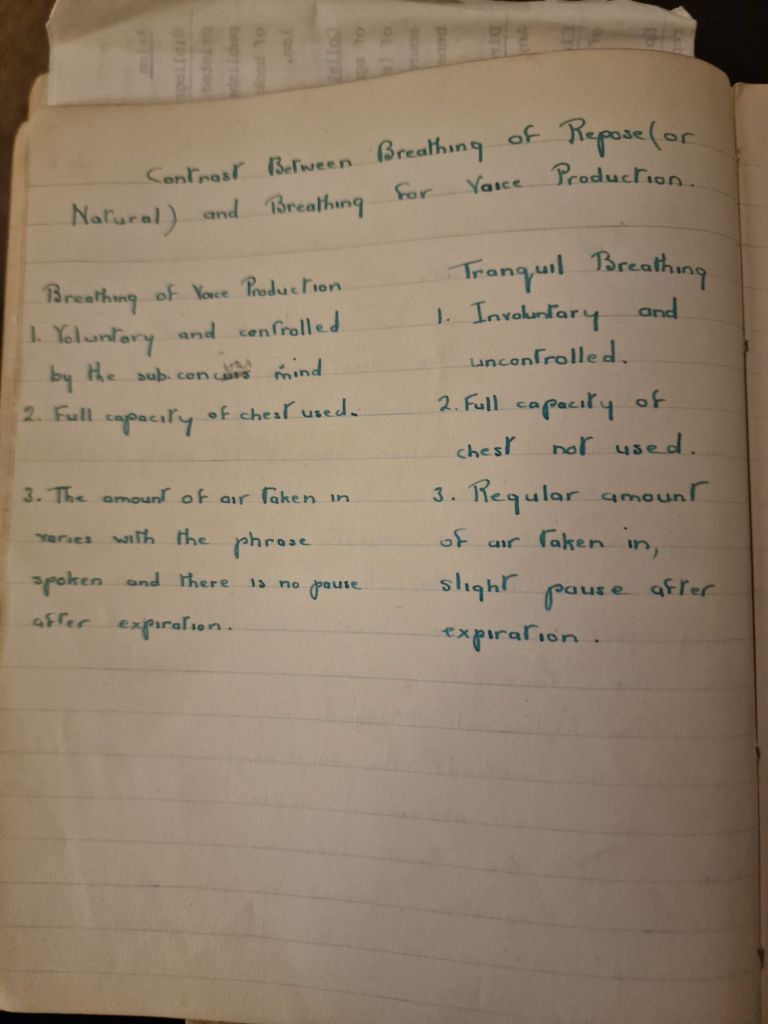
Contrast Between Breathing of Repose (or Natural) and Breathing for Voice Production

Breathing of Voice Production

  1. Voluntary and controlled by the subconscious mind
  2. Full capacity of chest used
  3. The amount of air taken in varies with the phrase spoken and there is no pause after expiration

Tranquil Breathing

  1. Involuntary and uncontrolled
  2. Full capacity of chest not used
  3. Regular amount of air taken in, slight pause after expiration

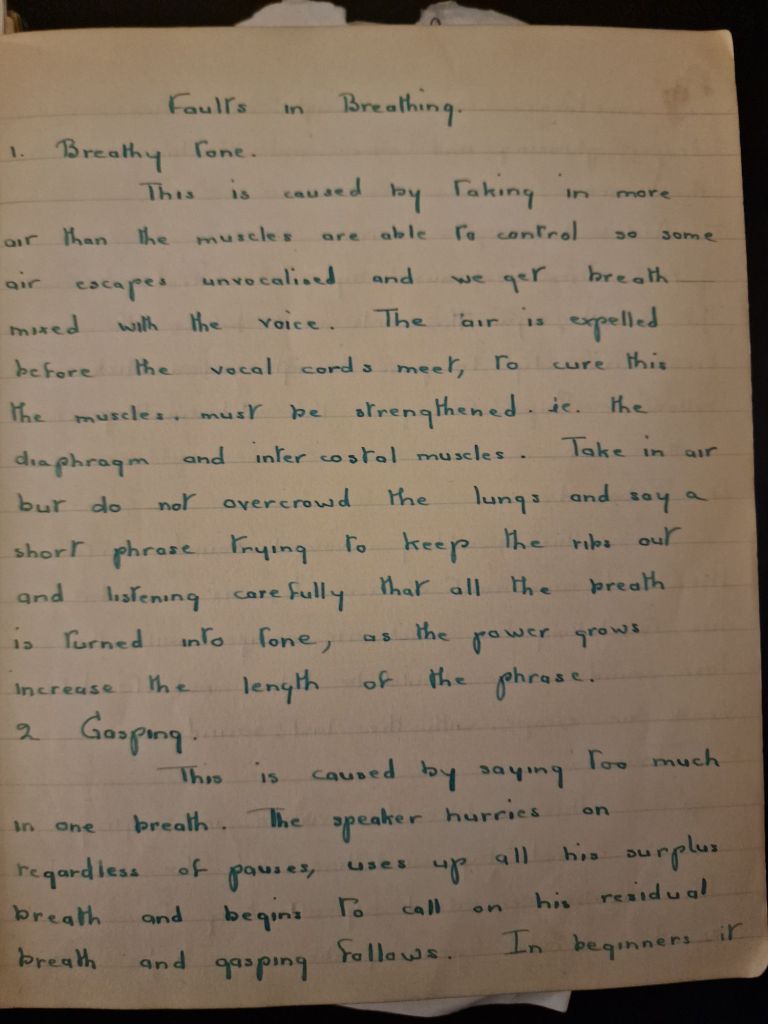
Faults in Breathing

  1. Breathing Tone: This is caused by taking in more air than the muscles are able to control so some air escapes unvocalised and we get breath mixed with the voice. The air is expelled before the vocal cords meet. To cure this the muscles must be strengthened, ie. The diaphragm and inter costal muscles. Take in air but do not overcrowds the lungs and say a short phrase trying to keep the ribs out and listening carefully that all the breath is turned into tone, as the power grows increase the length of the phrase.
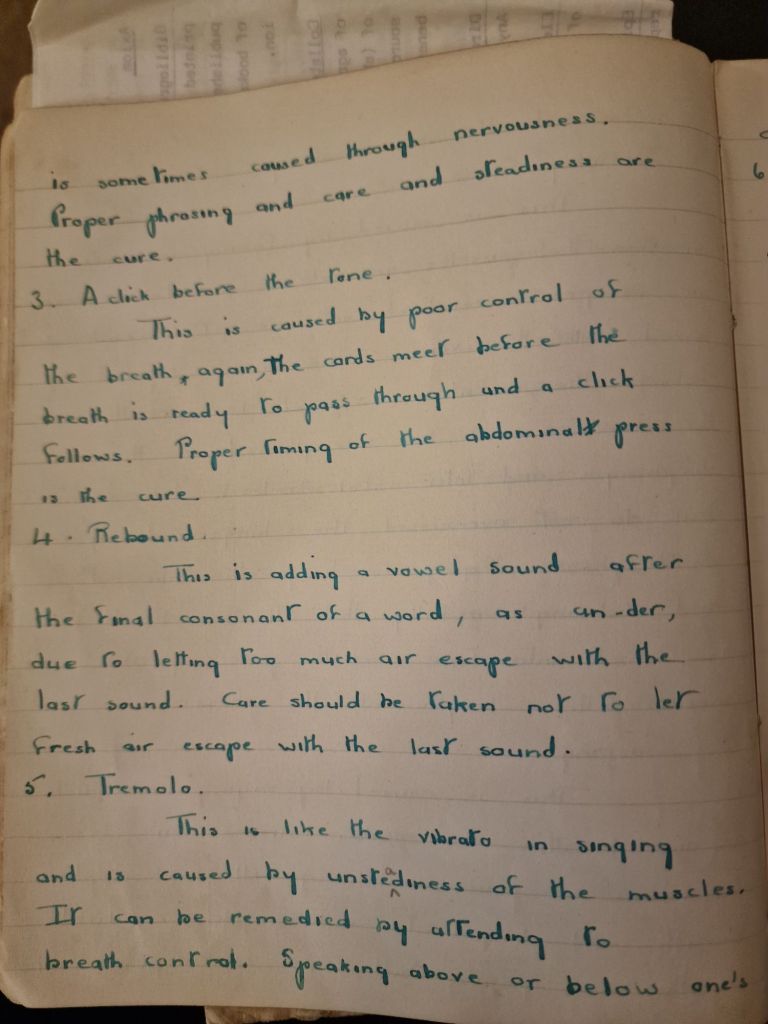
  2. Gasping: This is caused by saying too much in one breath. The speaker hurries on regardless of pauses, uses up all their surplus breath and begins to call on their residual breath and gasping follows. In beginners it is sometimes caused through nervousness. Proper phrasing and care and steadiness are the cure.
  3. A Click before Tone: This is caused by poor control of the breath again. The cords meet before the breath is ready to pass through and a click follows. Proper timing of the abdominal press is the cure.
  4. Rebound: This is adding a vowel sound after the final consonant of a word, as un-der due to letting too much air escape with the last sound. Care should be taken not to let fresh air escape with the last sound.
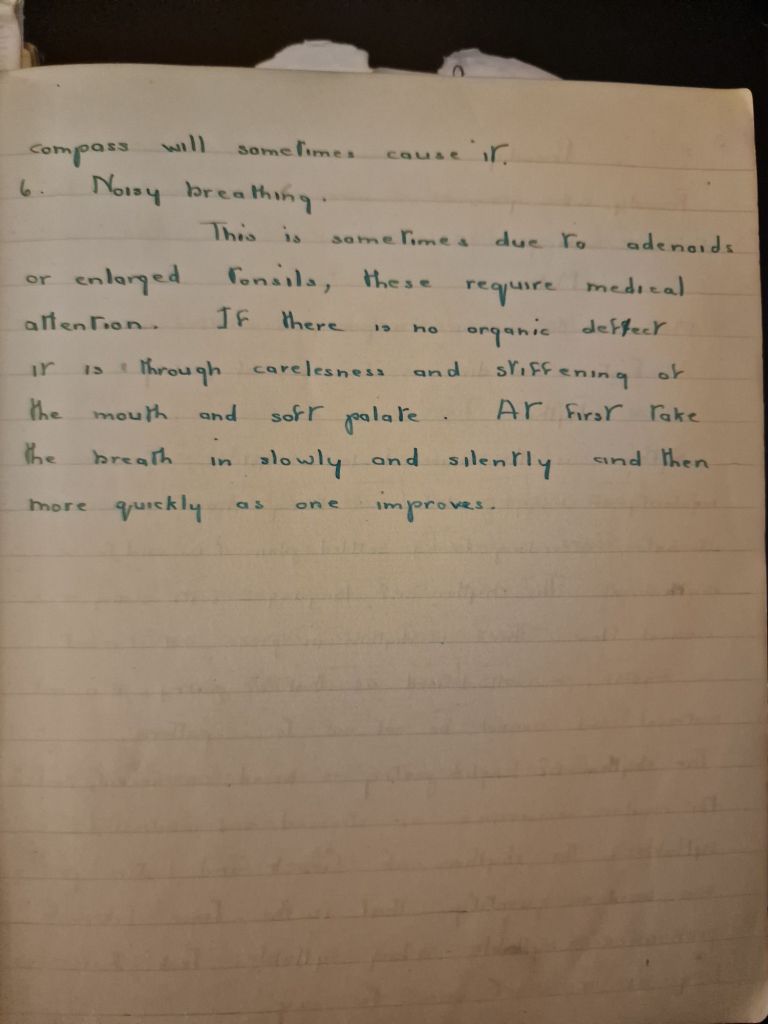
  5. Tremolo: This is like the vibrato in singing an is caused by unsteadiness of the muscles. It can be remedied by attending to breath control. Speaking above or below one’s compass will sometimes cause it.
  6. Noisy Breathing: This is sometimes due to adenoids or enlarged tonsils, these require medical attention. If there is no organic defect it is through carelessness and stiffening of the mouth and soft palate. At first take the breath in slowly and silently and the more quickly as one improves.

Above are an excerpt from my grandmothers notebook.

Modern Insights: Bringing Breathing Techniques into the 21st Century

Today experts in vocal performance, mindfulness and even sports science universally acknowledge (see further reading for articles) the value of deliberate breathing. The costal diaphragmatic method, as described above, remains central to performance technique but now we better understand its role in stress reduction, stamina and vocal clarity.

  • Mindful breathing is proven to lower anxiety before speaking, enhancing confidence and focus.
  • Nose breathing is preferred in general health to filter and humidify air, but for vocal projection, mouth breathing is effective when done consciously with relaxed facial muscles.
  • Apps and devices can now help speakers track and train their breathing, while modern trainers emphasise relaxation as much as control.
  • Warm-up routines for presenters often include breath exercises, stretching and even short meditation to prime both body and mind.
  • Understanding your own “breathing faults” helps tailor practice, video and audio feedback help track progress.

Blending this wisdom of past and present empowers presenters and storytellers to use breath as a foundation for authenticity and impact to as a key to unlocking their best voice.

Further Reading

  • Diaphragmatic Breathing: The First Step to a Good Voice — University of Mississippi Medical Center ENT handout
  • Correct Breathing and “Support” for Singing — SingWise
  • Diaphragmatic breathing techniques for singers (exercises and benefits)
  • The Effects of Mindfulness Practices on Speaking Anxiety and Performance (ResearchGate)
  • Nasal Breathing – ScienceDirect Topics
Lessons from my Grandmother’s Notebook: Rediscovering the Art of Speaking

Share this:

  • Click to share on Facebook (Opens in new window) Facebook
  • Click to share on LinkedIn (Opens in new window) LinkedIn
  • Click to email a link to a friend (Opens in new window) Email
  • Click to share on Pinterest (Opens in new window) Pinterest
  • Click to share on Reddit (Opens in new window) Reddit
  • Click to share on X (Opens in new window) X
  • Click to share on Tumblr (Opens in new window) Tumblr
  • Click to share on Pocket (Opens in new window) Pocket
  • Click to share on Telegram (Opens in new window) Telegram
  • Click to share on Threads (Opens in new window) Threads
  • Click to share on WhatsApp (Opens in new window) WhatsApp
  • Click to share on Mastodon (Opens in new window) Mastodon
  • Click to share on Bluesky (Opens in new window) Bluesky
  • Click to share on Nextdoor (Opens in new window) Nextdoor
Like Loading...

Ditch Resolutions: Embrace Habit-Building for Success
05 Monday Jan 2026

Posted by Max Hemingway in 21st Century Human, Mindset, Productivity, Story Telling

≈ Leave a comment

Tags

21st Century Human, Journal, Mindset, Productivity, Story Telling

Every January lots of people vow to turn over a new leaf with ambitious New Year’s resolutions only to feel beaten and deflated when their goals slip away just weeks later.

I am have done this and lots count over the years starting with good intentions and then failing.

Research suggests that up to 80% of resolutions fail by February, often because they’re too vague, too lofty, or rely solely on fleeting willpower.

What if there’s a better way? Instead of chasing motivation that fizzles out, you can lay the groundwork for real transformation by building habits that last.

Why Habits Beat Resolutions Every Time

Habits focus on small, repeatable actions and are more sustainable than motivation-driven resolutions.
Source: James Clear – Atomic Habits Principles

Resolutions might sound inspiring, but they can set you up for disappointment when not followed through. Habits centre on small, repeatable actions that naturally become part of your everyday routine.

Below are some habit building tips:

  • Use Consistency Over Intensity
  • Little actions done regularly are more sustainable than big one-off effort
  • Work on Process, Not Perfection
  • Habits focus on steady improvement
  • Automaticity
  • When a behaviour becomes a habit it is something you do it without needing to muster up motivation each time. It can take time to get to this stage though, builing the brain muscle memory.

Habits become automatic through consistent cues and responses, making them easier to maintain.
Source: Behavioral Science Research on Habit Formation

Start Small: Make Daily Journaling Your First Habit

A journal is one of my daily habits and I have written 41 journals so far amassing over 7,000 pages of notes.

Keeping a daily journal or carrying a pocket notebook is one of the most effective productivity habits you can adopt.

A journaling habit can help to transform your day-to-day life by:

  • Boosting Productivity
  • Jotting down tasks, ideas and reflections helping you stay organised and focused
  • Enhance Memory and Learning
  • Writing things down cements knowledge and makes it easier to recall later
  • It can help reduce stress by recounting things and looking at the with a different lens.
  • Journaling provides a healthy outlet for processing your thoughts and emotions
  • A journal can sparks creativity and can lead to innovative thoughts
  • Regular writing can encourage new ideas and creative problem-solving
  • Journalling can help increase your ablities for storytelling

A journal also allows you to reflect back on what you have done and achieved over days, months and even years.

How to Build the Journaling Habit

  1. Start Small – Jot down a single sentence each day or just a quick note about how you’re feeling. There’s no need for lengthy entries.
  2. Tie It to a Cue– Link journaling to an existing routine, such as having your morning brew or winding down before bed.
  3. Keep It Visible – Place your journal somewhere you’ll see it easily (on your bedside table, desk or in your bag) so you’re reminded to use it. Keep a pen with it as well.
  4. Focus on Progress, Not Perfection – Don’t stress if you miss a day or your entry isn’t perfect. The aim is to build consistency and not to write a masterpiece.

Why This Approach Works

Unlike resolutions, habits don’t hinge on bursts of motivation.

They are built from small, consistent actions that accumulate over time, eventually becoming second nature.  Like muscle memory, but using your brain as the muscle.

Further Reading

Why New Year’s Resolutions Set You Up to Fail

James Clear – Atomic Habits Principles

The Power of Habit: Why We Do What We Do, and How to Change

5 Benefits of Journaling for Mental Health

No Batteries Required: My Personal Journal
Journaling my Daily Musings

Share this:

  • Click to share on Facebook (Opens in new window) Facebook
  • Click to share on LinkedIn (Opens in new window) LinkedIn
  • Click to email a link to a friend (Opens in new window) Email
  • Click to share on Pinterest (Opens in new window) Pinterest
  • Click to share on Reddit (Opens in new window) Reddit
  • Click to share on X (Opens in new window) X
  • Click to share on Tumblr (Opens in new window) Tumblr
  • Click to share on Pocket (Opens in new window) Pocket
  • Click to share on Telegram (Opens in new window) Telegram
  • Click to share on Threads (Opens in new window) Threads
  • Click to share on WhatsApp (Opens in new window) WhatsApp
  • Click to share on Mastodon (Opens in new window) Mastodon
  • Click to share on Bluesky (Opens in new window) Bluesky
  • Click to share on Nextdoor (Opens in new window) Nextdoor
Like Loading...

Graceful Speech & Timeless Tales: The Power of Pitch

10 Wednesday Dec 2025

Posted by Max Hemingway in 21st Century Human, Story Telling

≈ Leave a comment

Tags

21st Century Human, Story Telling

The way we use our voice can make all the difference. One of the most subtle yet powerful tools in a speaker’s arsenal is pitch. The very note on which our words begin and the emotional current that runs through our spoken stories.

The Essence of Pitch

Pitch simply refers to how high or low our voice sounds as we speak. Just as a musical instrument offers a wide range of notes, our voices too have a spectrum of pitches.

We normally group pitch into three main categories: high, middle (or normal) and low.

  • High pitch is often reserved for moments of joy, excitement or surprise. Think of the thrill in your voice when recounting a plot twist of a book or movie or announcing good news.
  • Middle pitch is the mainstay for most descriptions and narratives. It is the comfortable, conversational tone that carries your story along.
  • Low pitch is best suited for conveying sorrow, solemnity or gravity. When sharing a poignant moment or delivering a serious message, a deeper tone draws listeners in and signals importance.

Adapting Pitch for Maximum Impact

Masterful presenters and storytellers instinctively adjust their pitch to reflect changes in subject, introduce new paragraphs or mark the entrance of different characters in a narrative. Even passages enclosed in parentheses often benefit from a subtle shift in pitch, helping listeners follow the thread of the story or presentation.

The Science Behind the Sound

So, what actually causes these changes in pitch? It all comes down to the vocal cords. When we speak in a higher pitch, our vocal cords tighten and only a small part of their inner edges vibrate rapidly.

With a lower pitch, the cords are looser and vibrate more fully across their length, breadth and thickness. The faster the vibration, the higher the pitch.

Pitch Versus Inflection: Knowing the Difference

It’s easy to confuse pitch with inflection, but they serve different purposes. Pitch is about the overall note on which a sentence or paragraph is set, determining the general ‘mood music’ of our delivery. Inflection meanwhile, is the subtle rise and fall on individual words or syllables, giving nuance and meaning to our message.

  • Pitch shapes the expression of entire sentences or sections, guiding the emotional journey of your audience.
  • Inflection dances within the pitch, clarifying meaning and intent word by word.

Bringing Stories to Life

Next time you share a story from your own life or step up to present,

Remember: the art of pitch isn’t just for singers, it is a vital skill you should use when next presenting or telling a story. Harness the heights, depths and comfortable middles of your voice and watch your words come alive.

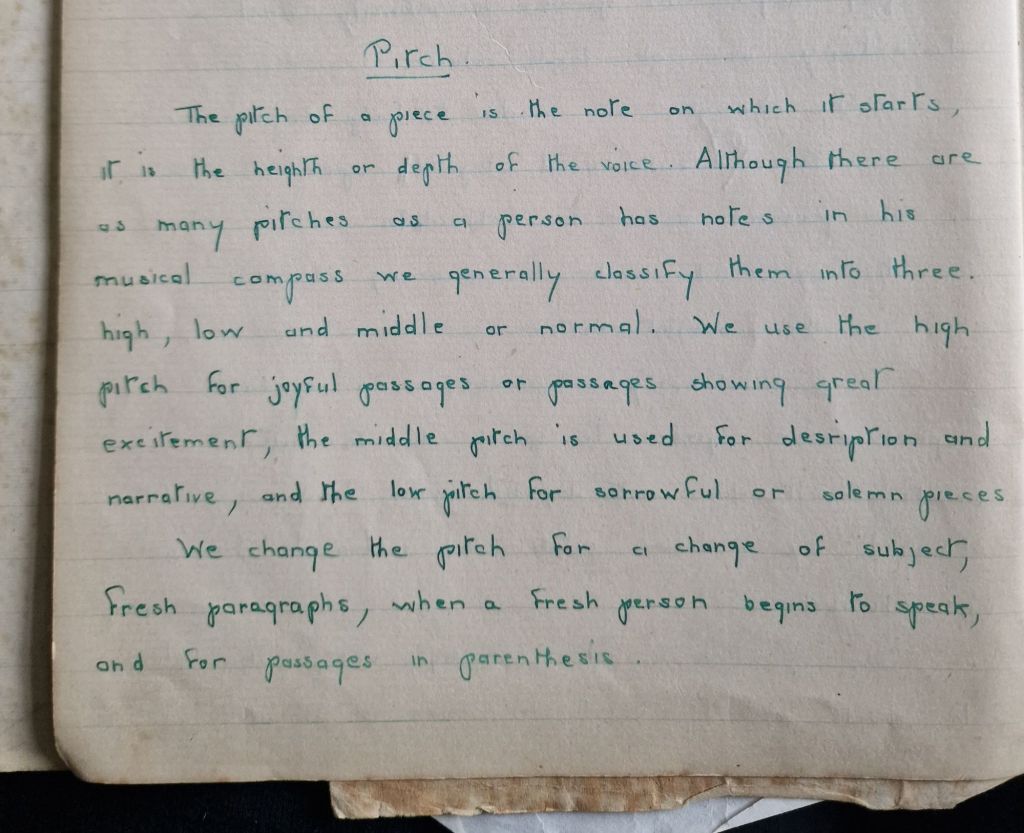
The pitch is a piece is the note on which it starts, it is the height or depth of the voice. Although there are as many pitches as a person has notes in their musical compass we generally classify them into three. High, low and middle or normal. We use the high pitch for joyful passages or passages showing great excitement, the middle pitch is used for description and narrative and the low pitch for sorrowful or solemn pieces.

We change the pitch for a change of subject, fresh paragraphs, when a fresh person begins to speak and for passages in parenthesis.

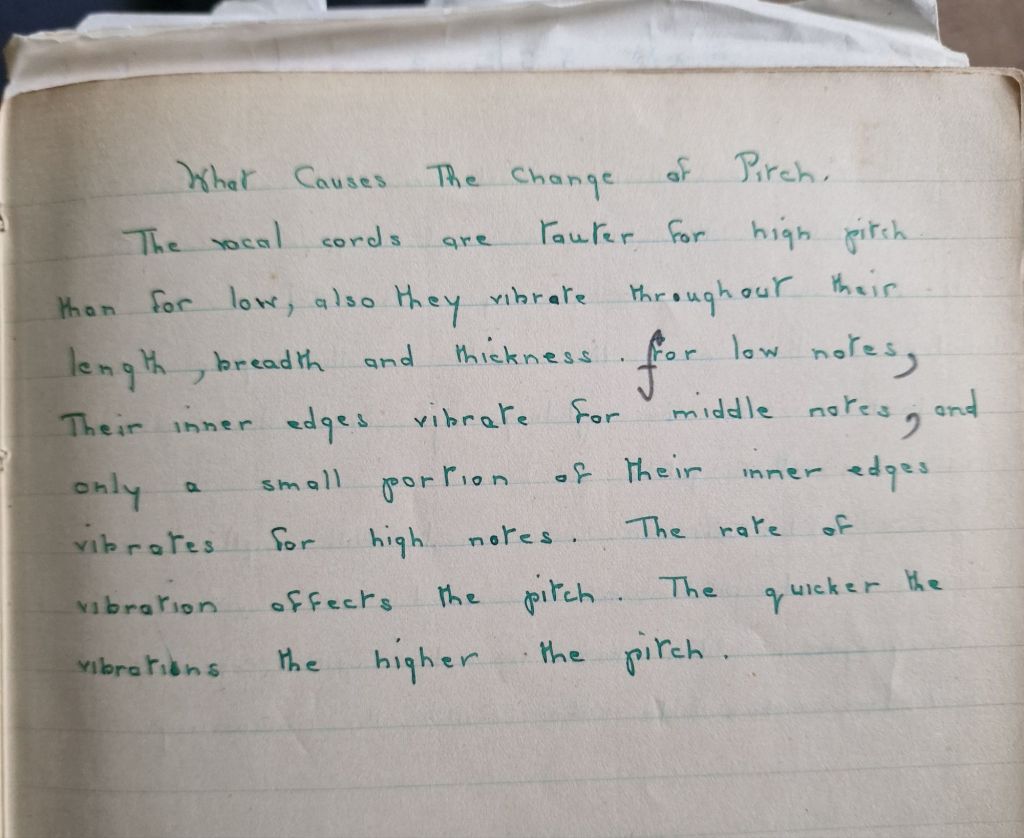
What causes the change in pitch

The vocal cords are tauter for high pitch than for low, also they vibrate throughout their length, breadth and thickness for the low notes. Their inner edges vibrate for the middle notes and only a small portion of their inner edges vibrate for the high notes. The rate of vibration affects the pitch. The quicker the vibrations the higher the pitch.

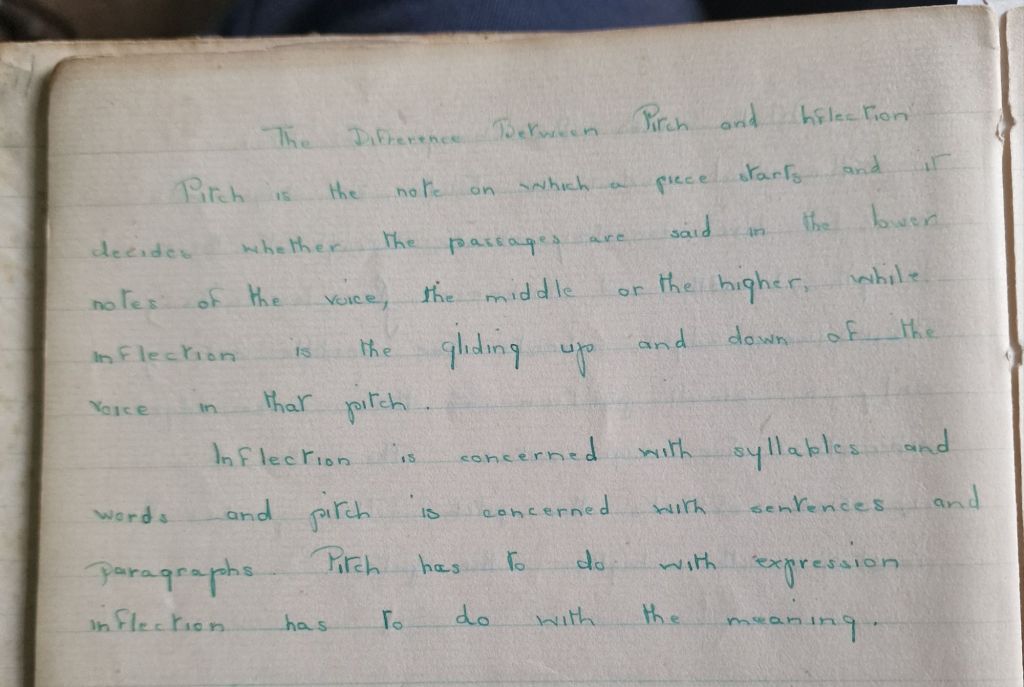
The Difference Between Pitch and inflection

Pitch is the note on which a piece starts and it decides whether the passages are said in the lower notes of the voice, the middle or the higher, while inflection is the gliding up and down of the voice in that pitch.

Inflection is concerned with syllables and words and pitch is concerned with sentences and paragraphs. Pitch has to do with expression. Inflection has to do with the meaning.

Excerpt from my grandmothers notebook.

Inspired by wisdom from my grandmother’s notebook, these insights remind us that the heart of storytelling and presenting lies not only in the words we choose, but in the way we bring them to life through the music of our voices.

Further Reading

Lessons from my Grandmother’s Notebook: Rediscovering the Art of Speaking

https://maxhemingway.com/2025/11/26/graceful-speech-timeless-tales-harnessing-inflection/

Share this:

  • Click to share on Facebook (Opens in new window) Facebook
  • Click to share on LinkedIn (Opens in new window) LinkedIn
  • Click to email a link to a friend (Opens in new window) Email
  • Click to share on Pinterest (Opens in new window) Pinterest
  • Click to share on Reddit (Opens in new window) Reddit
  • Click to share on X (Opens in new window) X
  • Click to share on Tumblr (Opens in new window) Tumblr
  • Click to share on Pocket (Opens in new window) Pocket
  • Click to share on Telegram (Opens in new window) Telegram
  • Click to share on Threads (Opens in new window) Threads
  • Click to share on WhatsApp (Opens in new window) WhatsApp
  • Click to share on Mastodon (Opens in new window) Mastodon
  • Click to share on Bluesky (Opens in new window) Bluesky
  • Click to share on Nextdoor (Opens in new window) Nextdoor
Like Loading...

Graceful Speech & Timeless Tales: Modulation

03 Wednesday Dec 2025

Posted by Max Hemingway in 21st Century Human, Story Telling

≈ Leave a comment

Tags

21st Century Human, Story Telling

Stepping onto a stage to deliver a presentation or a story, your voice is your most influential tool. Mastering the art of modulation though changing your pitch, pace and power can transform not only the way you speak but also how your message is received.

What Is Modulation?

Modulation is all about change. It is the dynamic variation in pitch (how high or low your voice sounds), pace (the speed at which you speak) and power (the intensity and emotion behind your words).

A well-modulated voice offers a pleasing rise and fall in tone, adjusts speed to match the mood and shifts intensity to suit the subject matter. This interplay of vocal elements adds colour and expressiveness to your speech, making it engaging and memorable.

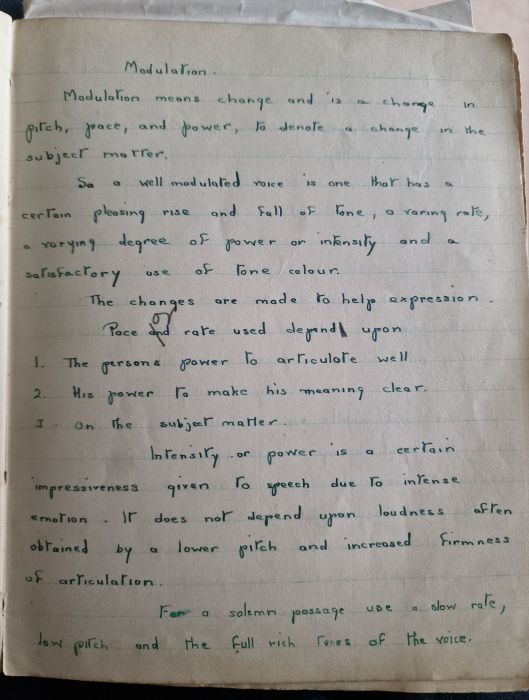
Modulation means change and is a change in pitch, pace and power, to denote a change in the subject matter.

So a well modulated voice I one that has a certain pleasing rise and fall of tone, a varying rate, a varying degree of power or intensity and a satisfactory use of tone colour.

The changes are made to help expression. Pace or rate used depend upon

  1. The persons power to articulate well
  2. Their power to make their meaning clear
  3. On the subject matter

Intensity or power is a certain impressiveness given to speech due to intense emotion. It does not depend upon loudness often obtained by a lower pitch and increased firmness of articulation.

For a solemn passage use a slow rate, low pitch and the full rich tones of the voice.

For great sorrow, slow rate low pitch and the tone rather heavy.

For joyful passages quick rate, high pitch and the voice rather light in quality

For descriptions or reflective pieces use a moderate rate and the middle pitch

Excerpt from my grandmothers notebook.

Why Modulation Matters

Imagine listening to someone who speaks in a flat, unchanging monotone. No matter how compelling the content, the delivery quickly becomes tedious. Modulation on the other hand, breathes life into your voice, helping you articulate clearly and convey meaning effectively. It is not just about sounding good, but making your audience feel the emotions and understand the nuances of your story or presentation.

Practical Tips for Modulating Your Voice

  • Know Your Subject: Modulation should reflect changes in your content. Shift your pitch and pace to match the emotion or gravity of what you are saying.
  • Articulate Clearly: The ability to enunciate well is key. Modulation can help you stress important points and clarify your message.
  • Emphasise Emotion: Power or intensity in speech comes from genuine emotion, not just volume. Sometimes, a lower pitch with firmer articulation conveys solemnity far better than shouting.

Modulation for Different Moments

ScenarioPacePitchQuality of Voice
Solemn PassageSlowLowFull, rich tones
Great SorrowSlowLowHeavy, sombre
Joyful PassageQuickHighLight, bright
Descriptive or Reflective PieceModerateMiddleBalanced, thoughtful

Bringing It All Together

Next time you prepare a talk or craft a story, remember that your voice is a versatile instrument. With intentional modulation, your words will resonate long after you’ve spoken them.

Further Reading

Lessons from my Grandmother’s Notebook: Rediscovering the Art of Speaking

Share this:

  • Click to share on Facebook (Opens in new window) Facebook
  • Click to share on LinkedIn (Opens in new window) LinkedIn
  • Click to email a link to a friend (Opens in new window) Email
  • Click to share on Pinterest (Opens in new window) Pinterest
  • Click to share on Reddit (Opens in new window) Reddit
  • Click to share on X (Opens in new window) X
  • Click to share on Tumblr (Opens in new window) Tumblr
  • Click to share on Pocket (Opens in new window) Pocket
  • Click to share on Telegram (Opens in new window) Telegram
  • Click to share on Threads (Opens in new window) Threads
  • Click to share on WhatsApp (Opens in new window) WhatsApp
  • Click to share on Mastodon (Opens in new window) Mastodon
  • Click to share on Bluesky (Opens in new window) Bluesky
  • Click to share on Nextdoor (Opens in new window) Nextdoor
Like Loading...

Graceful Speech & Timeless Tales: Harnessing Inflection

26 Wednesday Nov 2025

Posted by Max Hemingway in 21st Century Human, Story Telling

≈ 1 Comment

Tags

21st Century Human, Story Telling

When it comes to presenting or weaving a captivating story, it’s not just the words you use that matter, it’s how you say them. The art of inflection is the subtle gliding of the speaking voice up or down. It is the secret ingredient that brings dialogue and narrative to life and mastering inflection transforms your delivery, ensuring your message resonates and your audience remains enthralled.

Inflection is a gliding of the speaking voice in an upward or a downward direction. The function of inflection is to bring out the exact shade of meaning. There are three kinds:

  • Simple rising
  • Simple falling
  • Compound or circumflex

Rules for the Rising Inflection

  1. For incomplete statements
  2. To show uncertainty or doubt “The book may be on the shelf”
  3. Sentences in the negative end in a rising inflection “I will not stay”
  4. Appeals use rising inflections “I pray you have mercy”
  5. Questions which can be answered by a simple “yes” or “no”. Take a rising inflection “Is it still snowing?”. These are the same as questions by inversion or questions by inflection.

Rule for the Falling Inflection

  1. Complete statements
  2. Commands
  3. Questions beginning with interrogatives end with a falling inflection
  4. Questions ending with alternative words end with a falling inflection
  5. Exclamatory phrases when not appeals “Woe is me!”, “Alack the day!”

Circumflex or compound inflection is a combination of rising and falling on one word. It is used whenever the meaning of the words is greater than or opposite to the words themselves.

Rules for Circumflex Inflection

  1. To show irony, scorn reproach, incredulity
  2. To make antithesis stronger
  3. For implied antithesis

Excerpt from my grandmothers notebook.

These notes are fairly comprehensive and to the point. I would add the following bits.

The Role of Inflection in Captivating Audiences

Storytelling isn’t just about recounting events, it is about breathing life into words, guiding listeners through a world of feeling and imagination.

Inflection acts as your compass. A rising tone can intrigue, suggest uncertainty or invite participation. Conversely a falling inflection seals a statement, commands attention or signals finality.

The compound, or circumflex, inflection can infuse irony or highlight contrasts, making your narrative richer and more engaging.

Inflection in Presentations: More Than Just Words

Consider your next presentation. When you pose a rhetorical question “Isn’t this what we’ve all been waiting for?”, a gentle upward inflection invites your audience to consider and agree.

When delivering a decisive message “The time is now”, let your voice fall to communicate resolve.

If you wish to underscore a contrast or add a touch of humour, try the circumflex: “Oh, that’s a brilliant idea,” where the shift in tone suggests a layer of irony.

Further Reading

Lessons from my Grandmother’s Notebook: Rediscovering the Art of Speaking

Share this:

  • Click to share on Facebook (Opens in new window) Facebook
  • Click to share on LinkedIn (Opens in new window) LinkedIn
  • Click to email a link to a friend (Opens in new window) Email
  • Click to share on Pinterest (Opens in new window) Pinterest
  • Click to share on Reddit (Opens in new window) Reddit
  • Click to share on X (Opens in new window) X
  • Click to share on Tumblr (Opens in new window) Tumblr
  • Click to share on Pocket (Opens in new window) Pocket
  • Click to share on Telegram (Opens in new window) Telegram
  • Click to share on Threads (Opens in new window) Threads
  • Click to share on WhatsApp (Opens in new window) WhatsApp
  • Click to share on Mastodon (Opens in new window) Mastodon
  • Click to share on Bluesky (Opens in new window) Bluesky
  • Click to share on Nextdoor (Opens in new window) Nextdoor
Like Loading...

Graceful Speech & Timeless Tales: The Power of the Pause

19 Wednesday Nov 2025

Posted by Max Hemingway in 21st Century Human, Story Telling

≈ Leave a comment

Tags

21st Century Human, Story Telling

Storytelling and presenting are crafts shaped as much by silence as by speech. Where words often tumble out in rapid succession and trying to get your message out quickly, the pause remains a storyteller’s most understated yet powerful tool.

Pause is a stoppage of the voice

Why we pause:

  1. To take breath
  2. To separate phrases from each other and so keep the meaning clear
  3. Before or after words to emphasise them
  4. To show feeling
  5. To keep the rhythm of poetry

Kinds of pause:

  1. Breath or sense pauses
  2. Emphatic pauses
  3. End line and caesural pauses

Excerpt from my grandmothers notebook.

Drawing inspiration from this excerpt, let’s break down further why pausing is essential for anyone looking to captivate an audience, whether on stage or around a dinner table.

What Is a Pause?

At its simplest, a pause is a deliberate stoppage of the voice. It is a moment of silence that gives your words weight, your audience space and your message clarity.

Why Do We Pause?

  • To take a breath: Speaking is as physical as it is mental. Pausing allows you to breathe, keeping your delivery steady and your nerves in check.
  • To separate phrases and clarify meaning: Without pauses, sentences blur together and the story loses its thread. Pausing makes sure each idea stands out, helping listeners follow your narrative with ease.
  • To emphasise words: A well-timed pause before or after a key word draws attention to it, making your message linger in the minds of your audience.
  • To show feeling: Silence can convey emotion that words sometimes cannot—a pause after a heartfelt confession, for instance, lets the weight of the moment settle.
  • To maintain the rhythm of storytelling: Just as music relies on rests, stories and presentations need pauses to keep their natural flow and prevent monotony.
  • Pauses allow you small gaps to check your audience and message: are they still listening?, is the message on track?

The Different Kinds of Pauses

  • Breath or sense pauses: These occur where you would naturally take a breath or where the sense of the phrase demands a break.
  • Emphatic pauses: Used for dramatic effect, these pauses highlight a point or create suspense.
  • End line and caesural pauses: In poetry and prose, these pauses mark the end of a line or a significant division within a line, contributing to rhythm and structure.

Next time you stand up to speak or sit down to share a story, remember: grace in speech often lies not in what you say, but in the silences you allow.

Further Reading

Lessons from my Grandmother’s Notebook: Rediscovering the Art of Speaking

Share this:

  • Click to share on Facebook (Opens in new window) Facebook
  • Click to share on LinkedIn (Opens in new window) LinkedIn
  • Click to email a link to a friend (Opens in new window) Email
  • Click to share on Pinterest (Opens in new window) Pinterest
  • Click to share on Reddit (Opens in new window) Reddit
  • Click to share on X (Opens in new window) X
  • Click to share on Tumblr (Opens in new window) Tumblr
  • Click to share on Pocket (Opens in new window) Pocket
  • Click to share on Telegram (Opens in new window) Telegram
  • Click to share on Threads (Opens in new window) Threads
  • Click to share on WhatsApp (Opens in new window) WhatsApp
  • Click to share on Mastodon (Opens in new window) Mastodon
  • Click to share on Bluesky (Opens in new window) Bluesky
  • Click to share on Nextdoor (Opens in new window) Nextdoor
Like Loading...

Graceful Speech & Timeless Tales: The Art of Articulation

12 Wednesday Nov 2025

Posted by Max Hemingway in 21st Century Human, Story Telling

≈ Leave a comment

Tags

21st Century Human, Story Telling

Delivering your message with clarity and conviction is not just a skill to be mastered, but rather an art to be cultivated. Whether you’re pitching an idea, leading a team meeting or captivating an audience at a conference, your ability to articulate your thoughts can be the difference between being heard and being remembered.

As my grandmother scribed in her notebook on elocution:

Articulation is the moulding of the breath into vowels and consonants and combining these into syllables and words. Vowels help with the music of speech. Consonants help to make speech distinct.

For good articulation there should be accuracy of contact, firmness of contact, crispness of contact and fluency of moving from one sound to the next – Excerpt from my grandmothers notebook.

I have taken these words and expanded upon them and infused with some modern thinking.

The Power of Articulation in Presentations

When presenting in any setting, every word matters. Articulation ensures your message is not only delivered but also understood. Clear enunciation makes complex ideas accessible, while a rhythmic flow keeps your audience engaged.

The phrase “Vowels help with the music of speech. Consonants help to make speech distinct.” stands out to me as one of the keyways to master communication for impactful presentations.

Vowels provide the melody (music,) making your speech pleasant to listen to. Consonants sharpen your delivery (distinct), lending authority and precision to your words.

Articulation: the way in which you pronounce words or produce sounds.

https://dictionary.cambridge.org/dictionary/english/articulation

Breathing Life into Storytelling

Storytelling lies at the very core (the heart) of effective communication. While facts and figures are useful for delivering information, they rarely move people to take action. It is through stories that we truly connect with our audience and encourage them to respond.

Combining articulated and graceful speech with compelling narratives can create a memorable experience for the audience. Making the story more personable and relateable helps the audience feel that the speaker is genuine and approachable, they are more likely to be receptive, engaged and emotionally invested in what is being presented.

Practical Tips for Storytelling

  • Practice Clarity: Slow down and focus on crisp pronunciation, especially when introducing key concepts or statistics.
  • Use Pauses Effectively: Allow your audience time to absorb information and use pauses to emphasise important points.
  • Vary Your Tone: Let your voice reflect the highs and lows of your story, bring data to life with inflection and enthusiasm.
  • Connect with Your Audience: Personalise your tales, making them relatable with anecdotes and natural language.
  • Refine Your Delivery: Record yourself and listen back, focusing on the accuracy, firmness and fluency of your speech.
  • Personable and Relatable: Let your personality shine through. Smile, use appropriate humour and maintain eye contact if in person or on camera. A conversational tone helps build trust and rapport.
  • Know Your Material: Be thoroughly familiar with your content so that you can adapt if questions arise or if your audience’s energy shifts.
  • Engage with Visuals: Support your narrative with relevant visuals or props to reinforce your message and keep your audience interested. Keep the visuals simple and not cluttered with words.
  • Encourage Interaction: Invite questions, feedback and participation to make your storytelling session more dynamic and memorable.

Leave a Lasting Impression

Embrace the music and precision of speech and let your stories stand the test of time. Carefully chosen words, delivered with rhythm and clarity have the power to captivate listeners and ensure your message resonates long after it is heard.

Further Reading

Lessons from my Grandmother’s Notebook: Rediscovering the Art of Speaking
Data Storytelling
Mastering Storytelling Through Dungeons & Dragons: A Guide for Technologists

Share this:

  • Click to share on Facebook (Opens in new window) Facebook
  • Click to share on LinkedIn (Opens in new window) LinkedIn
  • Click to email a link to a friend (Opens in new window) Email
  • Click to share on Pinterest (Opens in new window) Pinterest
  • Click to share on Reddit (Opens in new window) Reddit
  • Click to share on X (Opens in new window) X
  • Click to share on Tumblr (Opens in new window) Tumblr
  • Click to share on Pocket (Opens in new window) Pocket
  • Click to share on Telegram (Opens in new window) Telegram
  • Click to share on Threads (Opens in new window) Threads
  • Click to share on WhatsApp (Opens in new window) WhatsApp
  • Click to share on Mastodon (Opens in new window) Mastodon
  • Click to share on Bluesky (Opens in new window) Bluesky
  • Click to share on Nextdoor (Opens in new window) Nextdoor
Like Loading...

Lessons from my Grandmother’s Notebook: Rediscovering the Art of Speaking

04 Tuesday Nov 2025

Posted by Max Hemingway in 21st Century Human, Story Telling

≈ 9 Comments

Tags

21st Century Human, Story Telling

Recently I have inherited a worn, well-used notebook from my late grandmother. Reading through these notes has felt like rediscovering a part of my grandmother’s voice and my own. Like a conversation across generations and I can still hear her voice all these years later as I read the notebook.

My grandmother was an elocution teacher and she understood that the art of speaking blends clarity, confidence and grace. Her pages and lessons remind me that carefully spoken words still have the power to move hearts and minds.

Elocution means to speak audibly (so that the voice may be heard), distinctly (so that words can be recognised), naturally and with expression, according to the custom of educated people of the day.

Excerpt from my grandmothers notebook.

Her notes are more than remnants of her learning and own discovery in the art of elocution. They are timeless lessons for anyone seeking to speak well. Of course modern practices may have overtaken some of the notes, but the core still remains the same.

Why Elocution Still Matters

Today where communication is often reduced to quick texts, brief social media posts and video calls about another meeting agenda, the power of spoken words can be easily overlooked. The ability to speak with clarity and confidence is just as important today as when my grandmother penned the paged.

Effective speech can:

  • Transform a presentation into a memorable story that resonates with listeners.
  • Build trust and rapport during interviews and negotiations.
  • Elevate everyday conversations into meaningful and impactful exchanges.

My grandmother deeply understood this and that speaking well is not about sounding grand or overly formal, it is about being understood.

Wisdom from the Notebook

Drawing from her teachings I have rephrased and reflected on a few key insights

  • Respect Every Syllable: Do not rush your words. Allow each word to breathe and carry its full meaning.
  • The Power of Pause: Silence is not empty; it serves to emphasise what comes next.
  • Projection with Purpose: Speak so that even the farthest listener can hear you, without resorting to shouting. The focus is on intention and clarity, not just volume.
  • Clarity Over Complexity: Simple, well-enunciated words often leave the most lasting impression.
  • Emphasis for Impact: Highlight important words or phrases to draw your listener’s attention. Emphasis can transform a mundane statement into something memorable and powerful.
  • Articulation and Precision: Pronounce each sound clearly, shaping your words so that they are easily understood. Good articulation ensures your message is not lost or misinterpreted.
  • Inflection for Expression: Vary the pitch and tone of your voice to convey meaning, emotion and interest. Thoughtful inflection keeps your audience engaged and brings your words to life.

An Excerpt from the Notebook

Emphasis is the promonence given to the most important word or words in a sentence. The function of emphasis is to make the exact meaning clear.

The ways of giving emphosis:

By stress of extra force on the word e.g you must do that.

By pause. pause can be made before or after the word or phrase to be emphasised or both before and after. e.g. Morning will find me / gone. And what is mre you’ll be a man / my son.

By a change of pace. This refers to phrases.

By inflection. Often rising inflection is used to give emphasis, sometimes instead of stress and sometimes with stress.

By the use of gesture.

You only emphasise the important words. Over emphasis results in a jerky delivery and does not make the meaning clear.

Excerpt from my grandmothers notebook.

Practical Exercises to Try

Adapted from her notes, these exercises can help anyone improve their speech:

  • Breathing for Control: Before speaking, take a deep breath from your diaphragm. This steadies your voice and helps calm any nerves.
  • Tongue Twisters for Agility: Practise phrases such as: “Crisp clear consonants create confident communication.” Start slowly, then increase your speed, ensuring you do not lose clarity.
  • Mirror Practice: Speak in front of a mirror to observe your posture and facial expressions. Remember confidence is expressed visually as well as vocally.

Trying it Yourself

If you have ever struggled with public speaking or wish to refine your own voice, start with the basics. Respect the pause, breathe deeply and speak with intention. In doing so you may discover that the art of elocution is not lost – it is simply waiting to be heard once more.

Going forward as I read through I will post more from the insightful pages.

Share this:

  • Click to share on Facebook (Opens in new window) Facebook
  • Click to share on LinkedIn (Opens in new window) LinkedIn
  • Click to email a link to a friend (Opens in new window) Email
  • Click to share on Pinterest (Opens in new window) Pinterest
  • Click to share on Reddit (Opens in new window) Reddit
  • Click to share on X (Opens in new window) X
  • Click to share on Tumblr (Opens in new window) Tumblr
  • Click to share on Pocket (Opens in new window) Pocket
  • Click to share on Telegram (Opens in new window) Telegram
  • Click to share on Threads (Opens in new window) Threads
  • Click to share on WhatsApp (Opens in new window) WhatsApp
  • Click to share on Mastodon (Opens in new window) Mastodon
  • Click to share on Bluesky (Opens in new window) Bluesky
  • Click to share on Nextdoor (Opens in new window) Nextdoor
Like Loading...

Transforming Ideas into Reality: The Human Spark in Tech

31 Friday Oct 2025

Posted by Max Hemingway in 21st Century Human, AI, Innovation, Story Telling, Technologists Toolkit

≈ Leave a comment

Tags

21st Century Human, AI, artificial-intelligence, creativity, Innovation, Technologists Toolkit, technology

Technology may operate through flashing lights, chips, logic, algorithms and code, yet every genuine advancement starts with something innately human. Beneath every illuminated screen and every written line of code lies curiosity, the powerful, persistent force propelling us to explore, experiment and imagine.

From the first glimmer of an unconventional idea to the determined effort required to realise an improbable dream, it is our creativity, passion and curiosity that infuse technology with life and mould the digital future.

The Human Element: Asking “What If?”

Computers excel at processing information at astonishing speeds, but it is humans who pose the question “What if?”. This essential question embodies curiosity, turning technology from something functional into something truly revolutionary.

Throughout history, trailblazers have personified this spirit.:

  • Ada Lovelace envisioned machines that could do more than simple calculations.
  • Alan Turing not only deciphered codes but also laid the theoretical groundwork for artificial intelligence by asking, “Can a machine think?”

The most significant breakthroughs occur when determined individuals challenge norms and conceive solutions that no machine could ever dream up on its own.

Cultivating the Innovator’s Mindset

Innovation is not a rare secret, it is a cultivated habit. To foster it:

  • Embracing Radical Questions: Do not hesitate to ask “why not?” or challenge longstanding assumptions. Such straightforward questions often ignite major ideas.
  • Collaborating Wildly: Engage with people beyond your immediate discipline. Diverse perspectives and cross-disciplinary teamwork are powerful drivers for original solutions.
  • Experimenting Fearlessly: Consider every setback not as a failure but as critical data. Every test, refinement and adjustment moves you closer to a breakthrough.
  • Creating Safe Space for Ideas: Innovation flourishes when teams feel free to share bold, unconventional concepts without fear of criticism or judgement.
  • Harnessing AI as an Assistant: Leverage Artificial Intelligence (AI) to enhance your creative process. AI can help generate new ideas, identify patterns in data you might overlook and automate repetitive tasks. This can help free up more time for experimentation and bold thinking. By using AI as a collaborator rather than just a tool, you can quickly test hypotheses, prototype solutions and gain fresh insights, all while maintaining the uniquely human spark that drives innovation.

Creativity: The Catalyst for Redefinition

Creativity turns a technical obstacle into a transformative opportunity.

  • Steve Jobs did not invent the computer, but he reimagined it. Transforming a complex technical instrument into a sleek, intuitive device that revolutionised daily life.
  • The team at DeepMind redefined artificial intelligence by teaching it to learn and play games (such as Go) modelling how people master intricate subjects.

These innovators did not merely improve what already existed; they redefined what was possible by daring to adopt a fresh perspective.

AI can also act as a creative partner, from generating design concepts and composing music to suggesting code improvements. AI can spark unexpected connections and offer alternatives you might not have considered. It provides not only efficiency but also an expanded canvas for human ingenuity.

Harnessing Creative Energy

To convert curiosity into real progress:

  • Look Beyond Your Industry: Seek inspiration from art, nature and everyday experiences. Solutions frequently originate from unexpected analogies.
  • Build an Iteration Loop: Test, learn, and iterate constantly. Rapid prototyping is a practical method for asking increasingly complex “what if” questions.
  • Take a Strategic Pause: Occasionally, stepping away from your work is the best route to a breakthrough. Reflection and a fresh viewpoint are invaluable.
  • Utilise AI for Creative Exploration: Use AI-powered tools to brainstorm alternatives, simulate scenarios, and visualise outcomes. AI can help you rapidly test new ideas, uncover hidden relationships and even provide creative prompts when you feel stuck, acting as a catalyst for your next breakthrough.

The Twin Engines: Curiosity and Passion

Curiosity raises the questions; passion discovers the answers. Together, they fuel the persistence required to overcome obstacles and turn nebulous visions into concrete realities.

  • Tim Berners-Lee was curious about enabling information to flow effortlessly across a global network. This curiosity led to the creation of the World Wide Web. It was his passion for an open, interconnected world that ensured the idea was pursued tirelessly and ultimately shared.

To sustain these vital engines:

  • Never Stop Learning: Curiosity is a flame that grows with new knowledge. Pursue subjects that truly fascinate you, even if they do not relate directly to your current work. AI can support lifelong learning by recommending resources, summarising complex materials and connecting you with experts and communities worldwide.
  • Embrace Serendipity: Welcome surprises, fortunate accidents, and unexpected discoveries. Many innovations originate from exploring something new. AI algorithms can sometimes surface surprising insights or connections in vast amounts of information, leading to opportunities you might not have found alone.
  • Share Your Enthusiasm: Passion is infectious. Sharing your excitement attracts collaborators, builds momentum, and makes the lengthy process of innovation rewarding. With AI-powered platforms, it’s easier than ever to connect with like-minded peers, showcase your projects and gather feedback globally.

Conclusion

As technology advances at an unprecedented pace, one truth remains: the true engine of innovation is not the code we craft or the silicon we use – it is the human spark within us. Our creativity, curiosity, and passion fuel the discoveries that truly shape the future.

Whether you are a developer, designer, entrepreneur or simply a deeply curious individual your most powerful tool is not the technology at your disposal, but the imagination that guides it.

Artificial intelligence is a remarkable ally, amplifying our strengths and extending our reach, but it is only through human ingenuity and vision that technology becomes truly transformative.

“Keep exploring. Keep dreaming. Keep asking why. Don’t settle for what you already know. Never stop believing in the power of your ideas, your imagination, your hard work to change the world.”

― Barack Obama

Ultimately, it is people (not machines) who make technology truly remarkable. AI may assist, but it is the uniquely human qualities of curiosity, passion and creativity that turn possibility into reality.

Sources and Further Reading

  • The Human Element
  • How Can We Define The Human Element In The Age of AI
  • Human Element Podcast
Embracing Humility: Staying Open to Feedback and Continuous Improvement in Tech
Turning Failures into Success: The Mindset of Failing Forward for Technologists

Share this:

  • Click to share on Facebook (Opens in new window) Facebook
  • Click to share on LinkedIn (Opens in new window) LinkedIn
  • Click to email a link to a friend (Opens in new window) Email
  • Click to share on Pinterest (Opens in new window) Pinterest
  • Click to share on Reddit (Opens in new window) Reddit
  • Click to share on X (Opens in new window) X
  • Click to share on Tumblr (Opens in new window) Tumblr
  • Click to share on Pocket (Opens in new window) Pocket
  • Click to share on Telegram (Opens in new window) Telegram
  • Click to share on Threads (Opens in new window) Threads
  • Click to share on WhatsApp (Opens in new window) WhatsApp
  • Click to share on Mastodon (Opens in new window) Mastodon
  • Click to share on Bluesky (Opens in new window) Bluesky
  • Click to share on Nextdoor (Opens in new window) Nextdoor
Like Loading...

The Technologist’s Odyssey: A Modern Epic Inspired by Homer

19 Monday May 2025

Posted by Max Hemingway in 21st Century Human, Mindset, Story Telling, Technologists Toolkit

≈ Leave a comment

Tags

AI, artificial-intelligence, creativity, Innovation, Mindset, philosophy, Story Telling, Technologists Toolkit, technology

One of the skills a technologist needs and draws on is the ability to tell stories to help reach the goals and outcomes of the task at hand. So as a bit of fun, here is a comparison of today’s technologist and Homer’s Odyssey, drawing parallels between ancient adventures and modern innovation.

The journey of a technologist is much like the grandeur of an epic odyssey – an endless pursuit fuelled by curiosity, innovation, ingenuity, and the drive to reshape the world.

One of the skills a technologist needs and draws on is the ability to tell stories to help reach the goals and outcomes of the task at hand. So as a bit of fun, here is a comparison of today’s technologist and Homer’s Odyssey, drawing parallels between ancient adventures and modern innovation.

In Homer’s timeless masterpiece “The Odyssey”, we are taken on a journey of perseverance, discovery, and triumph over adversity. The tale of Odysseus navigating treacherous seas and facing formidable challenges resonates deeply with the modern odyssey undertaken by technologists today. While the landscapes may differ—one physical, the other digital—the indomitable spirit of curiosity, resilience, and ingenuity binds these stories across centuries.

The modern odyssey is a voyage of a technologist (in this case) marked by relentless exploration, failures (including learnings) and triumphs and a desire to transcend the limitations of today to and the promises of the future carve out the possibilities of tomorrow.

To quote a phrase that is often attributed to Homer’s The Odyssey but isn’t in translated text – “The journey is the thing.” This phrase emphasises the process which you go through in reaching your destination or goal (exploration, learning, failure, strength and growth).

Not every journey has a map, but you can chart your journey for others to follow. Although not every journey will be the same a guide helps keep you on the path.

The Hero’s Call: Beginnings of the Journey

In “The Odyssey”, Odysseus’s journey begins with the call to return home after the Trojan War. His longing for Ithaca symbolises a burning desire for purpose and belonging. This echoes the genesis of a technologist’s journey beginning usually with an ask to meet a business outcome, with the voyage being accepted often sparked by curiosity and wonder.

Whether it’s creating an architecture and system, dismantling an existing one to uncover its secrets or writing their first lines of code, technologists, too, experience their own call to adventure. The purpose of the journey being set by the outcome / goal to be achieved.

Homer writes, “Tell me, O Muse, of that ingenious hero who travelled far and wide…” (*The Odyssey*, Book 1), capturing the essence of exploration and ingenuity. For technologists, this “travelling far and wide” takes the form of navigating uncharted territories of innovation, driven by the same thirst to discover and create.

Trials and Tribulations: Overcoming Challenges

The path of innovation is rarely straightforward, much like Odysseus’s voyage through turbulent seas. Technologists encounter numerous challenges—developing solutions to existing problems, debugging seemingly insurmountable errors, adapting to rapid technological changes, and resolving complex issues. The ambiguity often faced by technologists requires an understanding and adaptation to change, both personally and professionally. Developing the ability to navigate uncertainty and act without complete information is essential, while also forming new habits that facilitate acceptance and management of change.

Odysseus’s encounter with the Cyclops Polyphemus teaches a valuable lesson about resourcefulness. “My name is Nobody; my mother and father call me Nobody…” (*The Odyssey*, Book 9) exemplifies his cleverness in overcoming adversity. Similarly, technologists use their creativity and problem-solving skills to “outwit” the hurdles that block their path toward innovation.

Challenges foster growth, helping technologists build resilience and enhance their skills. Overcoming obstacles leads to new discoveries.

The Collaborative Spirit: Navigating Together

A significant similarity between *The Odyssey* and a technologist’s path is the role of collaboration. Odysseus’s crew supports him throughout his journey, highlighting teamwork in overcoming challenges. Homer writes, “So we sent out two picked men and a herald as third…” (*The Odyssey*, Book 9).

In the field of technology, collaboration is important. Teams of technologists exchange ideas, learn from each other, and leverage their combined strengths. This collective effort leads to significant innovations that expand the possibilities. This teamwork emphasises that no substantial progress is made independently (Pack Learning).

Moments of Revelation: The Spark of Innovation

Technologists have moments where ideas become reality, similar to Odysseus’s moments of clarity and accomplishment. These are the instances when a concept transforms into significant innovation. For example, Odysseus’s escape from the Sirens – “I stopped the ears of my men with wax…” (*The Odyssey*, Book 12) – illustrates human problem-solving and planning.

For technologists, these moments are comparable to developing a new solution, using emerging technologies, or creating the next innovative thing. Each milestone represents not only technical progress but also the results of creativity, collaboration, and effort.

Redefining Horizons: A Journey with Purpose

Ultimately, Odysseus’s journey is about finding Ithaca, which represents both home and the culmination of his experiences and perseverance. For technologists, their Ithaca is the continually changing field of technology, innovation and growth. The pursuit of innovation involves not just reaching the outcome / goal of the task, technical progress and growth in knowledge, but also purpose, collaboration, and human elements.

Homer’s words, “There is nothing worse for mortals than a wandering life…” (*The Odyssey*, Book 15), highlight the importance of having direction and meaning in our journeys. For technologists, their journey involves continuous learning, exploring new areas, and redefining possibilities. Set your goals and have a vision of where you want your journey to take you.

It is important to note though that the journey of learning and knowledge is one that is continual, with some rest stops along the way.

Further Reading

Mastering Performance Under Pressure: The Importance of Training
Embracing Humility: Staying Open to Feedback and Continuous Improvement in Tech
Turning Failures into Success: The Mindset of Failing Forward for Technologists
Using the best of the Q Continuum
Stay Ahead of the Curve: Essential Strategies for Technologists to Stay Informed
Mastering the CPD Cycle for Professional Growth

Share this:

  • Click to share on Facebook (Opens in new window) Facebook
  • Click to share on LinkedIn (Opens in new window) LinkedIn
  • Click to email a link to a friend (Opens in new window) Email
  • Click to share on Pinterest (Opens in new window) Pinterest
  • Click to share on Reddit (Opens in new window) Reddit
  • Click to share on X (Opens in new window) X
  • Click to share on Tumblr (Opens in new window) Tumblr
  • Click to share on Pocket (Opens in new window) Pocket
  • Click to share on Telegram (Opens in new window) Telegram
  • Click to share on Threads (Opens in new window) Threads
  • Click to share on WhatsApp (Opens in new window) WhatsApp
  • Click to share on Mastodon (Opens in new window) Mastodon
  • Click to share on Bluesky (Opens in new window) Bluesky
  • Click to share on Nextdoor (Opens in new window) Nextdoor
Like Loading...
← Older posts

Follow Me on LinkedIn

www.linkedin.com – Click to Follow 

RSS Feed

RSS Feed RSS - Posts

Other Publications I contribute to

https://sparrowhawkbushcraft.com/

Recent Posts

  • Graceful Speech & Timeless Tales: Breathing
  • The Quotient Revolution: Building the Well-Rounded Person
  • Ditch Resolutions: Embrace Habit-Building for Success
  • Pen based Productivity Tools: The Chronodex 2026
  • Understanding ETSI TS 104 223 and ISO/IEC 42006

Categories

  • 21st Century Human
  • 3D Printing
  • AI
  • Applications
  • ArchiMate
  • Architecture
  • Arduino
  • Automation
  • BCS
  • Big Data
  • Certification
  • Climate Change
  • Cloud
  • Cobotics
  • Connected Home
  • Data
  • Data Fellowship
  • Data Science
  • Development
  • DevOps/OpsDev
  • Digital
  • DigitalFit
  • Drone
  • Enterprise Architecture
  • F-TAG
  • Governance
  • Health
  • Innovation
  • IoT
  • Machine Learning
  • Metaverse
  • Micro:Bit
  • Mindset
  • Mobiles
  • Networks
  • Open Source
  • Podcasts
  • Productivity
  • Programming
  • Quantum
  • Raspberry Pi
  • Robotics
  • Scouting
  • Scouts
  • Security
  • Smart Home
  • Social Media
  • Space
  • STEM
  • Story Telling
  • Technologists Toolkit
  • Tools
  • Uncategorized
  • Wearable Tech
  • Windows
  • xR

Archives

Reading Shelf

Archives

Recent Posts

  • Graceful Speech & Timeless Tales: Breathing
  • The Quotient Revolution: Building the Well-Rounded Person
  • Ditch Resolutions: Embrace Habit-Building for Success
  • Pen based Productivity Tools: The Chronodex 2026
  • Understanding ETSI TS 104 223 and ISO/IEC 42006

Top Posts & Pages

  • The Quotient Revolution: Building the Well-Rounded Person
  • Graceful Speech & Timeless Tales: Breathing
  • Understanding ETSI TS 104 223 and ISO/IEC 42006
  • Pen based Productivity Tools – The Chronodex 2025
  • Pen based Productivity Tools: The Chronodex 2026
  • Ditch Resolutions: Embrace Habit-Building for Success
  • Lessons from my Grandmother’s Notebook: Rediscovering the Art of Speaking
  • Transforming Ideas into Reality: The Human Spark in Tech
  • 20 Informative Podcasts for 2025: Boost Your PKMS
  • Boosting productivity with a Personal Knowledge Management System for 2024

Category Cloud

21st Century Human Architecture Automation Big Data Cloud Data Data Science Development DevOps/OpsDev Digital DigitalFit Enterprise Architecture Innovation IoT Machine Learning Mindset Open Source Podcasts Productivity Programming Raspberry Pi Robotics Security Social Media STEM Story Telling Technologists Toolkit Tools Uncategorized Wearable Tech

Tags

3D Printing 21st Century Human AI Applications Architecture artificial-intelligence Automation BCS Big Data Blockchain business Certification Cloud Cobot Cobotics Coding Communication Connected Home CPD creativity cybersecurity Data Data Fellowship Data Science Delivery Development DevOps Digital DigitalFit Digital Human Drone Email Enterprise Architecture GTD Infographic Information Theory Innovation IoT Journal Knowledge learning Machine Learning Metaverse MicroLearning Mindset Mixed Reality Networks Open Source OpsDev PKMS Podcasts Productivity Programming Proving It Quantum R RaspberryPI Robot Robotics Scouts Security Smart Home Social Media STEM Story Telling Technologists Toolkit technology Technology Couch Podcast Thinking Tools Training Visualisation Voice Wearable Tech xR

License

Creative Commons Licence
This work is licensed under a Creative Commons Attribution-NonCommercial-ShareAlike 4.0 International License.

Meta

  • Create account
  • Log in
  • Entries feed
  • Comments feed
  • WordPress.com

Blog at WordPress.com.

  • Subscribe Subscribed
    • Max Hemingway
    • Join 82 other subscribers
    • Already have a WordPress.com account? Log in now.
    • Max Hemingway
    • Subscribe Subscribed
    • Sign up
    • Log in
    • Report this content
    • View site in Reader
    • Manage subscriptions
    • Collapse this bar
 

Loading Comments...
 

    %d