• About Me Card

Max Hemingway

~ Musings as I work through life, career and everything.

Max Hemingway

Category Archives: Architecture

A good example of Enterprise Architecture doumentation

26 Thursday Feb 2015

Posted by Max Hemingway in Architecture, Enterprise Architecture

≈ Leave a comment

Tags

Architecture, Enterprise Architecture

BooksThere are many good examples of Enterprise Architecture documentation available as reference on the Internet. All following different methodologies, but ultimately illustrating how an Enterprise Architecture documentation set can assist in driving strategy and the business forward.

A bit dated now (2004), but a good example of such a document set is the 5 volumes from NASA.

NASA Enterprise Architecture Vol 1 – NASA Enterprise Architecture

NASA Enterprise Architecture Vol 2 – Office Automation, IT Infrastructure, and Telecommunications

NASA Enterprise Architecture Vol 3 – Program Unique IT and Multi-Program / Project IT Investment Category

NASA Enterprise Architecture Vol 4 – Strategies and Structure

NASA Enterprise Architecture Vol 5 NASA To-Be Architecture, Approach to Design and Implementation

The documents are based on the Federal Enterprise Architecture Framework

Share this:

  • Click to share on Facebook (Opens in new window) Facebook
  • Click to share on LinkedIn (Opens in new window) LinkedIn
  • Click to email a link to a friend (Opens in new window) Email
  • Click to share on Pinterest (Opens in new window) Pinterest
  • Click to share on Reddit (Opens in new window) Reddit
  • Click to share on Tumblr (Opens in new window) Tumblr
  • Click to share on Pocket (Opens in new window) Pocket
  • Click to share on Telegram (Opens in new window) Telegram
  • Click to share on Threads (Opens in new window) Threads
  • Click to share on WhatsApp (Opens in new window) WhatsApp
  • Click to share on Mastodon (Opens in new window) Mastodon
  • Click to share on X (Opens in new window) X
  • Click to share on Bluesky (Opens in new window) Bluesky
Like Loading...

Enterprise Architecture – Wikipedia Book

25 Wednesday Feb 2015

Posted by Max Hemingway in Architecture, Enterprise Architecture

≈ 1 Comment

Tags

Architecture

A while ago I created a book on Wikipedia on Enterprise Architecture (Back in August 2009) using Wikipedia Books. This is a function to pull together articles from Wikipedia together in a book format, then download as a PDF or even send to get printed.

I haven’t got far with the printing aspect on this book, although I did pull together some articles on a different subject and sent that to be printed. I was happy with the bound book that came back from the service and it was a reasonable cost.

Thought I would go back and revisit the book and see where it is up to today.

Available at https://en.wikipedia.org/wiki/Book:Enterprise_Architecture

I have created this as an open book so it can be added to should anyone wish to assist in collating relevant articles.

The current index is made up of following articles:

Enterprise Architecture

Enterprise architecture
Enterprise Architect
Enterprise architect
Enterprise Architecture
Enterprise Architecture Assessment Framework
Enterprise architecture planning
Enterprise Architecture Management
Architecture Patterns ( EA Reference Architecture)
Frameworks
Enterprise Architecture framework
Open Source or Consortia-developed frameworks
Enterprise Architecture Body of Knowledge
Generalised Enterprise Reference Architecture and Methodology
IDEAS Group
RM-ODP
The Open Group Architecture Framework
Commercial frameworks
Integrated Architecture Framework
OBASHI
Information Framework
Zachman Framework
Defense industry frameworks
Department of Defense Architecture Framework
MODAF
NATO Architecture Framework
AGATE Architecture Framework
Government frameworks
Government Enterprise Architecture
FDIC Enterprise Architecture Framework
Federal Enterprise Architecture
NIST Enterprise Architecture Model
Treasury Enterprise Architecture Framework
Lifecycles
Enterprise life cycle
ISO 12207
Systems Development Life Cycle
Technology Life Cycle
Whole-life cost
Modelling
Enterprise modelling
Collaboration
Business analyst
Systems analysis
Information architecture
Solutions Architect
Software architect
Systems architect
Project manager
Project management office
Chief information officer

Share this:

  • Click to share on Facebook (Opens in new window) Facebook
  • Click to share on LinkedIn (Opens in new window) LinkedIn
  • Click to email a link to a friend (Opens in new window) Email
  • Click to share on Pinterest (Opens in new window) Pinterest
  • Click to share on Reddit (Opens in new window) Reddit
  • Click to share on Tumblr (Opens in new window) Tumblr
  • Click to share on Pocket (Opens in new window) Pocket
  • Click to share on Telegram (Opens in new window) Telegram
  • Click to share on Threads (Opens in new window) Threads
  • Click to share on WhatsApp (Opens in new window) WhatsApp
  • Click to share on Mastodon (Opens in new window) Mastodon
  • Click to share on X (Opens in new window) X
  • Click to share on Bluesky (Opens in new window) Bluesky
Like Loading...

Architecture Thought Tool: Working out your Risks

24 Tuesday Feb 2015

Posted by Max Hemingway in Architecture, Enterprise Architecture, Governance, Productivity, Tools

≈ Leave a comment

Tags

Architecture, Productivity, Tools

An Architecture Thought Tool I use when looking to identify any Risks in a projects or assignment is to use the STORMCLOUD method.

This involves identifying the risks by going through the following areas:

  • ScheduleRisk
  • Technology
  • Organisation
  • Resources
  • Methods
  • Compatibility
  • Lifecycle
  • Over-engineering
  • Users
  • Dependencies
  • Suppliers

Once identified its then a case of mitigating the risks that can be and calling out those that cannot.

Using this method is just one of many, but helps focus on the important areas to consider.

Share this:

  • Click to share on Facebook (Opens in new window) Facebook
  • Click to share on LinkedIn (Opens in new window) LinkedIn
  • Click to email a link to a friend (Opens in new window) Email
  • Click to share on Pinterest (Opens in new window) Pinterest
  • Click to share on Reddit (Opens in new window) Reddit
  • Click to share on Tumblr (Opens in new window) Tumblr
  • Click to share on Pocket (Opens in new window) Pocket
  • Click to share on Telegram (Opens in new window) Telegram
  • Click to share on Threads (Opens in new window) Threads
  • Click to share on WhatsApp (Opens in new window) WhatsApp
  • Click to share on Mastodon (Opens in new window) Mastodon
  • Click to share on X (Opens in new window) X
  • Click to share on Bluesky (Opens in new window) Bluesky
Like Loading...

Data Scientist Job Titles, Architecture and Software Warlocks

23 Monday Feb 2015

Posted by Max Hemingway in Architecture, Data Science

≈ Leave a comment

Tags

Architecture, Data Science

An interesting piece of research on Data Scientist Job Titles has been carried out from data on LinkedIn of over 10,000 professionals.

The data splits out into 11 categories listing 700+ Job Titles:

  • Recruiter
  • Engineering
  • Developer
  • Data Plumbing
  • Data Science
  • Statistician
  • Research
  • Business Analytics
  • Consultant
  • Trainer
  • Student

The raw data is available to play with. I have been looking at the Architecture job titles that fall into the “Data Plumbing” category to initially have a view of Architecture Roles within Data Science and what that means. I will continue this research and blog later about it.

Architect

As a bit of fun if you want a generated Job Title, one app to try is this one – Generate a Job Title for you comes up with “Your Silicon Valley job title is……..”

My favourite Generation is the “Software Warlock”

Software Warlock

A close second is  “Grand Poobah of Digital Innovation”

Share this:

  • Click to share on Facebook (Opens in new window) Facebook
  • Click to share on LinkedIn (Opens in new window) LinkedIn
  • Click to email a link to a friend (Opens in new window) Email
  • Click to share on Pinterest (Opens in new window) Pinterest
  • Click to share on Reddit (Opens in new window) Reddit
  • Click to share on Tumblr (Opens in new window) Tumblr
  • Click to share on Pocket (Opens in new window) Pocket
  • Click to share on Telegram (Opens in new window) Telegram
  • Click to share on Threads (Opens in new window) Threads
  • Click to share on WhatsApp (Opens in new window) WhatsApp
  • Click to share on Mastodon (Opens in new window) Mastodon
  • Click to share on X (Opens in new window) X
  • Click to share on Bluesky (Opens in new window) Bluesky
Like Loading...

TechDays 2015 Replays

17 Tuesday Feb 2015

Posted by Max Hemingway in Architecture

≈ Leave a comment

Tags

Architecture, Coding, Knowledge, learning

Following another set of great and useful Techdays 2015 online days hosted by Microsoft, the replay is now available for those who could not attend.

The three days covered:

  • Day one: Devices and Managing a Mobile-First World
  • Day one evening: An evening with Office 365
  • Day two: The Journey to the Cloud-first World
  • Day three: Multi-device, Cross-platform Development

Techdays 2015 Replay

Share this:

  • Click to share on Facebook (Opens in new window) Facebook
  • Click to share on LinkedIn (Opens in new window) LinkedIn
  • Click to email a link to a friend (Opens in new window) Email
  • Click to share on Pinterest (Opens in new window) Pinterest
  • Click to share on Reddit (Opens in new window) Reddit
  • Click to share on Tumblr (Opens in new window) Tumblr
  • Click to share on Pocket (Opens in new window) Pocket
  • Click to share on Telegram (Opens in new window) Telegram
  • Click to share on Threads (Opens in new window) Threads
  • Click to share on WhatsApp (Opens in new window) WhatsApp
  • Click to share on Mastodon (Opens in new window) Mastodon
  • Click to share on X (Opens in new window) X
  • Click to share on Bluesky (Opens in new window) Bluesky
Like Loading...

Architecture in Practice

05 Thursday Feb 2015

Posted by Max Hemingway in Architecture, Cloud, Enterprise Architecture

≈ 1 Comment

Tags

Architecture, Development, Enterprise Architecture, learning

Having worked as an Architect for many years its always good to look at different methodologies and practices as they come up and to refresh your thinking on today’s Architecture practices.

One of the recent additions to the Microsoft Virtual Academy is the  “Architecture in Practice” course which brings Microsoft’s latest views on Architecture using their products as a base for some of the demonstrations and topics. Whilst this centers around Microsoft products and standard practices, (to a seasoned architect may not teach them anything new in Architecture practices), taking a course such as this certainly refreshes that thinking in today’s challenging market place of cloud, visualisation and mobile.

One of the underlying foundations that makes a great architect is their willingness to refreshing and renew skills and thinking when ever the opportunity arises.

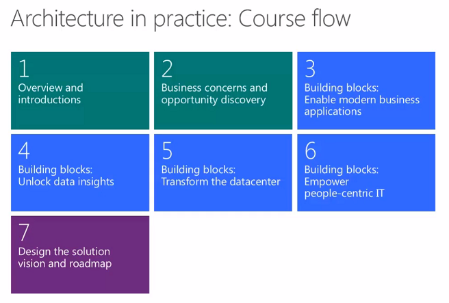
The diagram below shows the 7 areas that are covered in this course:

Architecture+in+Practice

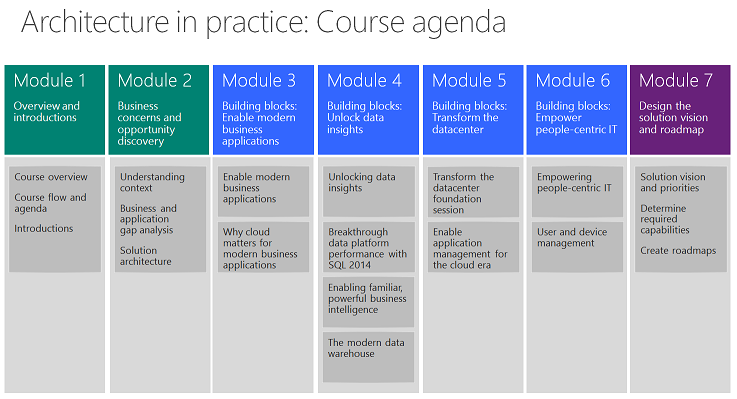
Further breakdown of the course with topic areas:

arch2

Source of pictures and link to the training: Architecture in Practice.

Share this:

  • Click to share on Facebook (Opens in new window) Facebook
  • Click to share on LinkedIn (Opens in new window) LinkedIn
  • Click to email a link to a friend (Opens in new window) Email
  • Click to share on Pinterest (Opens in new window) Pinterest
  • Click to share on Reddit (Opens in new window) Reddit
  • Click to share on Tumblr (Opens in new window) Tumblr
  • Click to share on Pocket (Opens in new window) Pocket
  • Click to share on Telegram (Opens in new window) Telegram
  • Click to share on Threads (Opens in new window) Threads
  • Click to share on WhatsApp (Opens in new window) WhatsApp
  • Click to share on Mastodon (Opens in new window) Mastodon
  • Click to share on X (Opens in new window) X
  • Click to share on Bluesky (Opens in new window) Bluesky
Like Loading...

Playing a Game with Innovation and Thinking

19 Friday Dec 2014

Posted by Max Hemingway in Architecture, DevOps/OpsDev, Innovation

≈ 4 Comments

Tags

Architecture, DevOps, Information Theory, Innovation, OpsDev

I have been looking at ways to assist me with Innovation and Thinking and looking outside of the box. Lots of different methodologies exist and there is no right or wrong way to what method to use or when to apply it.

After studying several methods in this arena and investigating, reading and learning some of these, I have come up with a set of “Playing Cards” that allow me to play games with Innovation and Thinking.

I took a pack of plain/blank playing cards and wrote out cards with different methodologies and ways of tackling/working on innovation.

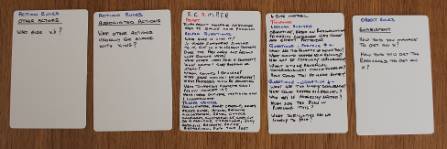
Innovation Cards

The Pack is currently based on 3 models and I am looking to add a few more as I develop the pack (Other methodologies are available)

  • 4 Site Model
  • Peter Drucker Thinking
  • SCAMPER

I have also added some:

  • Problem challenge cards – to add different problems to the area you are working on
  • Lens Cards – to challenge you to look at innovation through different lenses or view points

How to play the game

For the problem or area that I am wanting to tackle I shuffle the pack and apply 4-5 cards then work through it based on what has been dealt.

Dealt Innovation Cards

The lens cards may be shuffled in the main pack or dealt at the side one at a time.

Set a time limit on the cards dealt and then brainstorm writing everything down.

No thought or idea is a bad idea until it is qualified in or out.

When the time is up either play a different lens card against the cards on the table – or collect them up and shuffle the deck and start again.

Results

I have found that using the cards gives me different view across different methodologies rather than just applying one.

Sometimes the cards do not result in too much on the page, but other times they flourish ideas and innovations around the problem or area I have been looking at.

Next I plan to add more methodologies to the pack and expanding the cards already produced, although I don’t think that I will expand this pack much more as it then may become cumbersome and be too large to be effective.

I do have some blank cards left though so may innovate something new around the next thing to do with them.

Share this:

  • Click to share on Facebook (Opens in new window) Facebook
  • Click to share on LinkedIn (Opens in new window) LinkedIn
  • Click to email a link to a friend (Opens in new window) Email
  • Click to share on Pinterest (Opens in new window) Pinterest
  • Click to share on Reddit (Opens in new window) Reddit
  • Click to share on Tumblr (Opens in new window) Tumblr
  • Click to share on Pocket (Opens in new window) Pocket
  • Click to share on Telegram (Opens in new window) Telegram
  • Click to share on Threads (Opens in new window) Threads
  • Click to share on WhatsApp (Opens in new window) WhatsApp
  • Click to share on Mastodon (Opens in new window) Mastodon
  • Click to share on X (Opens in new window) X
  • Click to share on Bluesky (Opens in new window) Bluesky
Like Loading...

Learning Data Science

12 Friday Dec 2014

Posted by Max Hemingway in Architecture, Data Science

≈ 5 Comments

Tags

Architecture, Data Science

As a Architect I am always looking into ways of working with new technologies, innovations and fields. One of this is Data Science and as such I am currently undertaking a set of courses to get an understanding of the field of Data Science.
Having a level of understanding will allow me to work more closely with data scientists in helpling them with suitable solutions as well as increase my skills in manipulating data.

The John Hopkins University are currently running a set of courses on Data Science consisting of 9 modules. Below is a dependency chart for anyone wanting to take these
Coursera Johns Hopkins Specialization in Data Science course dependency information

There are 9 modules to take which can be done free of charge or you can pay about $30.00 per course to get a certificate and take a final capstone project to test your understanding.

Each course lasts around 4 week and consists of video based lectures, forums, projects and knowledge test quizes.

John Hopkins consider two forms of dependencis for these courses:

Hard dependency: Students will be required to know material from the prerequisite course. Taking the dependent course simultaneously will be challenging and only possible for highly motivated students willing to work ahead of the course schedule for the prerequisite. Taking hard dependent courses out of order is not possible unless the student already knows the material covered in the prerequisite course.

Soft dependency: Knowledge of material from the prerequisite course is recommended and useful. Concurrently taking the prerequisite course and the dependent course is possible. It is not recommended to take them out of order, but would be possible for highly motivated students willing to self teach components of the prerequisite course as needed.

The courses are listed below in order that they should be taken in with links to the courses.
The Data Scientist’s Toolbox
https://www.coursera.org/course/datascitoolbox

This is the primary introductory course for the specialization. It should be taken first and has no prerequisite courses. Students should be computer literate, have programmed in at least one computer language and be motivated self learners.

R Programming
https://www.coursera.org/course/rprog

This is the most crucial course for the remainder of the specialization. It is softly dependent on The Data Scientist’s Toolbox. It should be taken before the remaining courses in the series.

Getting and Cleaning Data
https://www.coursera.org/course/getdata

This course has hard dependencies on R Programming and The Data Scientist’s Toolbox.

Exploratory Data Analysis
https://www.coursera.org/course/exdata

This course has hard dependencies on R Programming and The Data Scientist’s Toolbox.

Reproducible Research
https://www.coursera.org/course/repdata

This course has hard dependencies on R Programming and The Data Scientist’s Toolbox.

Statistical Inference
https://www.coursera.org/course/statinference

This course has hard dependencies on R Programming and The Data Scientist’s Toolbox. In addition, students will need basic (non calculus) mathematics skills.

Regression Models
https://www.coursera.org/course/regmods

This course has hard dependencies on R Programming, The Data Scientist’s Toolbox and Statistical Inference.

Practical Machine Learning
https://www.coursera.org/course/predmachlearn

This course has hard dependencies on R Programming, The Data Scientist’s Toolbox and Regression Models. It has a soft dependency on Exploratory Data Analysis.

Developing Data Products
https://www.coursera.org/course/devdataprod

This course has hard dependencies on R Programming, The Data Scientist’s Toolbox and Reproducible Research. It has a soft dependency of Exploratory Data Analysis.

*material from Coursera John Hopkins University
https://www.coursera.org/jhu
Share this:

  • Click to share on Facebook (Opens in new window) Facebook
  • Click to share on LinkedIn (Opens in new window) LinkedIn
  • Click to email a link to a friend (Opens in new window) Email
  • Click to share on Pinterest (Opens in new window) Pinterest
  • Click to share on Reddit (Opens in new window) Reddit
  • Click to share on Tumblr (Opens in new window) Tumblr
  • Click to share on Pocket (Opens in new window) Pocket
  • Click to share on Telegram (Opens in new window) Telegram
  • Click to share on Threads (Opens in new window) Threads
  • Click to share on WhatsApp (Opens in new window) WhatsApp
  • Click to share on Mastodon (Opens in new window) Mastodon
  • Click to share on X (Opens in new window) X
  • Click to share on Bluesky (Opens in new window) Bluesky
Like Loading...
Newer posts →

RSS Feed

RSS Feed RSS - Posts

Other Publications I contribute to

https://sparrowhawkbushcraft.com/

Recent Posts

  • Graceful Speech & Timeless Tales: Mastering the Art of Gesture
  • Graceful Speech & Timeless Tales: The Power of Pitch
  • Graceful Speech & Timeless Tales: Modulation
  • Graceful Speech & Timeless Tales: Harnessing Inflection
  • Adventure Games: Open Sourced Zork

Categories

  • 21st Century Human
  • 3D Printing
  • AI
  • Applications
  • ArchiMate
  • Architecture
  • Arduino
  • Automation
  • BCS
  • Big Data
  • Certification
  • Climate Change
  • Cloud
  • Cobotics
  • Connected Home
  • Data
  • Data Fellowship
  • Data Science
  • Development
  • DevOps/OpsDev
  • Digital
  • DigitalFit
  • Drone
  • Enterprise Architecture
  • F-TAG
  • Governance
  • Health
  • Innovation
  • IoT
  • Machine Learning
  • Metaverse
  • Micro:Bit
  • Mindset
  • Mobiles
  • Networks
  • Open Source
  • Podcasts
  • Productivity
  • Programming
  • Quantum
  • Raspberry Pi
  • Robotics
  • Scouting
  • Scouts
  • Security
  • Smart Home
  • Social Media
  • Space
  • STEM
  • Story Telling
  • Technologists Toolkit
  • Tools
  • Uncategorized
  • Wearable Tech
  • Windows
  • xR

Archives

Reading Shelf

Archives

Recent Posts

  • Graceful Speech & Timeless Tales: Mastering the Art of Gesture
  • Graceful Speech & Timeless Tales: The Power of Pitch
  • Graceful Speech & Timeless Tales: Modulation
  • Graceful Speech & Timeless Tales: Harnessing Inflection
  • Adventure Games: Open Sourced Zork

Top Posts & Pages

  • Graceful Speech & Timeless Tales: The Art of Articulation
  • 20 Informative Podcasts for 2025: Boost Your PKMS
  • Understanding ISO/IEC 42001: A Course Review
  • Building Cyber Resilience: Enterprise Architecture and ArchiMate for Strategic Security
  • Graceful Speech & Timeless Tales: Modulation
  • Graceful Speech & Timeless Tales: The Power of Pitch
  • Graceful Speech & Timeless Tales: Mastering the Art of Gesture
  • Mastering the CPD Cycle for Professional Growth
  • Adventure Games: Open Sourced Zork

Category Cloud

21st Century Human Architecture Automation Big Data Cloud Data Data Science Development DevOps/OpsDev Digital DigitalFit Enterprise Architecture Innovation IoT Machine Learning Mindset Open Source Podcasts Productivity Programming Raspberry Pi Robotics Security Social Media STEM Story Telling Technologists Toolkit Tools Uncategorized Wearable Tech

Tags

3D Printing 21st Century Human AI Applications Architecture artificial-intelligence Automation BCS Big Data Blockchain business Certification Cloud Cobot Cobotics Coding Communication Connected Home CPD creativity cybersecurity Data Data Fellowship Data Science Delivery Development DevOps Digital DigitalFit Digital Human Drone Email Enterprise Architecture GTD Infographic Information Theory Innovation IoT Journal Knowledge learning Machine Learning Metaverse MicroLearning Mindset Mixed Reality Networks Open Source OpsDev PKMS Podcasts Productivity Programming Proving It Quantum R RaspberryPI Robot Robotics Scouts Security Smart Home Social Media STEM Story Telling Technologists Toolkit technology Technology Couch Podcast Thinking Tools Training Visualisation Voice Wearable Tech xR

License

Creative Commons Licence
This work is licensed under a Creative Commons Attribution-NonCommercial-ShareAlike 4.0 International License.

Meta

  • Create account
  • Log in
  • Entries feed
  • Comments feed
  • WordPress.com

Blog at WordPress.com.

  • Subscribe Subscribed
    • Max Hemingway
    • Join 82 other subscribers
    • Already have a WordPress.com account? Log in now.
    • Max Hemingway
    • Subscribe Subscribed
    • Sign up
    • Log in
    • Report this content
    • View site in Reader
    • Manage subscriptions
    • Collapse this bar
 

Loading Comments...
 

    %d