Building upon my previous recommendations for PKMS (Personal Knowledge Management System), I have updated the list for 2026 to include some from my list from 2025 which is still relevant, but also some new sites for news, reference and learning. It is important to stay ahead of the curve.
Using Feedly or similar aggregation tools for me still remains an excellent way to streamline your reading, as you can categorise sources, scan headlines efficiently and dive deeper into articles of interest.
Updated List of Tech Websites for 2026
BCS – Latest insights, ideas and perspectives from BCS and its community.
TechRepublic – News, tips, and advice for IT professionals.
Journaling is a simple habit as I discussed in a previous blog post (Ditch Resolutions: Embrace Habit-Building for Success). It is just about writing down your thoughts, feelings, notes, or anything else that comes to mind. I last wrote about my journalling in 2021 – Journaling my Daily Musings and I am now on journal 41 and over 7000 pages of about 18 years worth of daily notes. That is certainly a legacy I will be leaving for my family to read through (if they do).
People journal for all sorts of reasons such as a personal or work based journal and across different mediums of paper and digital. Some want to clear their heads, track their habits or work through tough feelings. Others may just want a record of their life. There’s no right or wrong reason to start and no set time to start either.
Starting a journal does not need to be about being a perfect writer or having a fancy notebook and pen or laptop/tablet.
Pick Your Format: You can write in a notebook, on your phone, or on your device. If your using your device there are plenty of journaling apps available
Start Small: You don’t have to write reams of pages/text. Start with two or three sentences, a short paragraph or a quick list.
Set a Time That Suits You: Some people may like mornings, I personally like to journal in the mornings and catch up with anything from the previous day and set out my day ahead. Othera may prefer evenings. There’s no best time and you should go with fits your day. It is important though to stick to this time to help make journalling a habit.
Time taken to Journal: Start small again. Five minutes can be enough. Your goal should be to write something, not to write the most perfect journal. You will improve over time.
Let Go of Judgement: Your journal is for you (and anyone you choose to read it). Write honestly, and in your style of writing. Don’t worry about spelling, grammar or crossing things out.
Build It Into a Routine: Pair journaling with something you already do, I like to start the day with a good cup of coffee and journal. This is called “habit stacking” and is a simple way to be consistent.
Types of Journaling: Find Your Style
Journaling isn’t just “dear diary”. There are lots of ways to do it. Here are some popular types, with examples and links for more info:
Daily/Reflective Journaling
This is the “write about your day” approach. It is good for understanding emotions, processing events and building self-awareness.
This is a structured way to stay focused and track progress and is the “bullet journal” approach. It is good for planners, habit trackers and self‑improvement.
Daily priorities
Weekly goals
Wins and challenges
For inspiration have a look at the examples and structure of a bullet journal at https://bulletjournal.com.
Brain Dump Journaling
This journaling method is where you empty your mind onto the page (with no rules). It is good for reducing mental clutter and boosting focus.
Presenting to an audience is not merely about speaking, it is about being engaging, connecting with and inspiring them.
Drawing on another page from my grandmothers notebook on elecution, here is some widom on this topic, whether you’re standing in front of a packed theatre or telling stories around a family dinner table, your delivery and expression are the keys to captivating listeners.
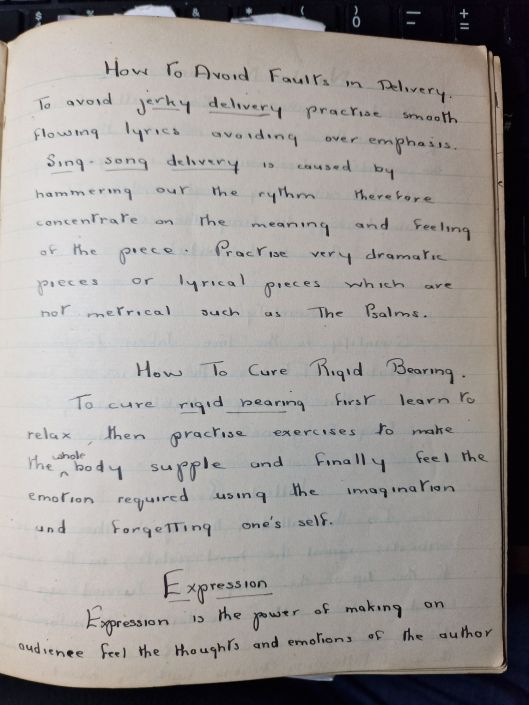
How to avoid faults in delivery
To avoid jerky delivery practice smooth flowing lyrics avoiding over emphasis. Sing song delivery is cause by hammering out the rhythm therefore concentrate on the meaning and feeling of the piece. Practice very dramatic pieces or lyrical pieces which are not metrical such as The Psalms.
How to cure rigid bearing
To cure rigid bearing first learn to relax, then practice exercises to make the whole body supple and finally feel the emotion required using the imagination and forgetting one’s self.
Expression
Expression is the power of making an audience feel the thoughts and emotions of the author.
Source: An excerpt from my grandmothers notebook.
How to Avoid Faults in Delivery
“To avoid jerky delivery, practise smooth flowing lyrics, avoiding overemphasis. Sing-song delivery is caused by hammering out the rhythm; therefore, concentrate on the meaning and feeling of the piece.”
One of the most common pitfalls in storytelling is letting the flow become mechanical or forced. Your audience can sense when you are simply reciting words rather than sharing an experience. Instead of focusing solely on rhythm and pace, put your energy into the meaning and emotion behind your story. Read your piece aloud and pay attention to the natural cadences and inflections that emerge.This will help you create a smooth, engaging delivery that draws listeners into your narrative.
Practice by recording yourself on your phone and replaying it to learn from where you need to improve. Try practising with stories that are emotionally charged or richly detailed, such as a chapter from your favourate novel. This will encourage you to connect with the content rather than just the structure.
By letting the story guide your tone and pace, you’ll avoid falling into a monotonous pattern and keep your audience invested throughout.
How to Cure Rigid Bearing
“To cure rigid bearing, first learn to relax, then practise exercises to make the whole body supple, and finally feel the emotion required using imagination and forgetting one’s self.”
Physical rigidity can undermine your presence, making you appear closed off or uncomfortable. Before stepping onto the stage or beginning your presentation, take a moment to relax. Simple breathing exercises, gentle stretches, or even a short walk can help loosen tension. Once you feel physically at ease, allow your imagination to transport you into the world of your story.
Effective storytelling demands that you immerse yourself in the emotions and scenarios you’re describing. If you truly feel what you’re telling, your body will naturally reflect those feelings, making your gestures and movements more expressive and authentic. Remember, the goal is not to perform, but to share—and that requires letting go of self-consciousness and embracing the narrative.
Practice by standing in front of a mirror and try the presentation, noting your stance and actions.
The Essence of Expression
“Expression is the power of making an audience feel the thoughts and emotions of the author.”
The heart of a compelling presentation lies in your ability to transmit not just information but genuine emotion and ideas. Expression is the bridge between your story and your audience’s hearts. When you care deeply about your message, your listeners will too. Speak with passion, vary your tone and let your facial expressions and body language mirror your words.
Again practice by recording yourself on your phone and replaying it to learn from where you need to improve.
Ultimately, great storytelling is about forging a connection. Focusing on smooth delivery, relaxed bearing and expressive communication can ensure that your presentation doesn’t just inform but inspire.
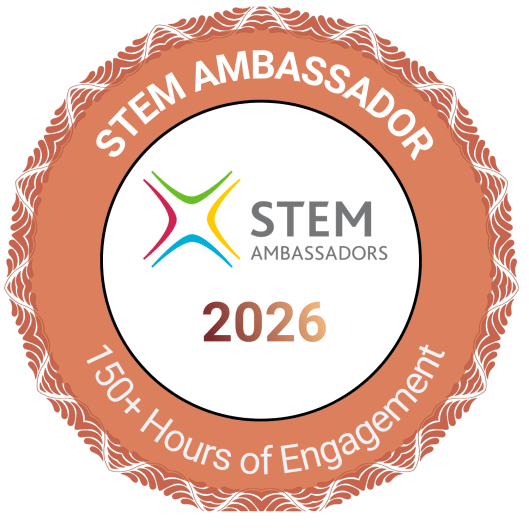
Today marks a milestone I’m incredibly proud to celebrate after recieving an email from STEM Ambassadors with a Bronze badge surpassing 150 hours of STEM volunteering.
Each year we will mark your cumulative volunteering hours with one of our digital badges to recognise all the volunteering hours you’ve completed since becoming a STEM Ambassador. This year’s badge includes all your volunteering hours up to 31 December 2025. Badges will now be issued once a year, so your next one will arrive in January 2027. – From the STEM Email I received.
What began as a commitment to give back has grown into one of the most rewarding parts of my work, helping young people discover the possibilities of science, technology, engineering and mathematics.
Reaching 150 hours is not just a number for me, it is a reminder of the brilliant young people I’ve met, the questions that have challenged me and the excitement that comes from helping someone take their first step toward a future in tech. Their enthusiasm is infectious and it motivates me to keep showing up, sharing knowledge and championing STEM wherever I can.
Through the STEM Ambassador programme, I’ve had the opportunity to support schools, colleges, community groups and regional initiatives that have opened doors, expanded knowledge and thinking for the next generation. I have achieved this through delivering hands‑on workshops, speaking at STEM events, participating in outreach programmes and supporting digital skills activities, every hour has contributed to building curiosity, confidence and opportunity.
Across the wider region and UK, STEM Ambassadors are making a tremendous impact, with thousands of hours logged collectively and ambitious new targets being set year after year.
I’m grateful to be part of a programme that recognises the value of volunteering, supports continuous development and encourages individuals, companys and industries to push for even greater impact. Here’s to the next 150 hours and many more opportunities to help shape the innovators, creators and problem‑solvers of tomorrow.
There’s something undeniably magical about opening an old notebook and discovering the wisdom of the author. I have been exploring my grandmother’s notes on elocution and have written a number of blogs on its contents, aptly titled “Graceful Speech & Timeless Tales”
This post is to serve as an index and as a gateway to the treasure trove of posts, notes and personal reflections on the art of speaking with poise and telling stories with heart.
Having written these posts and exploring the notebook, I often wonder what she would think about my additions and how they are being used. Good I hope in reflecting her life as a teacher and in helping others.
I hope that you have found these posts both helpful and inspiring. Writing this series has been a rewarding experience for me and gained as much from reading it as I have from putting it together.
It is likely that there will be additional posts in this series as I continue to explore and reflect upon more entries in the notebook. I will update and republish this list when I post anything further from the notebook.
With the world overflowing with messages, videos, social media and influencers, making a presentation or story truly resonate is key to engaging an audience and attracting new views. The answer to this lies not just in the words we choose, but in how we deliver them through the colour and quality of our voice.
Drawing inspiration from a excerpt in my grandmother’s notebook, the art of tone remains as vital today as it was in generations past.
The Timeless Impact of Tone: More Than Just Sound
Tone is the unique character our voices take on, reflecting our connection to what we’re saying. Even if the audience doesn’t understand the language, the emotion behind the words can still be felt. This universal quality is why great presenters and storytellers engage an audiences hearts as well as their minds.
It is important to consider the actual language that you use and any words that are specific to your trade or industry are simplified for the audience. Not everyone will know what a Wobjiglinkthingibob is!
Physical and Mental Aspects: A Two-Pronged Approach
The notes describe tone colour as having two sides: the physical and the mental. Modern voice coaches echo this, emphasising both body and mind.
Physical Resonance: Today, we know that the way sound vibrates in our chest, throat and head shapes our vocal tone. Good posture, relaxed muscles, and proper breathing allow your voice to carry emotion more naturally. This means practising vocal exercises and staying mindful of tension and anger, as this can often tighten the muscles and constrict the voice.
Mental Imagination: To truly connect, you must immerse yourself in the content and envision its emotional landscape. The best storytellers use empathy and imagination to internalise the mood of their message, letting genuine feeling colour their voice. Mindfulness and visualisation techniques help cultivate mental quickness, helping speakers pivot smoothly between emotions as their story unfolds.
Modern Applications: Engaging Today’s Audience
Presenting and storytelling in the digital era offer new challenges and opportunities. Audiences are diverse, attention spans are short (20-40 mins) and authenticity is prized. To stand out:
Be Present: Before speaking, centre yourself. Take a deep breath and mentally step into the scene you’re about to describe.
Feel the Emotion: Don’t just recite, relive the emotions behind your words. Let your voice reflect your excitement, concern, joy or suspense.
Adapt and Respond: Modern presenters read the room, whether in person or online. Adjust your tone in real time to maintain connection and engagement.
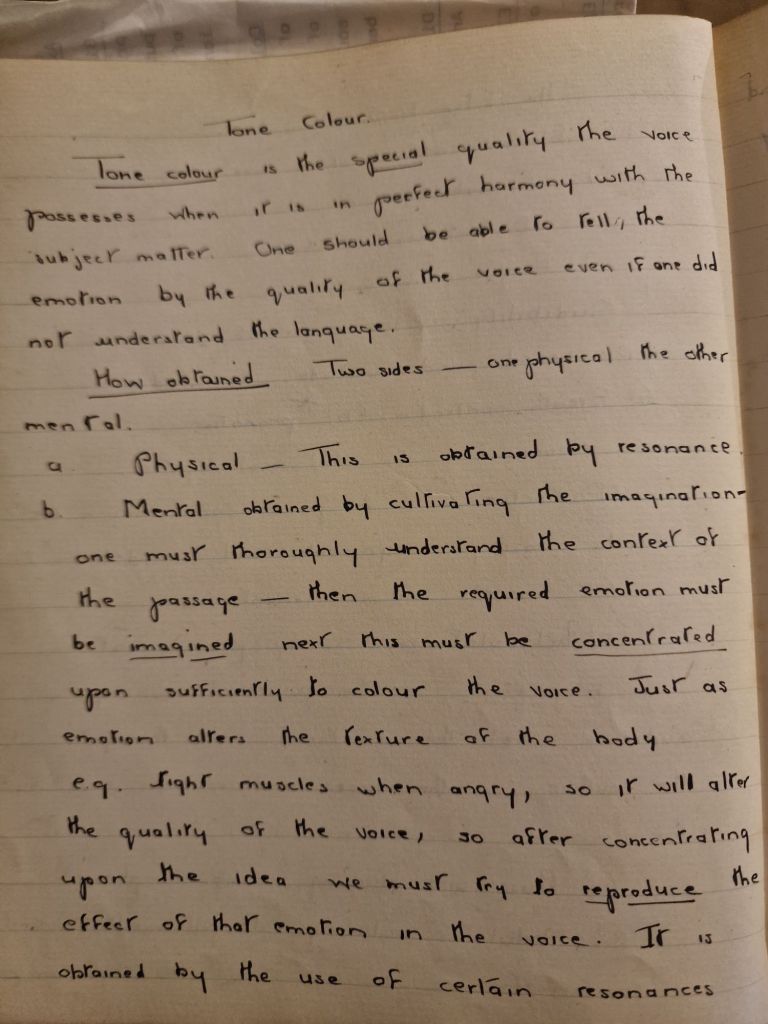
Tone Colour is the special quality the voice possesses when it is in perfect harmony with the subject matter. One should be able to tell the emotion by the quality of the voice even if one did not understand the language.
How obtained: Two sides – one physical the other mental
Physical – This is obtained be resonance
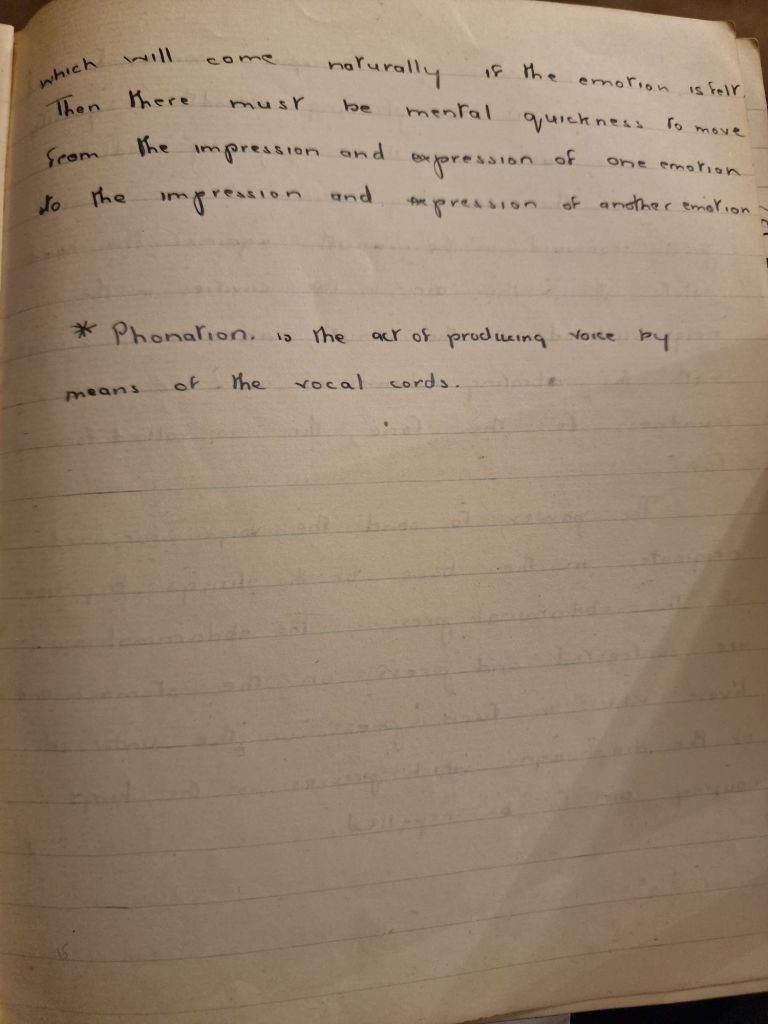
Mental – obtained by cultivating the imagination one must thoroughly understand the context if the passage – then the required emotion must be imagined next this must be concentrated upon sufficiently to colour the voice. Just as emotion alters the texture of the body. Eg. Tight muscles when angry, so it will alter the quality of the voice, so after concentrating upon the idea we must try to reproduce the effect of that emotion in the voice. It is obtained by the use of certain resonances which will come naturally if the emotion is felt then there must be mental quickness to move from the impression and expression of one emotion to the impression and expression of another emotion.
Above are an excerpt from my grandmothers notebook.
By balancing physical technique with emotional intelligence, presenters and storytellers can ensure their message not only reaches the audience but resonates long after the final word.
The art of elocution once reserved for the grand stages and parlours of yesteryear is today replaced by speaking to pitch ideas, deliver a keynote or weave a captivating tale. These all rely crucially on how you speak.
1. Audibility: Make Yourself Heard
Audibility is more than just volume. It is about ensuring your voice reaches every listener, whether in a packed auditorium or on a video call. This means understanding your environment, using microphones effectively, managing background noise and projecting your voice confidently. Techniques like breath control, resonance and mastering your vocal registers help you maintain clarity and stamina, especially in longer sessions.
2. Distinctness: Speak Clearly, Be Understood
With diverse audiences and global reach, clear speech is essential to be understood. Distinctness involves crisp articulation of vowels and consonants, precise pronunciation and mindful enunciation. This also means being aware of regional accents, inclusive language and if presenting virtually, ensuring that your technology and slides don’t muffle your message. Practising ensures your words are easily recognisable and your message doesn’t get lost in translation.
3. Expression: Breathe Life Into Your Words
Storytelling is about connection and making your audience feel the emotions behind your words. Expression encompasses how you pace your speech (using pause and phrasing), where you place emphasis and how you modulate your voice with changes in rate, pitch and intensity.
Expression also means harnessing body language, gesture and facial expressions, even through a webcam. What we do can say more than our words.
Rhyme, rhythm, prosody and the subtle use of tone colour turn even the most factual presentations into memorable experiences.
The elements of elocution are:
Audibility
Distinctness
Expression
Audibility is the power of making the voice heard and includes the study of:
Breath control
Phonation (the act of producing voice by means of the vocal cord)
Resonance
Vocal registers
Distinctness is the power of making words easily recognisable and includes the study of:
Vowel and consonants
Articulation
Pronunciation
Expression is the power of making an audience feel the emotions and thoughts of the author – the voice and manner must suit the words. Expression includes the study of:
Pause and phrasing
Emphasis
Modulation including rate, pitch inflection and intensity
Rhyme, rhythm and prosody
Gesture and facial expression
Tone colour
Above are an excerpt from my grandmothers notebook.
Bringing It All Together
At its core, elocution is about authenticity and connection. By combining audibility, distinctness and expression, presenters and storytellers can engage audiences, foster understanding and inspire action.
When you are getting ready to next practice, present or share a story, remember – your voice is your instrument and every audience deserves to hear it played beautifully.
The best way to get better is to practice, present and tell stories more, obtaining feedback afterwards from your audience.
As 2026 begins, I am once again in the process of updating my Personal Knowledge Management System (PKMS). This update reflects the latest advancements in knowledge management, as well as my evolving personal priorities.
With an increase in walking I have been doing as part of my routine, my approach to learning has shifted towards podcasts and micro learning. Instead of spending time endlessly scrolling through information, I have leveraged AI to create podcasts and short, voiced snippets on various topics on interest. These concise audio segments help break down complex subjects into manageable, bite-sized chunks, making it easier to keep up with new ideas while on the move.
I am publishing these updates so that others may use this approach as a model for developing their own PKMS.
What is a PKMS?
The primary aim of a PKMS (Personal Knowledge Management System) is to enhance an individual’s capacity to learn, retain and apply knowledge efficiently in both their personal and professional life. By providing structure to the way information is handled, it supports ongoing development.
A well formed PKMS can help provide several benefits:
Continuous Learning: With the right mindset, a PKMS offers a systematic approach to acquiring, organising and reviewing knowledge, thereby supporting lifelong learning.
Increased Productivity: Having immediate access to relevant and organised information enables individuals to remain proactive and ahead of the curve.
Knowledge Retention: The ability to store information in an organised repository facilitates easy retrieval as and when needed.
Adaptability: As technology, information and data continue to evolve rapidly, a PKMS helps users stay informed and adaptable to change.
Maintaining a clear distinction between personal social and business social knowledge remains important, even though there are occasions when the two may overlap. While it is sometimes necessary for these areas to intersect, keeping them largely separate helps maintain clarity, focus and a layer of personal security.
Various tools are available that can be used to build a PKMS tailored to individual needs. The choice of tools may differ from person to person however, the underlying principle is to use resources that support the structured management of knowledge. The specific tools utilised can contribute greatly to the effectiveness of a PKMS.
Various tools are available that can be used to build a PKMS tailored to individual needs. The choice of tools may differ from person to person however, the underlying principle is to use resources that support the structured management of knowledge. The specific tools utilised can contribute greatly to the effectiveness of a PKMS.
Professional Life
Research
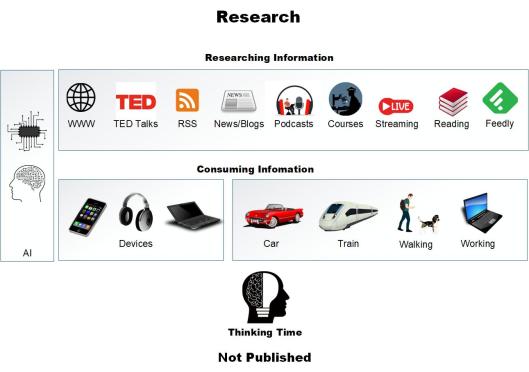
Research is an integral part of my Personal Knowledge Management System (PKMS). It involves gathering information that supports learning and integration into my work. Continuous learning is my key goal of my PKMS to stay ahead as a Technologist. Below is a high-level list of the types of content that I utilise for research and learning.
AI
Streaming Services
RSS Feeds
Podcasts
TED Talks
Web Searches
Blog Posts
Learning
Micro Learning
Reading
Some of these are fairly self explanatory as sources. I may expand on some of the sources I use in future posts.
AI (Artificial Intelligence)
Artificial Intelligence (AI) is growing in use and works well in my PKMS to enhance the way information is gathered, organised and retrieved.
AI is a good tool to ask as an assistant when researching, asking questions and can provide a reasonable summary of long documents and papers.
RSS
Some sites have an RSS feed which allows me to pull updates from sites directly into Feedly.
Podcasts
Podcasts cover both audio and video casts that I watch/stream online or download to my phone/media player to listen to when I am on journeys in the car or other transportation methods or out walking the dog. Daily walks with the dog provide a good time to listen to these acting as my daily comute to and from work (laptop).
Feedly
Feedly provides an aggregation tool that collects stories from various blogs and websites that I find useful for research and information . This generates a list of stories that can be quickly scanned on a single screen without having to visit multiple sites. Clicking on a story displays a snippet from the source site and provides a link to read the full article, if necessary. Using a series of keystrokes, it is possible to read the headlines, then move through the articles efficiently, stopping and opening them as needed.
Sources can be categorised to allow an all-view or just what’s new in a category.
Thinking Time
Thinking Time covers the time that I spend absorbing the PKMS information coming in from the different sources and then processing and applying it in different ways. It is also good to spend time reflecting on what I have learned and think of different and new ways to use the information and learnings.
Note Taking
I use two tools now for note-taking: OneNote and Obsidian. I favour Obsidian as it uses Markdown, which I use a lot for documentation and its ability to structure data in a logical way and allows you to query data in an interactive graph.
Being Social
I use several social channels to publish my thoughts as a Technologist. The main channel I use is this blog site.
Blog Site
www.maxhemingway.com is my main published site that I use to share my thoughts, leadership and updates through. From this I send out links to various social channels.
Podcast
My podcast “Technology Couch Podcast” has not had an update for a while (that said it does still get lots of downloads), but hopefully this will change soon. This can be found on my blog page and also normal podcast streaming sites.
Social Sites
I use social sites to publish my blog and podcast updates.
I use GitHub to store any code or projects that I want to publish externally.
Personal Life
Personal Journal
My personal journals have always been Moleskine plain pocket books, be more recently I have made a switch to using Rhodia range of pocket books with dots. My main reason was on price as Moleskine has risen a fair bit for their products. I have used a couple of Rhodia pocket books since my switch and I actually find the paper a lot better and its slightly thicker which can support more inks without a bleed through to the pages below.
I still favour the Pilot ball ink pens as before in 0.5 or 0.7 size.
To keep my work life separate from my personal life, I use social platforms like Instagram and Facebook for friends and family, ensuring that two-factor authentication and appropriate security settings are in place.
Even with these precautions, it’s essential to remember that anything posted online could potentially become public in the future.
Further Reading
If you are looking for inspiration in creating your own PKMS, Reddit has a great list of PKMS tools that is worth a look and a discussion board on setting up a PKMS.
Effective communication, whether you’re commanding a stage, weaving a story or pitching a big idea depend not only on your words, but on how you breathe.
Below, you’ll find an excerpt from my grandmother’s notebook, which, when seen through a contemporary lens, offers valuable lessons for present-day presenters and storytellers alike.
Notes on Breathing from the Notebook
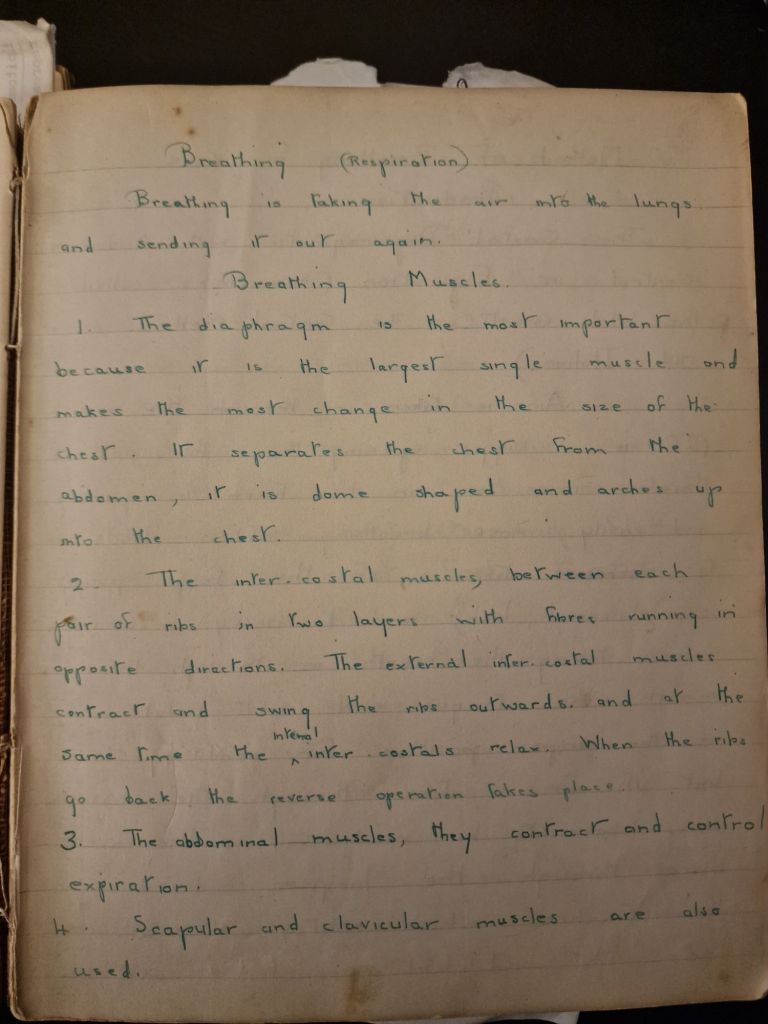
Breathing is taking the air into the lungs and sending it out again.
Breathing Muscles
The diaphragm is the most important because it is the largest single muscle and makes the most change in the size of the chest. It separates the chest from the abdomen, it is dome shaped and arches up into the chest.
The inter costal muscles, between each pair of ribs in two layers with fibres running in opposite directions. The external inter costal muscles contract and swing the ribs outwards and at the same time the internal inter costals relax. When the ribs go back the reverse operation takes place.
The abdominal muscles, they contract and control expiration.
Scapular and clavicular muscles are also used.
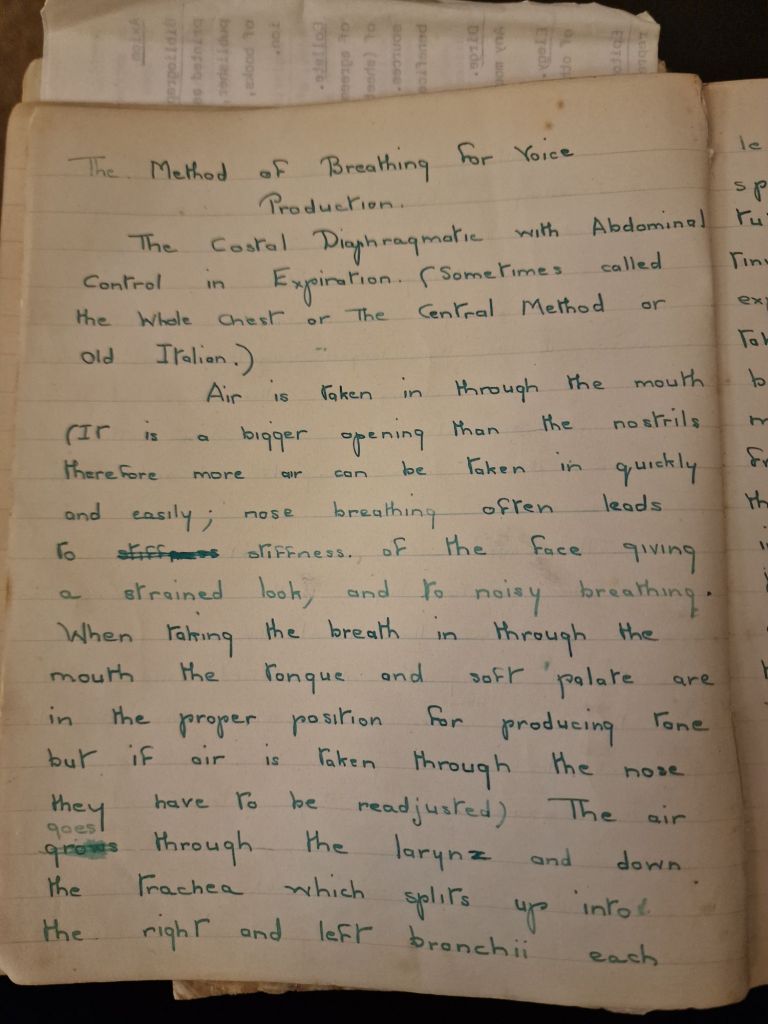
The Method of Breathing for you Production
The Costal Diaphragmatic with Abdominal Control in Expiration (sometimes called the Whole Chest or the Central Method or Old Italian).
Air is taken in through the mouth (it is a bigger opening than the nostrils therefore more air can be taken in quickly and easily; nose breathing often leads to stiffness of the face giving a strained look and to noisy breathing.
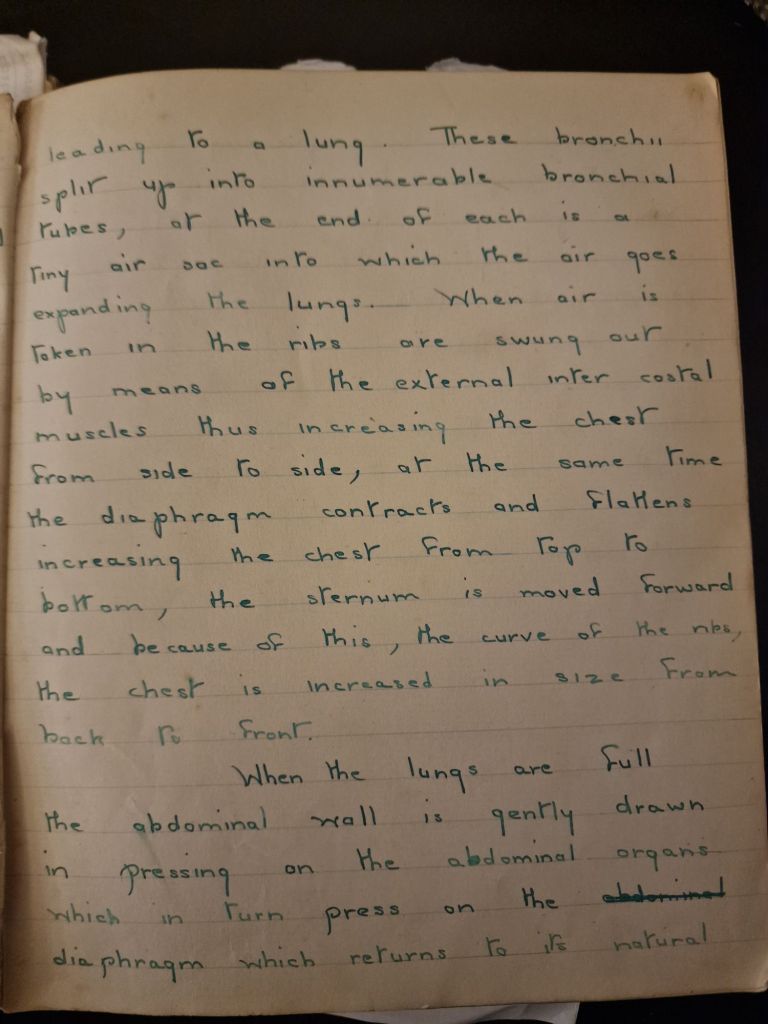
When taking the breath in through the mouth the tongue and soft palate are in the proper position for producing tone but if air is taken through the nose they have to be readjusted. The air goes through the larynx and down the trachea which splits up into the right and left branchii each leading to a lung. These branchii split up into innumerable bronchial tubes, at the ends of each is a tiny air sac into which the air goes expanding the lungs. When air is taken in the ribs are swung out by means of the external inter costal muscles thus increasing the chest from side to side, at the same time the diaphragm contracts and flattens increasing the chest from top to bottom, the sternum is moved forward and because of this, the curve of the ribs, the chest is increased in size from back to front.
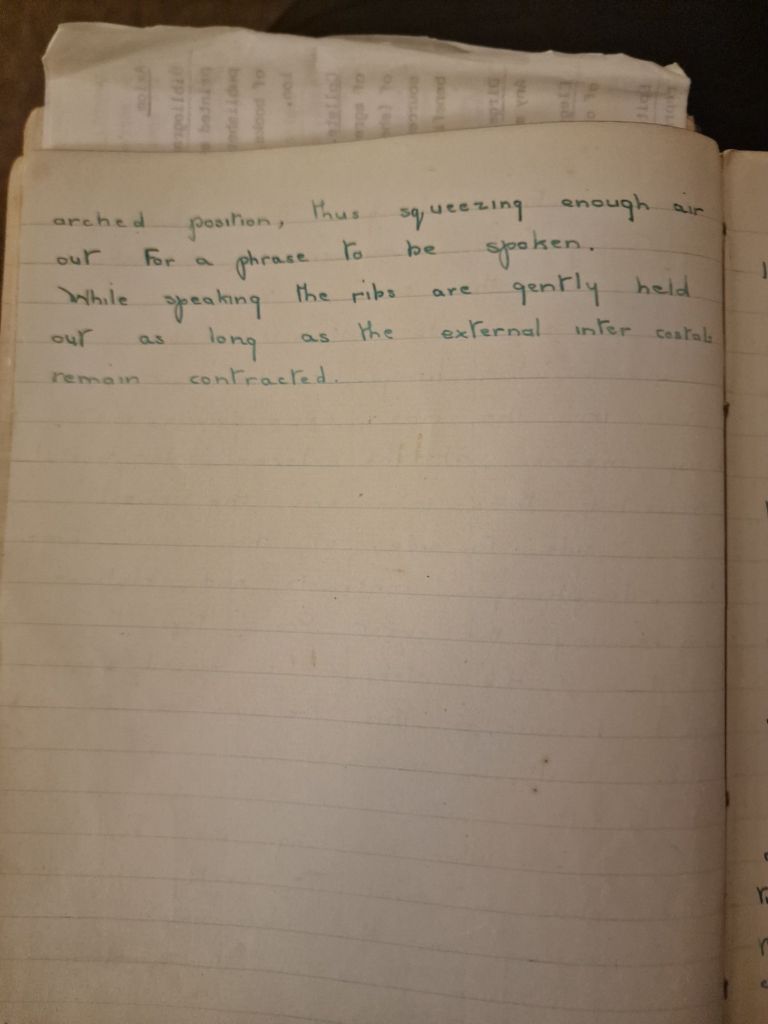
When the lungs are full the abdominal wall is gently drawn in pressing on the abdominal wall is gently drawn in pressing on the abdominal organs which in turn press on the diaphragm which returns to its natural arched position, thus squeezing enough air out for a phrase to be spoken.
While speaking the ribs are gently held out as long as the external inter costal remains contracted.
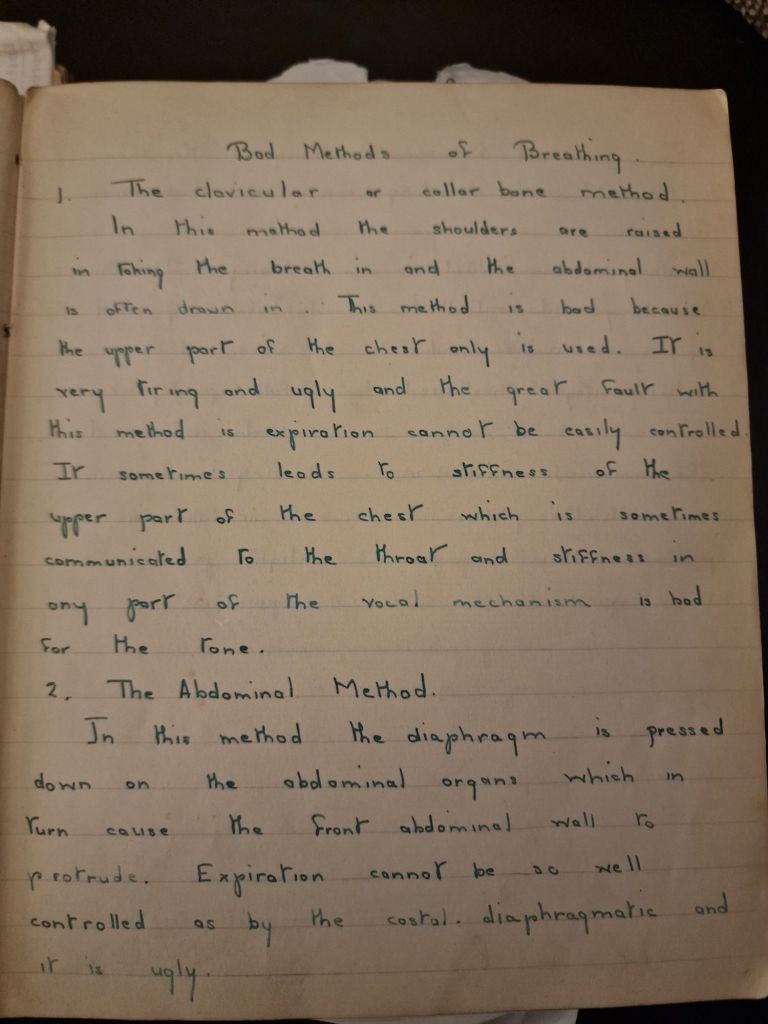
Bad Methods of Breathing
The clavicular or collar bone method. In this method the shoulders are raised in taking the breath in and the abdominal wall is often drawn in. This method is bad because the upper part of the chest is used. It is very tiring and ugly and the great fault with this method is expiration cannot be easily controlled. It sometimes leads to stiffness of the upper part of the chest which is sometimes communicated to the throat and stiffness in any part of the vocal mechanism is bad for the tone.
The abdominal method. In this method the diaphragm is pressed down on the abdominal organs which in turn cause the front abdominal wall to protrude. Expiration cannot be so well controlled as by the costal diaphragmatic and it is ugly.
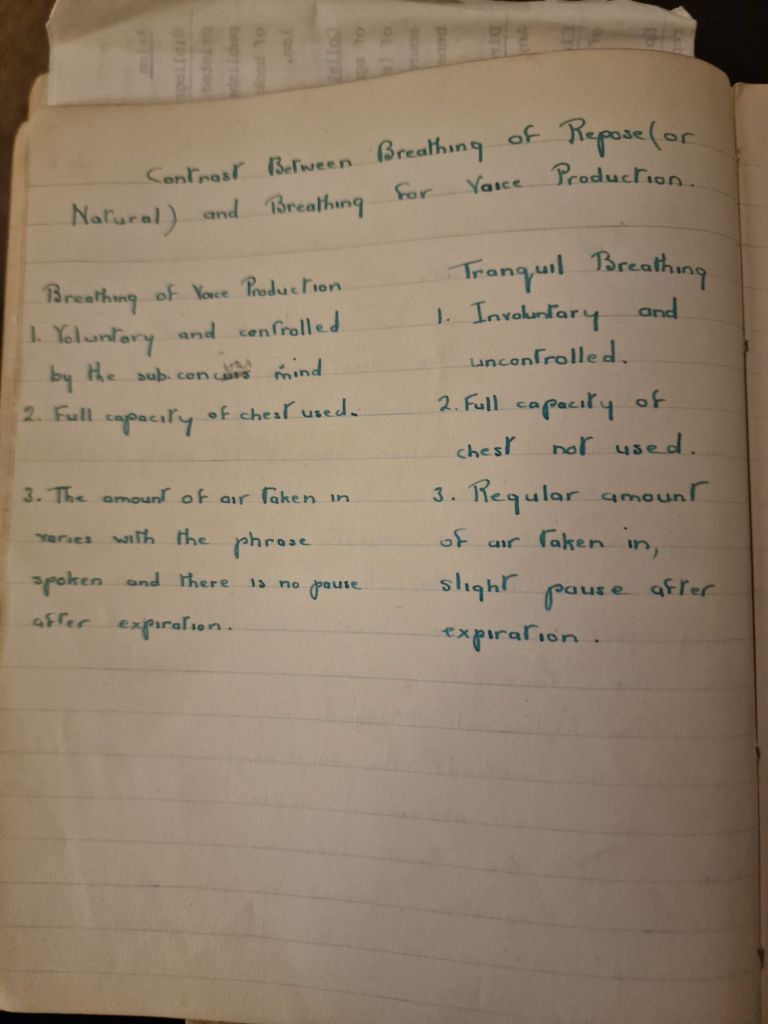
Contrast Between Breathing of Repose (or Natural) and Breathing for Voice Production
Breathing of Voice Production
Voluntary and controlled by the subconscious mind
Full capacity of chest used
The amount of air taken in varies with the phrase spoken and there is no pause after expiration
Tranquil Breathing
Involuntary and uncontrolled
Full capacity of chest not used
Regular amount of air taken in, slight pause after expiration
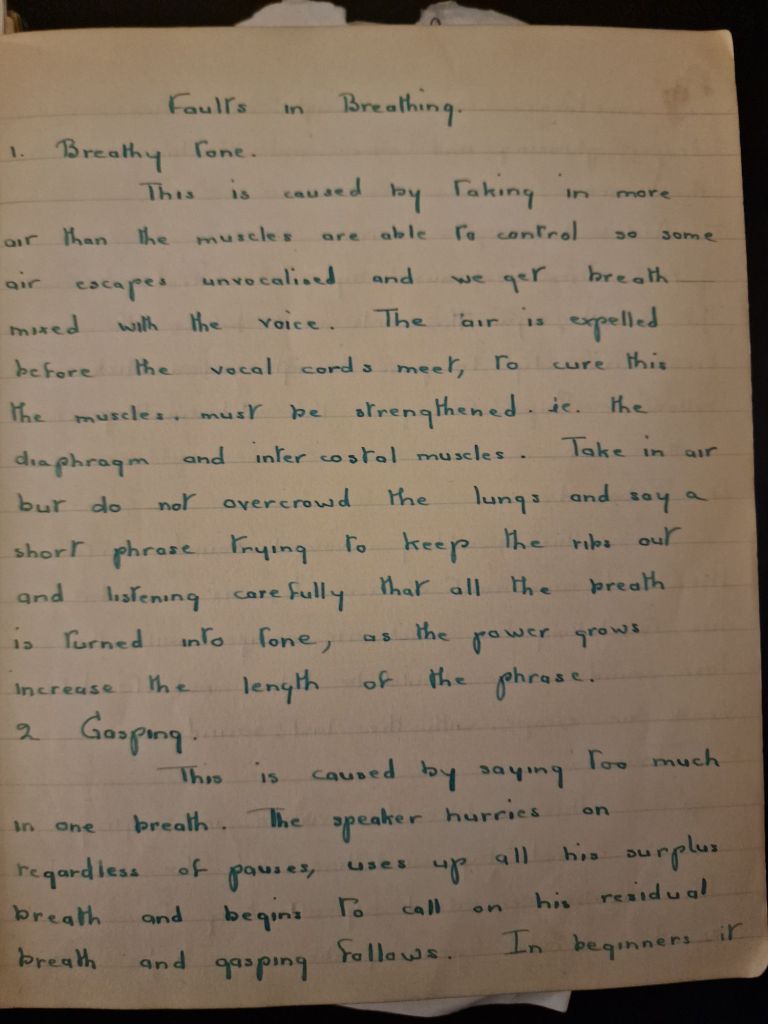
Faults in Breathing
Breathing Tone: This is caused by taking in more air than the muscles are able to control so some air escapes unvocalised and we get breath mixed with the voice. The air is expelled before the vocal cords meet. To cure this the muscles must be strengthened, ie. The diaphragm and inter costal muscles. Take in air but do not overcrowds the lungs and say a short phrase trying to keep the ribs out and listening carefully that all the breath is turned into tone, as the power grows increase the length of the phrase.
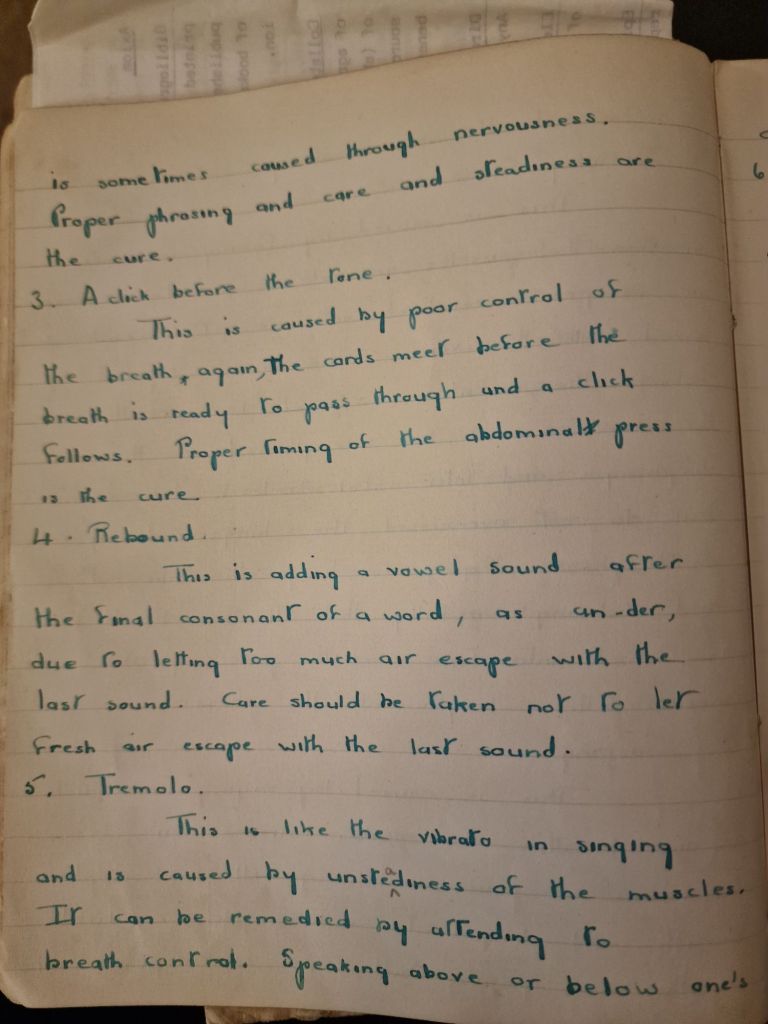
Gasping: This is caused by saying too much in one breath. The speaker hurries on regardless of pauses, uses up all their surplus breath and begins to call on their residual breath and gasping follows. In beginners it is sometimes caused through nervousness. Proper phrasing and care and steadiness are the cure.
A Click before Tone: This is caused by poor control of the breath again. The cords meet before the breath is ready to pass through and a click follows. Proper timing of the abdominal press is the cure.
Rebound: This is adding a vowel sound after the final consonant of a word, as un-der due to letting too much air escape with the last sound. Care should be taken not to let fresh air escape with the last sound.
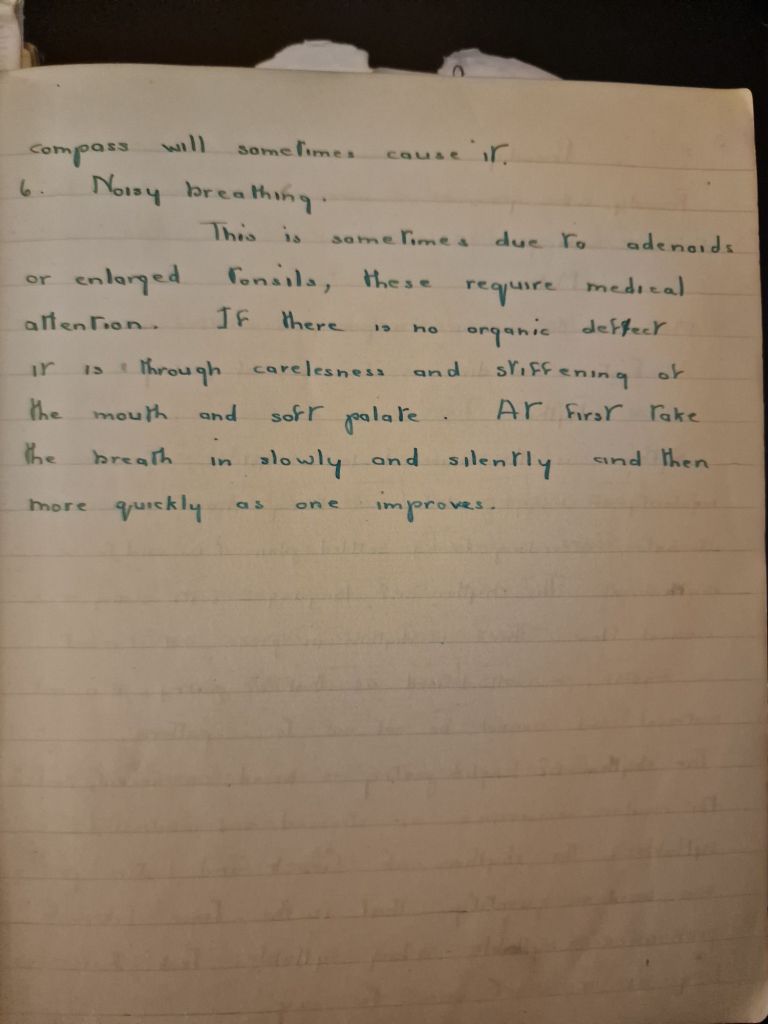
Tremolo: This is like the vibrato in singing an is caused by unsteadiness of the muscles. It can be remedied by attending to breath control. Speaking above or below one’s compass will sometimes cause it.
Noisy Breathing: This is sometimes due to adenoids or enlarged tonsils, these require medical attention. If there is no organic defect it is through carelessness and stiffening of the mouth and soft palate. At first take the breath in slowly and silently and the more quickly as one improves.
Above are an excerpt from my grandmothers notebook.
Modern Insights: Bringing Breathing Techniques into the 21st Century
Today experts in vocal performance, mindfulness and even sports science universally acknowledge (see further reading for articles) the value of deliberate breathing. The costal diaphragmatic method, as described above, remains central to performance technique but now we better understand its role in stress reduction, stamina and vocal clarity.
Mindful breathing is proven to lower anxiety before speaking, enhancing confidence and focus.
Nose breathing is preferred in general health to filter and humidify air, but for vocal projection, mouth breathing is effective when done consciously with relaxed facial muscles.
Apps and devices can now help speakers track and train their breathing, while modern trainers emphasise relaxation as much as control.
Warm-up routines for presenters often include breath exercises, stretching and even short meditation to prime both body and mind.
Understanding your own “breathing faults” helps tailor practice, video and audio feedback help track progress.
Blending this wisdom of past and present empowers presenters and storytellers to use breath as a foundation for authenticity and impact to as a key to unlocking their best voice.
As we begin the year the concept of what it means to be a well-rounded individual continues to evolve.
Traditionally, people were considered well-rounded if they demonstrated both intelligence and emotional awareness, measured through IQ (Intellectual Quotient) and EQ (Emotional Quotient). However with the demands of an increasing complexity of modern life, work and social environments, it now demands a more rounded and comprehensive suite of skills and attributes.
The addition of recognising and usinng more “Quotients” provides a broader framework for personal development, meeting the diverse challenges and opportunities we face.
Expanding Beyond IQ and EQ for a More Holistic Future
While IQ and EQ remain crucial, they can be accompanied by a range of other Quotients essential for success. Below is a list of the key Quotients and some of the reasons each is so important:
More Than Just IQ and EQ
AQ – Adversity Quotient: Represents the ability to withstand and recover from setbacks. Developing AQ involves learning to adapt, bounce back and thrive despite challenges.
BQ – Body Quotient: Encompasses physical health in a holistic sense, including fitness, nutrition, sleep, and overall wellness. Advances in technology (senors) allow people to better understand and improve their BQ, leading to enhanced quality of life and productivity.
CQ – Cultural Quotient: Highlights the importance of navigating diverse cultures with sensitivity and adaptability. CQ is important for building inclusive environments and succeeding in multicultural and diverse teams, both personally and professionally.
CQ – Curiosity Quotient: Reflects the motivation to pursue new knowledge, skills, and experiences. CQ helps individuals stay innovative and relevant.
DQ – Decency Quotient: Leadership requires more than intelligence and emotional awareness; it demands decency. DQ is about integrity, kindnes, and fairness, ensuring that everyone is valued and respected. DQ can help to distinguish good leaders.
EQ – Emotional Quotient: Mastery of one’s own emotions and understanding those of others is crucial for building relationships, resolving conflicts and leading with empathy. As collaboration is part of our daily lives EQ is increasingly valuable.
IQ – Intellectual Quotient: Cognitive ability remains fundamental for problem solving and analytical thinking. IQ should be integrated with other Quotients for genuine effectiveness.
LQ – Learning Quotient: The ability to unlearn old habits and embrace new ones is increasingly vital. Adaptability is anchored in continual learning and personal growth.
MQ – Moral Quotient: MQ serves as the moral compass, guiding individuals and organisations to act ethically and uphold values. With the onset of an AI world, dealing with complex ethical dilemmas and moral integrity is growing in importantance.
PQ – Physical Quotient: Focuses on self-awareness of bodily needs and limits, including stress and fatigue. Understanding PQ helps individuals maintain high performance and avoid burnout.
SQ – Spiritual Quotient: Involves seeking meaning, purpose and inner peace. SQ is not necessarily religious but about connecting with something greater and fostering a sense of balance and fulfilment.
SQ – Social Quotient: Social intelligence is essential for navigating complex networks, both online and offline. SQ supports trust-building, influencing others and effective teamwork.
TQ – Technology Quotient: As the transformation of technology and the workplace accelerates, comfort and fluency with technology (from artificial intelligence to remote collaboration tools) are fundamental for success in both professional and personal spheres.
Modernising the Equation for 2026
The well-rounded individual is defined not by a single strength, but by the ability to blend these Quotients into a harmonious whole. The equation for personal effectiveness is:
AQ + BQ + CQ (Cultural) + CQ (Curiosity) + DQ + EQ + IQ + LQ + MQ + PQ + SQ (Spiritual) + SQ (Social) + TQ = The Well-Rounded Person
Self-Reflection: Questions to Guide Your Growth
Which of these Quotients do you naturally excel in and which require more attention?
How can you combine your strengths across different Quotients to create greater impact?
What steps can you take to develop areas like AQ, CQ, LQ or TQ?
How might your Quotients support your personal and professional goals in 2026?
In what ways can you help others around you build their own Quotients?
The journey is ongoing, but the rewards (personal fulfilment, resilience and meaningful impact) make it a worthy pursuit.




 Max Hemingway