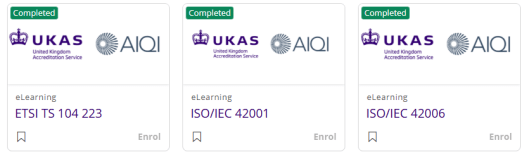
The AIQI Consortium has recently expanded its portfolio of educational offerings related to ISO standards and AI security controls. Following my previous experience with the ISO/IEC 42001 course, I have complete the next two and can recommend these to anyone wanting a greater understanding of the standards and looking to implement them.
Courses Offered
ISO/IEC 42001: Provides foundational knowledge of ISO standards specifically designed for Artificial Intelligence Management Systems. The course delves into the principles, requirements and implementation strategies necessary for compliance.
ISO/IEC 42006: Extends the learning to cover additional protocols and auditing techniques, focusing on advanced elements within the ISO framework. Learners gain exposure to practical applications and case studies relevant to complex organisational environments.
ETSI TS 104 223: Offers a comprehensive overview of the European Telecommunications Standards Institute technical specification, with a particular emphasis on AI security controls and risk management. The course equips participants with the tools to assess and enhance security measures within AI-driven systems.
Course Structure and Format
Each course is well structured, providing a good overview and understanding of the standards and ensuring a logical progression from fundamental concepts to more advanced topics. The modules are clearly organised, featuring worked examples and detailed guidance on auditing processes.
Where to take the courses
All three courses (ISO/IEC 42001, ISO/IEC 42006, and ETSI TS 104 223) are available on the UKAS website (enrollment required).
The NCSC Annual Review 2025 serves as a powerful reminder that cyber risk is no longer confined to the IT department. Instead, it has become a critical issue that demands attention at the highest levels of leadership. The NCSC report emphatically urges decision-makers to “open your eyes to the imminent risk to your economic security.” It makes clear that cyber incidents have the potential to disrupt essential operations, inflict lasting reputational damage and result in significant financial and legal repercussions.
In an environment where threats are ever-present and the risk of future threatsis growing rapidly, true organisational resilience depends on strategic foresight, thorough preparation and the capacity to recover effectively from attacks.
The pressing question then, is how organisations can translate these warnings and insights into practical action. A compelling solution lies in the adoption of robust Enterprise Architecture practices. Specifically the use of ArchiMate enables organisations to systematically document their enterprise landscape and the relationships between systems, providing the clarity needed to strengthen resilience.
Enterprise Architecture: A Blueprint for Cyber Resilience
The NCSC report makes it clear: cyber security is now critical to business longevity and success. It is not just about technology anymore. It is about understanding how your organisation operates, how systems interact and where vulnerabilities lie. The report calls for all business leaders to take responsibility for their organisation’s cyber resilience, moving beyond technical silos to a holistic, strategic approach.
Enterprise Architecture provides the blueprint for this approach. It helps organisations map out their business processes, applications, data and technology infrastructure. By visualising these elements and their interconnections, leaders can take meaningful steps towards resilience.
Key Benefits of Enterprise Architecture for Cyber Resilience
Identify critical assets and dependencies
Assess risk exposure across the enterprise
Plan for continuity and rapid recovery
Communicate cyber risk in business terms
ArchiMate: Documenting the Enterprise
ArchiMate is an open and widely adopted modelling language specifically designed for enterprise architecture. It allows organisations to create clear and consistent diagrams that illustrate how business processes, application landscapes, and technology layers align and interact with one another.
Using ArchiMate, organisations can achieve several key objectives:
Model business processes and their supporting systems – Providing a structured view of how core operations are underpinned by technology.
Map data flows and integrations between applications – Offering clarity on how information moves throughout the organisation and where potential integration points or vulnerabilities may exist.
Visualise technology infrastructure and network boundaries – Enabling a comprehensive understanding of the technology landscape and its security perimeters.
Document relationships and dependencies between systems – Ensuring that all critical interconnections and dependencies are recorded, which is essential for risk assessment and resilience planning.
This approach is particularly important in the context of cyber resilience. The NCSC report underscores that attackers often exploit the complexity and interconnectedness of systems. Without a clear understanding of how systems depend on and relate to each other, organisations risk overlooking critical vulnerabilities or being unable to recover swiftly from security incidents.
The NCSC Annual Review emphasises that resilience extends beyond mere prevention; it encompasses an organisation’s capacity to continue operating and to recover effectively after a disruptive incident. One crucial aspect of building such resilience is the thorough documentation of relationships between systems. This practice serves several essential purposes:
Risk Assessment – A clear understanding of how systems depend on one another is fundamental for identifying single points of failure as well as recognising where cascading impacts may arise. By mapping out these dependencies, organisations can better anticipate and manage risks that might jeopardise operational continuity.
Incident Response – In the event of a cyberattack or other disruptive incident, having documented knowledge of system interconnections allows for quicker isolation and containment of threats. This, in turn, enables a more efficient recovery process, minimising downtime and damage.
Compliance and Governance – With regulatory bodies increasingly demanding proof of robust cyber risk management, having comprehensive documentation of system architecture provides the necessary assurance. It demonstrates a proactive approach to governance and supports compliance with industry standards.
Continuous Improvement – The technology landscape and threat environment are constantly evolving. Maintaining up-to-date architecture documentation ensures that organisations remain agile, capable of adapting to new risks, and able to reinforce their defences as needed.
Identification of Organisational and Technical Debt – Documenting relationships also helps in pinpointing areas of organisational and technical debt. This awareness is vital for planning improvements and ensuring that legacy issues do not compromise cyber resilience.
Practical Steps for Enhancing Cyber Resilience
The following practical steps outline how to leverage enterprise architecture tools and the ArchiMate framework to strengthen your organisation’s defences:
Utilise Enterprise Architects and Tooling – A good Enterprise Architect understands how to get the best out of modelling a business and systems. Use Enterprise Architecture tools such as ArchiMate to streamline the process of mapping and documenting your organisation’s systems and their interconnections.
Start with a Baseline – Begin by creating a high-level overview of your organisation’s business processes, applications, and underlying technology. This baseline serves as the foundation for understanding how different elements interact and where vulnerabilities may exist.
Identify Relationships – Carefully document all integrations, data flows, and dependencies within your system architecture. Paying particular attention to legacy systems and third-party connections, as these often present unique risks and challenges.
Assess and Prioritise – Use your architectural model to pinpoint critical assets. This enables you to prioritise resilience measures, ensuring that essential systems receive appropriate attention and protection.
Communicate – Share your documented architecture with key stakeholders, including board members, IT teams, and external partners. Clear communication ensures all parties are aware of the risks involved and the responsibilities required to mitigate them.
Review Regularly – Continuously update your system documentation to reflect changes in technology, emerging threats, and lessons learned from past incidents. Regular reviews ensure that your organisation remains prepared to adapt to an evolving threat landscape.
Keep a copy offline – Keep a copy of your models so that you can access them when you cant access you systems.
With quantum computing progressing, transitioning to post-quantum cryptography (PQC) is crucial. Quantum computers threaten current cryptographic systems by efficiently solving complex mathematical problems used in asymmetric Public Key Cryptography (PKC).
Post-Quantum Cryptography (PQC), or quantum-resistant cryptography, develops algorithms secure against quantum computer attacks, which uses problems quantum computers can’t solve efficiently.
The NCSC (National Cyber Security Centre) has released the “Timelines for migration to post-quantum cryptography” today (20/03/25), detailing steps organisations need to take to protect against Post Quantum Cryptography (PQC).
The national migration to PQC is a major technological shift that will take years and it is important that organisations start now. The NCSC provides guidance on early-stage migration activities and sets timelines for UK industry, government, and regulators. These timelines apply to all organisations, especially large ones, critical infrastructure operators, and those with custom IT systems.
Key Milestones
As highlighted in the report the key milestones are:
By 2028: Define migration goals, conduct a full discovery exercise, and build an initial migration plan.
By 2031: Carry out early, high-priority PQC migration activities and refine the migration plan.
By 2035: Complete the migration to PQC for all systems, services, and products.
Migration Strategy Selection
Organisations have several options for migration detailed in the report.
In-place migration: Replacing vulnerable PKC components with PQC equivalents.
Re-platform: Switching to a new or upgraded platform that supports PQC.
Retire the service: Setting a future date for withdrawal.
Tolerate the risk: Continuing to operate without mitigation.
What to do next?
The report highlights a series of steps you should take next with an expectation of 2-3 years timeline to migrate to PQC.
Given the intricacies involved in PQC migration, looking at external help should be considered through a company/consultancy with expertise in cryptographic assessments and migration strategies. They can provide invaluable support in several key areas:
Comprehensive Assessment: Conducting a detailed discovery and assessment of your current cryptographic infrastructure, identifying vulnerabilities and dependencies that need to be addressed.
Tailored Migration Plan: Develop a customised migration plan that aligns with your organisation’s specific needs and regulatory requirements. This plan will include timelines, resource allocation, and risk management strategies.
Expert Recommendations: Leveraging deep knowledge of cryptographic technologies, can recommend the most suitable PQC algorithms and protocols for your systems. Provide guidance on integrating these new technologies without disrupting your existing operations.
Ongoing Support: Throughout the migration process, offering continuous support, ensuring that your transition to PQC is seamless and that any issues are promptly addressed.


 Max Hemingway