• About Me Card

Max Hemingway

~ Musings as I work through life, career and everything.

Max Hemingway

Category Archives: Uncategorized

Graceful Speech & Timeless Tales: Mastering the Art of Gesture

17 Wednesday Dec 2025

Posted by Max Hemingway in Uncategorized

≈ Leave a comment

Body language is a powerful tool in any presenter or storyteller’s toolkit. Drawing inspiration from my grandmother’s notebook, let’s explore how the art of gesture and broader body language (once meticulously practised for public speaking) remains just as relevant today, albeit with some modern tweaks.

Why Gestures and Body Language Matter

Gestures and body language are more than just movements. They are physical expressions of feeling that bridge the gap between words and emotions. When you present or tell a story, your entire body naturally reacts to what you’re conveying.

As you walk onto stage and present the audience is already building a picture and opinion of you based on everything you do and you haven’t even spoken yet. Harnessing these non-verbal cues can make your delivery more authentic, engaging and memorable. Facial expressions, posture and even your stance contribute to how your message is received, often conveying as much meaning as your spoken words.

Guidelines for Impactful Gestures and Body Language

  • Keep It Natural: The best gestures and body movements don’t look forced. Let your movements flow from genuine emotion rather than mechanical choreography. Relaxed shoulders and an open posture instantly make you appear more approachable.
  • Express, Don’t Describe: Use gestures and body language to embody the emotion behind your words, not just to mime what you’re talking about. A smile, a nod or a gentle lean forward can express enthusiasm or empathy.
  • Emphasise Key Points: Align your gestures and body orientation with the most important ideas or words. This helps reinforce your message and adds drama at the right moment. Step forward when making a key point or use an open hand to invite attention.
  • Avoid Overdoing It: Gestures and body language should be neither stiff nor exaggerated. Subtle, fluid movements can often be more effective than grand, sweeping motions. Avoid fidgeting or pacing, which can distract from your message.
  • Move with Purpose: Curved, outward movements of the arms and open body language tend to appear more relaxed and inviting than sharp or angular ones. An upright but relaxed stance conveys confidence.
  • Finish Gracefully: After a gesture, let your hands and arms naturally return to a resting position. Don’t snap them back, let the movement dissolve gently  and allow your posture to settle back into a comfortable stance.
  • Make Every Gesture and Movement Count: Each gesture and aspect of body language should serve your message, clarifying or amplifying your words rather than distracting from them. Maintain eye contact and be mindful of your facial expressions.

Develop Graceful Gestures and Confident Body Language

Becoming comfortable with gestures and body language takes practice and learning. You have to be more self-aware and confident at the same time. It is an investment that pays off in more confident and compelling presentations.

  • Loosen Up: Regularly stretch and move to keep your body relaxed and flexible. Tension can make gestures and posture look awkward or forced. Breathing deeply before you speak helps release stiffness.
  • Observe the Greats: Watch skilled speakers, whether on stage, in videos or even in photos. Notice how their gestures, posture and facial expressions support their message.
  • Practise with Purpose: Rehearse your talk in front of a mirror or record yourself. Focus on how your gestures, stance and facial expressions feel and look. Do they match the emotion and content you’re aiming to convey?
  • The Anatomy of a Gesture and Effective Body Language
  • Preparation: Start with the emotion you want to express. Let it build before you move, and allow your whole body to reflect that feeling,  whether through an open stance or a thoughtful tilt of the head.
  • Execution: Make your gesture in a smooth, curved motion, reaching its peak on your key word or message. Let your posture and facial expression support the gesture, reinforcing your intention.
  • Release: Let your arm and hand relax naturally, completing the movement without abruptness. Allow your body to settle back into a poised, open position, ready for your next point.

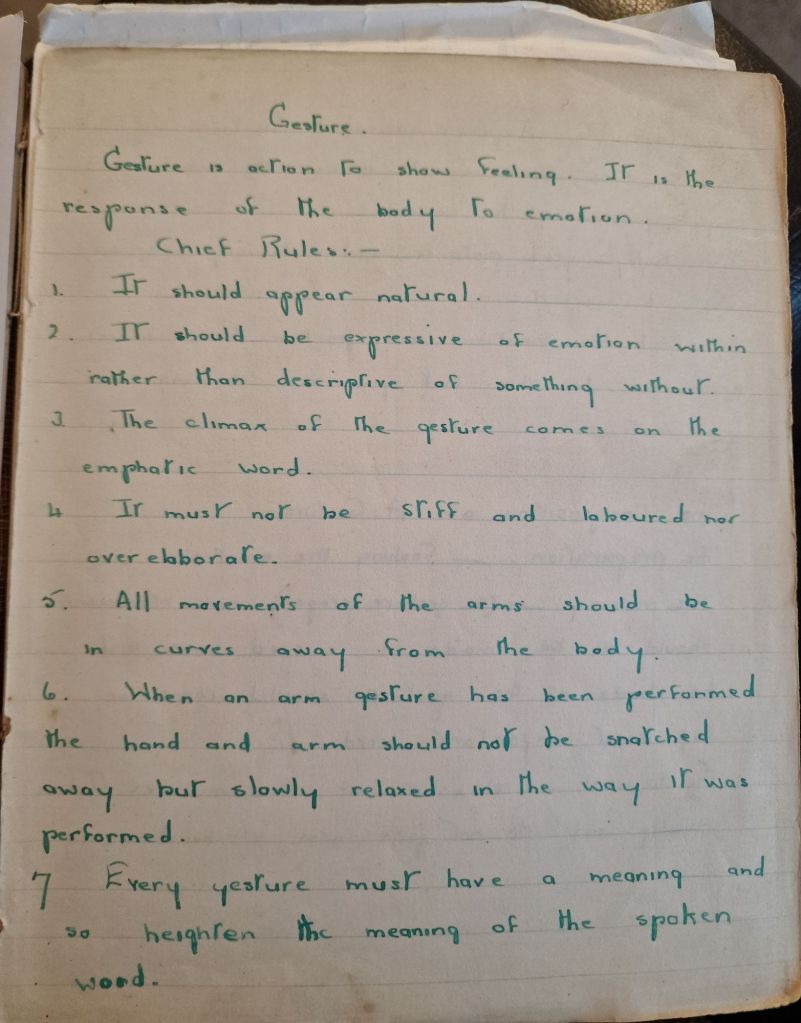
Gesture is action to show feeling. It is the response of the body to emotion.

Chief Rules:

  1. It should appear natural
  2. It should be expressive of emotion within rather than descriptive of something without
  3. The climax of the gesture comes on the emphatic word
  4. It must not be stiff and laboured not over elaborate
  5. All movements of the arms should be in curves away from the body
  6. When an arm gesture has been performed the hand and arm should not be snatched away but slowly relaxed in the way that it is formed
  7. Every gesture must have a meaning and so heighten the meaning of the spoken word

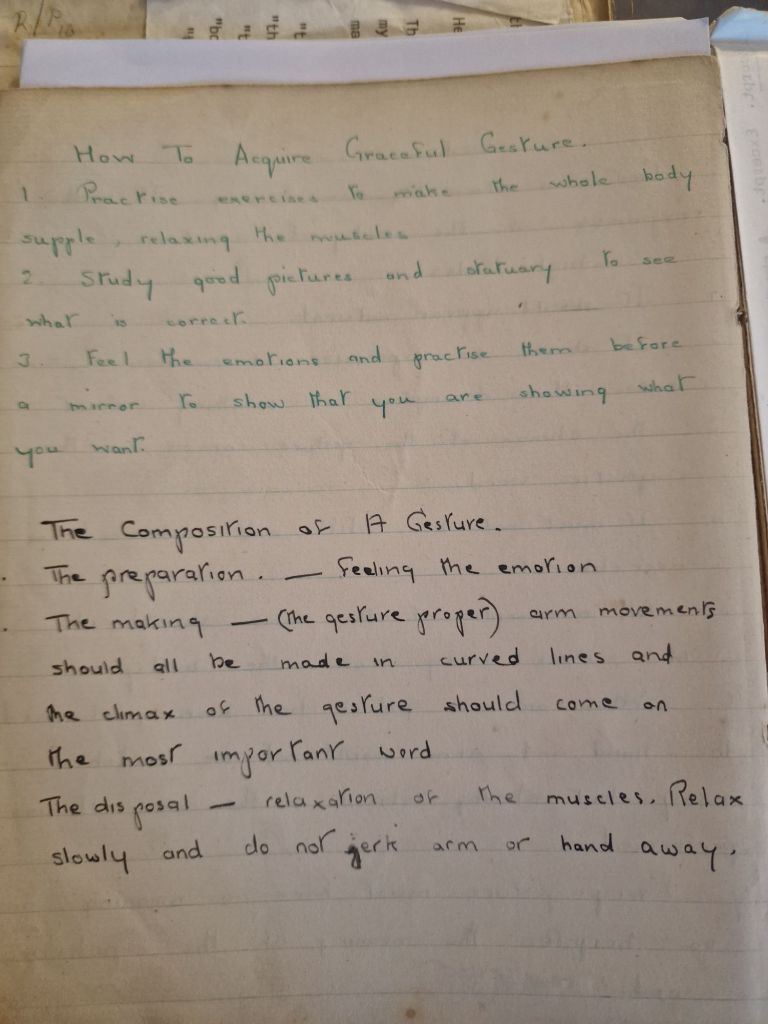
How to Acquire Graceful Gesture

  1. Practice exercise to make the whole body supple, relaxing the muscles
  2. Study good pictures and statuary to see what is correct
  3. Feel the emotions and practice them before a mirror to show that you are showing what you want

The Composition of a Gesture

  1. The preparation – feeling the emotion
  2. The making – (the gesture proper) arm movements should all be made in curved lines and the climax of the gesture should come on the most important word
  3. The disposal – relaxation of the muscles. Relax slowly and do not jerk arm or hand away

Excerpt from my grandmothers notebook.
Talks, presentations, meetings and virtual meetings, gestures and body language are still cornerstones of effective communication. Let your body language reflect your passion and conviction. Remember: authentic, purposeful gestures and confident body language never go out of style, they simply adapt to the times. What my grandmother wrote years ago still applies as much today as it did then.

Further Reading

Lessons from my Grandmother’s Notebook: Rediscovering the Art of Speaking
Does body language help a TED Talk go viral? 5 nonverbal patterns from blockbuster talks

Share this:

  • Click to share on Facebook (Opens in new window) Facebook
  • Click to share on LinkedIn (Opens in new window) LinkedIn
  • Click to email a link to a friend (Opens in new window) Email
  • Click to share on Pinterest (Opens in new window) Pinterest
  • Click to share on Reddit (Opens in new window) Reddit
  • Click to share on Tumblr (Opens in new window) Tumblr
  • Click to share on Pocket (Opens in new window) Pocket
  • Click to share on Telegram (Opens in new window) Telegram
  • Click to share on Threads (Opens in new window) Threads
  • Click to share on WhatsApp (Opens in new window) WhatsApp
  • Click to share on Mastodon (Opens in new window) Mastodon
  • Click to share on X (Opens in new window) X
  • Click to share on Bluesky (Opens in new window) Bluesky
Like Loading...

The Power of Focus: Why Quiet Time Matters

07 Tuesday Oct 2025

Posted by Max Hemingway in Uncategorized

≈ Leave a comment

Life often feels relentless, with work routines sometimes even more hectic. Despite our best efforts to organise diaries and schedules, there always seems to be another task or meeting demanding our attention. Finding moments of genuine quiet can be a challenge, especially where multitasking and constant connectivity are the norms.

Technology has a big part to play in the distractions of today with email, chat, news, social media and information feeds poping up on devices causing momentary lapses in concetration to see that latest ping and respond in some format.

Applications such as Outlook can be used to automatically put “Focus Time” blocks of time in to a calendar automatically and turn on a do not disturb status, however, it is all too common for these sessions to be interrupted or overridden by the need to attend other meetings or respond to the information or request for help ping on the screen, making it difficult to protect this valuable time.

The importance and significance of quiet time and focus sessions cannot be overstated. This time is a powerful tool that can enhance focus, foster deep thinking, and ultimately lead to more innovative and effective work.

The Benefits of Quiet Time

Quiet time is an invaluable aspect of maintaining both productivity and well-being. It provides an opportunity to step away from the constant stream of distractions and demands that characterise modern life, particularly in fast-paced and technology-driven environments. By intentionally setting aside moments of silence and solitude, individuals can reap a range of benefits that enhance both their professional effectiveness and personal health.

Enhanced Focus: Dedicating time to work in a quiet environment allows you to concentrate on a single task without interruptions. Freed from the continual barrage of notifications and external stimuli, you are able to immerse yourself more fully in your work. This increased level of concentration often leads to greater productivity and results of a higher standard.

Deep Thinking: Complex problem-solving and innovative thinking are most effective when given time to develop without disruption. Quiet time creates the mental space required to ponder and explore ideas thoroughly. This uninterrupted period supports deeper thinking, enabling the development of creative solutions and insightful approaches.

Stress Reduction: The relentless pace and high demands of the technology industry can often be overwhelming. Setting aside quiet time offers a necessary respite, helping to alleviate stress and mental exhaustion. Regular periods of silence allow you to recharge, returning to your responsibilities with renewed clarity and energy.

Improved Decision-Making: When constantly bombarded with information, there is a tendency to make quick, sometimes ill-considered decisions. Quiet time provides the opportunity to process information more carefully, resulting in decisions that are more thoughtful and informed.

Boosted Creativity: Moments of silence and solitude are often when creativity thrives. By making time for quiet reflection, you can tap into your creative potential, leading to more original ideas and innovative approaches to your work.

How to Incorporate Quiet Time into Your Routine

Establishing quiet time as a regular part of your routine requires intention and planning. By taking simple yet effective steps, you can ensure that these periods become an integral part of your daily schedule, supporting focus, creativity, and well-being.

Schedule Quiet Time: Treat quiet time with the same importance as meetings or project deadlines. Allocate specific blocks in your calendar dedicated solely to uninterrupted work, and regard these times as non-negotiable appointments. Prioritising quiet time ensures that it becomes a consistent and valued part of your day.

Create a Quiet Space: Designate a particular area where you can work without interruptions. This could be a dedicated room, a comfortable corner, or even a peaceful spot outdoors. The key is to ensure the space is free from distractions and conducive to maintaining deep focus.

Set Boundaries: Communicate to colleagues and family members when you are observing quiet time, and ask for their cooperation in respecting this period. To further minimise disturbances, turn off notifications, silence your phone, and create an environment that supports undisturbed work.

Practice Mindfulness: Incorporate mindfulness techniques such as meditation or deep breathing exercises during your quiet time. These practices can help calm the mind, fostering a sense of readiness for focused work and greater mental clarity.

Reflect and Review: Use a portion of your quiet time to reflect on your work and progress. Activities such as journaling or note-taking provide space to process thoughts, assess achievements, and identify areas for improvement.

Further Reading

Research Papers

  • A Demonstration Study of the Quiet Time Transcendental Meditation Program
  • Going beyond Mindfulness: How Concentration and Tranquility Commonly Co-Arising with Mindfulness Account for Mental Health
  • Many of us are not optimally using our concentration span
  • The Power of Silence
  • Waiting, Thinking, and Feeling: Variations in the Perception of Time During Silence

Blogs

Overcoming Mental Clutter for Improved Productivity
Journey to 21C Human – Getting your head space sorted
Adaptability: The Key to Thriving as a Technologist

Share this:

  • Click to share on Facebook (Opens in new window) Facebook
  • Click to share on LinkedIn (Opens in new window) LinkedIn
  • Click to email a link to a friend (Opens in new window) Email
  • Click to share on Pinterest (Opens in new window) Pinterest
  • Click to share on Reddit (Opens in new window) Reddit
  • Click to share on Tumblr (Opens in new window) Tumblr
  • Click to share on Pocket (Opens in new window) Pocket
  • Click to share on Telegram (Opens in new window) Telegram
  • Click to share on Threads (Opens in new window) Threads
  • Click to share on WhatsApp (Opens in new window) WhatsApp
  • Click to share on Mastodon (Opens in new window) Mastodon
  • Click to share on X (Opens in new window) X
  • Click to share on Bluesky (Opens in new window) Bluesky
Like Loading...

UK Compute Roadmap 2024: Transforming National Infrastructure for AI, HPC & Digital Growth

22 Tuesday Jul 2025

Posted by Max Hemingway in Uncategorized

≈ Leave a comment

The United Kingdom (UK) Government’s newly published Compute Roadmap sets out a bold vision for transforming the nation’s computing infrastructure. As digital needs grow in fields like Analytics, artificial intelligence (AI), Quantum, and climate modelling, the roadmap details how the UK will expand its computing power to stay competitive and technologically independent.

The roadmap has a focus on compute power which is a fundamental basis of the paper to contemporary innovation. Compute underpins advancements such as large language model training, complex system simulations, and real-time data analytics. (However it should also be noted that applications and data that play a big part in this success as well). High-performance computing (HPC) and AI infrastructure serve as strategic assets essential for progress, a priority recognised within the roadmap.

Key Components of the Roadmap

Here are some of the key components extracted from the roadmap:

World-Class Infrastructure

The UK is committed to developing a federated national compute ecosystem that will integrate exascale systems, AI accelerators, and cloud platforms. This initiative includes significant investments in new data centres and enhancements to current facilities.

Access and Usability

Ensuring broad access is central to the roadmap’s objectives. It outlines the creation of unified platforms and intuitive interfaces, enabling researchers, small and medium-sized enterprises, and public sector organisations to utilise compute resources effectively.

Sustainability and Skills

Sustainability remains a core focus, with the roadmap advocating for energy-efficient architectures and environmentally responsible data centre practices. It also highlights the importance of workforce development through programmes designed to cultivate future compute specialists.

Implications for Industry and Government

For organisations operating in this landscape, the roadmap presents clear opportunities to align with national priorities. This roadmap highlights that compute strategy extends beyond hardware, serving as a catalyst for transformation at scale.

Future Outlook

As the UK advances toward a compute-driven future, collaboration among government, academia, and industry will be critical. Whether focused on AI model development, network security, or public service delivery, the roadmap provides a coherent direction and encourages collective action.

Thoughts on the Roadmap

The roadmap does provide steps forward to shape a resilient, innovative and inclusive digital future. The commitment to accessibility ensures that the benefits of these advancements extend across academia, industry, and public services, while a collaborative spirit strengthens the nation’s capacity to address both present and emerging challenges. The challenge as always is ensuring that everything in the roadmap is implemented and the benefits realised.

Further Reading

UK Compute Roadmap

Share this:

  • Click to share on Facebook (Opens in new window) Facebook
  • Click to share on LinkedIn (Opens in new window) LinkedIn
  • Click to email a link to a friend (Opens in new window) Email
  • Click to share on Pinterest (Opens in new window) Pinterest
  • Click to share on Reddit (Opens in new window) Reddit
  • Click to share on Tumblr (Opens in new window) Tumblr
  • Click to share on Pocket (Opens in new window) Pocket
  • Click to share on Telegram (Opens in new window) Telegram
  • Click to share on Threads (Opens in new window) Threads
  • Click to share on WhatsApp (Opens in new window) WhatsApp
  • Click to share on Mastodon (Opens in new window) Mastodon
  • Click to share on X (Opens in new window) X
  • Click to share on Bluesky (Opens in new window) Bluesky
Like Loading...

Online Meetings – Be yourself!

06 Tuesday Jul 2021

Posted by Max Hemingway in Uncategorized

≈ Leave a comment

Over the past year and a bit the world was forced online more that it was before and meetings in the most case became video calls. Some loved it and excelled, some we okay and some shy’d away from the camera completely for a number of reasons.

So not everyone wants to be in front of a camera and not everyone has a film studio set up and is broadcasting from their kitchen table – That’s okay. You use what you have to do the best that you can do. So what can you do to help yourself look better on the calls.

Be Yourself!

Most importantly is Be Yourself.

Relax. You are not presenting the news or interviewing a top senior official (Unless you actually are of course).

Be confident and have a positive mindset.

If you are camera shy, consider joining on camera to do the introductions, then turn the camera off.

Meetings will have a bigger impact when your on camera as your audience can see your reactions and expressions just as though you are in a face to face meeting.

Contribute to the call. Don’t forget to contribute to the call. That’s why your there.

Treat each call as a face to face meeting, it is but using video instead.

Reduce any distractions so you concentrate on the call in hand.

Lighting

Try not to sit with a window directly behind you, especially with the sun shining as this produces a halo effect around you which does not look good to others on the call.

If you can’t move and don’t have blinds or curtains, then consider bring some light in front of you to counter balance the light behind you. You will need to do this even if you are using an in call backdrop.

Search for “led video light” on somewhere like Amazon for some good options. It doesn’t have to be expensive.

If you are using your phone to make calls, consider an “LED Selfie Light Stand”.

Camera

Knowing where your camera is on your device is important, it can make the difference between the audience looking up your nose and seeing your face at a good level.

Clean the lens. It can make a big difference, especially if you are using a phone.

If you are using a laptop and have an external keyboard and mouse, consider using a laptop stand to raise the camera or even an external camera on a stand to get a better shot.

If you are using a mobile, consider getting a stand for it if inside so you can keep the camera steady.

Microphone

Also knowing where your microphone is on your device is and setting its sensitivity can ensure that you are heard okay and reduces any other background noises in your environment. Headsets with mics often have a mic set to only pick up the wearers voice only.

If you have an external mic, consider a windshield or pop shield to help reduce background noises.

This can mostly be controlled via your operating system device settings or for external mics and headsets the appropriate software/drivers may have options.

Remember your microphone has a mute option in the video calls.

Speakers

Software in devices is very good at stopping feedback where you hear yourself speak on a call and the microphone is picking that up and replaying in over the top. Some people prefer to use an headset with inbuilt mic so they only hear the call in the environment you are in.

Background

Most of the main video calling platforms now have the ability to place backgrounds behind you so the audience can’t see the area that you are calling from.

When using these it is important to remember that the software is using your camera to cut around your image and display the background behind you, so if you want to show something on camera, it may struggle and you may have to turn off your background to do this.

Test it out

Once you have a set up you are comfortable, test it out. There are options on most of the video calling platforms to do this, or set up a call with a colleague or friend to test out the set up and get some feedback.

References

Dr Lucy Rogers has produced a set of videos that were for her students, but would help anyone looking for some advice.

Speaking to an Online Audience – Tech
https://www.youtube.com/watch?v=iaKATPbrNhc&t=44s

Speaking to an Online Audience – Voice
https://www.youtube.com/watch?v=3j9TgUh8bQE&t=33s

Speaking to an Online Audience – Content
https://www.youtube.com/watch?v=4TezFfYyXjo&t=180s

Speaking to an Online Audience – You!
https://www.youtube.com/watch?v=ilzhziTdHSk&t=33s

Share this:

  • Click to share on Facebook (Opens in new window) Facebook
  • Click to share on LinkedIn (Opens in new window) LinkedIn
  • Click to email a link to a friend (Opens in new window) Email
  • Click to share on Pinterest (Opens in new window) Pinterest
  • Click to share on Reddit (Opens in new window) Reddit
  • Click to share on Tumblr (Opens in new window) Tumblr
  • Click to share on Pocket (Opens in new window) Pocket
  • Click to share on Telegram (Opens in new window) Telegram
  • Click to share on Threads (Opens in new window) Threads
  • Click to share on WhatsApp (Opens in new window) WhatsApp
  • Click to share on Mastodon (Opens in new window) Mastodon
  • Click to share on X (Opens in new window) X
  • Click to share on Bluesky (Opens in new window) Bluesky
Like Loading...

3 Resources for Entertaining your Children whilst Working from Home

22 Sunday Mar 2020

Posted by Max Hemingway in Uncategorized

≈ Leave a comment

imaginationIn these unprecidented times everyone who can is staying at home. Firstly a big thank you to all those essential front line staff our Health Services and those key workers that keep the country working and support the national infrastructures around the world.

With Schools closed and Working From Home (WFH) becoming a normality for the time being, it can be hard to keep young people entertained, so here are some free resources to help that are work a look.

Reading

World Book Online have made over 3,000 ebooks and audio books available for children of all ages and can be searched by age.

https://worldbook.kitaboo.com/reader/worldbook/index.html

Zoo Cams

13 Zoos have WebCams to view a selection of the animals online

https://www.holidaypirates.com/travel-magazine/13-zoos-that-offer-live-streams-see-giraffes-koalas-pandas-tigers-penguins-more_35765

Virtual Museum

Take a trip around Pitt Rivers Museum and look at the artifacts in a virtual museum

https://my.matterport.com/show/?m=ns3yCKpUzSq&help=1&fbclid=IwAR2gx2M7UoASHQ9Fy6cIns7oAIQEe-r2yvrq7rD2V4ECcXHyNrPmiExKI80

Share this:

  • Click to share on Facebook (Opens in new window) Facebook
  • Click to share on LinkedIn (Opens in new window) LinkedIn
  • Click to email a link to a friend (Opens in new window) Email
  • Click to share on Pinterest (Opens in new window) Pinterest
  • Click to share on Reddit (Opens in new window) Reddit
  • Click to share on Tumblr (Opens in new window) Tumblr
  • Click to share on Pocket (Opens in new window) Pocket
  • Click to share on Telegram (Opens in new window) Telegram
  • Click to share on Threads (Opens in new window) Threads
  • Click to share on WhatsApp (Opens in new window) WhatsApp
  • Click to share on Mastodon (Opens in new window) Mastodon
  • Click to share on X (Opens in new window) X
  • Click to share on Bluesky (Opens in new window) Bluesky
Like Loading...

Neural Interfaces – How far should we go?

10 Tuesday Sep 2019

Posted by Max Hemingway in Uncategorized

≈ Leave a comment

Digital BrainA report out today from The Royal Society looks at the history, advancements, challenges and risks of neural interface technology.

The report asks for input from the general public via a consultation on what their views in shaping the future of neural interface regulation.

We have visualised the connection of humans and machines in Science Fiction for a long time from books to films. More recently with films such as Johnny Mnemonic and The Matrix, (Yes I just referenced 2 Keanu Reeves films). Are we ready to become Borg and be assimilated?

Medicine is evolving at a fantastic speed with new developments that are helping patients to help treatments for a wide range of conditions using non-invasive and invasive technologies. Should we now use the same techniques for connecting a human brain to a computer to make us more efficient and responsive to information?

“Neural interfaces connect the brain or nervous system to

equipment, typically digital devices or IT systems. Some act to
record physiological activity, such as brain signals or movements,
while others stimulate it. Some technologies, known as ‘closedloop’ systems, record activity and deliver stimulation in response.”

Source: report


We are already doing this with devices we use on a daily basis such as a mobile phone, reality glasses and cars with heads up displays. Moving this information closer to the brain is the next technological evolutionary step in this area.

Elon Musk’s Neuralink is looking at how its possible to connect computer chips to the human brain and has already connected a Rats brain to a chip and USB port.

The report represents some of the advancements made and possible ways forward that are helping people today and helps set out some principles and practices. A worthwhile read.

For me there are still a lot of areas to discuss ethically around moving forward – Just because we can doesn’t mean we should.  I think that the quote in the report by Paul Virilio covers this and what we need to think about and accept the outcome possibilities:

“ When you invent the ship, you also invent the shipwreck; when you invent the plane you also invent the plane crash; and when you invent electricity, you invent  electrocution… Every technology carries its own negativity, which is invented at the same time as technical progress.” – Paul Virilio

Source: report

Further Reading

  • iHuman perspective: Neural interfaces
  • iHuman perspective: Supplementary material
  • An integrated brain-machine interface platform with thousands of channels
  • A-Z of Digital – J is for Jacking
  • Time to get chipped?

Share this:

  • Click to share on Facebook (Opens in new window) Facebook
  • Click to share on LinkedIn (Opens in new window) LinkedIn
  • Click to email a link to a friend (Opens in new window) Email
  • Click to share on Pinterest (Opens in new window) Pinterest
  • Click to share on Reddit (Opens in new window) Reddit
  • Click to share on Tumblr (Opens in new window) Tumblr
  • Click to share on Pocket (Opens in new window) Pocket
  • Click to share on Telegram (Opens in new window) Telegram
  • Click to share on Threads (Opens in new window) Threads
  • Click to share on WhatsApp (Opens in new window) WhatsApp
  • Click to share on Mastodon (Opens in new window) Mastodon
  • Click to share on X (Opens in new window) X
  • Click to share on Bluesky (Opens in new window) Bluesky
Like Loading...

Recent STEM Activity Roundup

18 Thursday Apr 2019

Posted by Max Hemingway in Uncategorized

≈ Leave a comment

A roundup in videos of some of the recent STEM activities that I have been involved with and help run.

February 2019 Stemettes Hack Chorley with DXC and Stemettes


March 2019 – Chorley Hack with Chorley Council


Share this:

  • Click to share on Facebook (Opens in new window) Facebook
  • Click to share on LinkedIn (Opens in new window) LinkedIn
  • Click to email a link to a friend (Opens in new window) Email
  • Click to share on Pinterest (Opens in new window) Pinterest
  • Click to share on Reddit (Opens in new window) Reddit
  • Click to share on Tumblr (Opens in new window) Tumblr
  • Click to share on Pocket (Opens in new window) Pocket
  • Click to share on Telegram (Opens in new window) Telegram
  • Click to share on Threads (Opens in new window) Threads
  • Click to share on WhatsApp (Opens in new window) WhatsApp
  • Click to share on Mastodon (Opens in new window) Mastodon
  • Click to share on X (Opens in new window) X
  • Click to share on Bluesky (Opens in new window) Bluesky
Like Loading...

Technology Couch Podcast – Episode 6

04 Monday Mar 2019

Posted by Max Hemingway in Podcasts, Uncategorized

≈ Leave a comment

Tags

Podcasts, Technology Couch Podcast

Technology Couch Podcast Logo

https://maxhemingway.com/wp-content/uploads/2019/03/technology-couch-podcast-episode-6.mp3

In this episode I chat to Sukhi Gill about “Distruptive technologies and their impact on consumers and the enterprise”

The podcast is also available in iTunes https://itunes.apple.com/gb/podcast/technology-couch-podcast

Podcast References:

  • Why software is eating the world
  • Lead, Follow or Get Out of the Way

To confirm, I am not getting any funding/promotions from any products discussed in this podcast.

Share this:

  • Click to share on Facebook (Opens in new window) Facebook
  • Click to share on LinkedIn (Opens in new window) LinkedIn
  • Click to email a link to a friend (Opens in new window) Email
  • Click to share on Pinterest (Opens in new window) Pinterest
  • Click to share on Reddit (Opens in new window) Reddit
  • Click to share on Tumblr (Opens in new window) Tumblr
  • Click to share on Pocket (Opens in new window) Pocket
  • Click to share on Telegram (Opens in new window) Telegram
  • Click to share on Threads (Opens in new window) Threads
  • Click to share on WhatsApp (Opens in new window) WhatsApp
  • Click to share on Mastodon (Opens in new window) Mastodon
  • Click to share on X (Opens in new window) X
  • Click to share on Bluesky (Opens in new window) Bluesky
Like Loading...

Technology Couch Podcast – Episode 5

11 Tuesday Dec 2018

Posted by Max Hemingway in Podcasts, Uncategorized

≈ Leave a comment

Tags

Podcasts, Technology Couch Podcast

Technology Couch Podcast Logo

https://maxhemingway.com/wp-content/uploads/2018/12/technology-couch-podcast-episode-5.mp3

In this episode I chat to people at HPE Discover (Madrid) and ask the question “Whats your prediction for 2019?”

The podcast is also available in iTunes https://itunes.apple.com/gb/podcast/technology-couch-podcast

Podcast References:

  • Having the Right Digital Mindset

To confirm, I am not getting any funding/promotions from any products discussed in this podcast.

Share this:

  • Click to share on Facebook (Opens in new window) Facebook
  • Click to share on LinkedIn (Opens in new window) LinkedIn
  • Click to email a link to a friend (Opens in new window) Email
  • Click to share on Pinterest (Opens in new window) Pinterest
  • Click to share on Reddit (Opens in new window) Reddit
  • Click to share on Tumblr (Opens in new window) Tumblr
  • Click to share on Pocket (Opens in new window) Pocket
  • Click to share on Telegram (Opens in new window) Telegram
  • Click to share on Threads (Opens in new window) Threads
  • Click to share on WhatsApp (Opens in new window) WhatsApp
  • Click to share on Mastodon (Opens in new window) Mastodon
  • Click to share on X (Opens in new window) X
  • Click to share on Bluesky (Opens in new window) Bluesky
Like Loading...

Pwned on the Dark Web – Have you checked recently?

25 Tuesday Sep 2018

Posted by Max Hemingway in Uncategorized

≈ Leave a comment

DarkwebOne of the Internet’s secret sides is the Dark Web which is one of those places that you may know of its existence from news articles where data hacked from systems is sold. Its one of those places most of us don’t really want to access, but want to know if any of our data is on there. Its certainly a place where the bounds of GDPR can’t reach either.

Some services such as https://haveibeenpwned.com/ allow you to check to see if any of your data exists on the dark web. The main identification normally searched for is an email address.

Its always good when you get the message:

Good news — no pwnage found!

No breached accounts and no pastes (subscribe to search sensitive breaches)

They offer a subscription service that will check to see if you have been breached and be notified if you are in the future.

Firefox have now joined in providing this type of service to its users https://monitor.firefox.com/.

Its good to see the launch of another checking service that allow you to see if your data (Now out of beta testing).

Another good message:

So far, so good

Your account did not appear in our basic scan. That’s good news, but data breaches can happen any time and there is still more you can do. Subscribe to Firefox Monitor for a full report, alerts when new breaches happen, and tips on protecting your passwords.

You can never have enough checking tools.

Further Reading:

Introducing Firefox Monitor, Helping People Take Control After a Data Breach

If your data is found on the dark web, Firefox Monitor will let you know


Share this:

  • Click to share on Facebook (Opens in new window) Facebook
  • Click to share on LinkedIn (Opens in new window) LinkedIn
  • Click to email a link to a friend (Opens in new window) Email
  • Click to share on Pinterest (Opens in new window) Pinterest
  • Click to share on Reddit (Opens in new window) Reddit
  • Click to share on Tumblr (Opens in new window) Tumblr
  • Click to share on Pocket (Opens in new window) Pocket
  • Click to share on Telegram (Opens in new window) Telegram
  • Click to share on Threads (Opens in new window) Threads
  • Click to share on WhatsApp (Opens in new window) WhatsApp
  • Click to share on Mastodon (Opens in new window) Mastodon
  • Click to share on X (Opens in new window) X
  • Click to share on Bluesky (Opens in new window) Bluesky
Like Loading...
← Older posts

RSS Feed

RSS Feed RSS - Posts

Other Publications I contribute to

https://sparrowhawkbushcraft.com/

Recent Posts

  • Graceful Speech & Timeless Tales: Mastering the Art of Gesture
  • Graceful Speech & Timeless Tales: The Power of Pitch
  • Graceful Speech & Timeless Tales: Modulation
  • Graceful Speech & Timeless Tales: Harnessing Inflection
  • Adventure Games: Open Sourced Zork

Categories

  • 21st Century Human
  • 3D Printing
  • AI
  • Applications
  • ArchiMate
  • Architecture
  • Arduino
  • Automation
  • BCS
  • Big Data
  • Certification
  • Climate Change
  • Cloud
  • Cobotics
  • Connected Home
  • Data
  • Data Fellowship
  • Data Science
  • Development
  • DevOps/OpsDev
  • Digital
  • DigitalFit
  • Drone
  • Enterprise Architecture
  • F-TAG
  • Governance
  • Health
  • Innovation
  • IoT
  • Machine Learning
  • Metaverse
  • Micro:Bit
  • Mindset
  • Mobiles
  • Networks
  • Open Source
  • Podcasts
  • Productivity
  • Programming
  • Quantum
  • Raspberry Pi
  • Robotics
  • Scouting
  • Scouts
  • Security
  • Smart Home
  • Social Media
  • Space
  • STEM
  • Story Telling
  • Technologists Toolkit
  • Tools
  • Uncategorized
  • Wearable Tech
  • Windows
  • xR

Archives

Reading Shelf

Archives

Recent Posts

  • Graceful Speech & Timeless Tales: Mastering the Art of Gesture
  • Graceful Speech & Timeless Tales: The Power of Pitch
  • Graceful Speech & Timeless Tales: Modulation
  • Graceful Speech & Timeless Tales: Harnessing Inflection
  • Adventure Games: Open Sourced Zork

Top Posts & Pages

  • Graceful Speech & Timeless Tales: The Art of Articulation
  • Graceful Speech & Timeless Tales: Modulation
  • Graceful Speech & Timeless Tales: The Power of Pitch
  • Graceful Speech & Timeless Tales: Mastering the Art of Gesture
  • Mastering the CPD Cycle for Professional Growth
  • Adventure Games: Open Sourced Zork
  • 20 Informative Podcasts for 2025: Boost Your PKMS
  • Understanding ISO/IEC 42001: A Course Review
  • Building Cyber Resilience: Enterprise Architecture and ArchiMate for Strategic Security

Category Cloud

21st Century Human Architecture Automation Big Data Cloud Data Data Science Development DevOps/OpsDev Digital DigitalFit Enterprise Architecture Innovation IoT Machine Learning Mindset Open Source Podcasts Productivity Programming Raspberry Pi Robotics Security Social Media STEM Story Telling Technologists Toolkit Tools Uncategorized Wearable Tech

Tags

3D Printing 21st Century Human AI Applications Architecture artificial-intelligence Automation BCS Big Data Blockchain business Certification Cloud Cobot Cobotics Coding Communication Connected Home CPD creativity cybersecurity Data Data Fellowship Data Science Delivery Development DevOps Digital DigitalFit Digital Human Drone Email Enterprise Architecture GTD Infographic Information Theory Innovation IoT Journal Knowledge learning Machine Learning Metaverse MicroLearning Mindset Mixed Reality Networks Open Source OpsDev PKMS Podcasts Productivity Programming Proving It Quantum R RaspberryPI Robot Robotics Scouts Security Smart Home Social Media STEM Story Telling Technologists Toolkit technology Technology Couch Podcast Thinking Tools Training Visualisation Voice Wearable Tech xR

License

Creative Commons Licence
This work is licensed under a Creative Commons Attribution-NonCommercial-ShareAlike 4.0 International License.

Meta

  • Create account
  • Log in
  • Entries feed
  • Comments feed
  • WordPress.com

Blog at WordPress.com.

  • Subscribe Subscribed
    • Max Hemingway
    • Join 82 other subscribers
    • Already have a WordPress.com account? Log in now.
    • Max Hemingway
    • Subscribe Subscribed
    • Sign up
    • Log in
    • Report this content
    • View site in Reader
    • Manage subscriptions
    • Collapse this bar
 

Loading Comments...
 

    %d