• About Me Card

Max Hemingway

~ Musings as I work through life, career and everything.

Max Hemingway

Category Archives: Programming

Query LinkedIn with RlinkedIn

20 Friday Mar 2015

Posted by Max Hemingway in Data Science, Programming

≈ Leave a comment

Tags

Data Science, Programming

A good article has appeared on R Bloggers on how to analyse LinkedIn using R.

It shows how to analyse using a package called RlinkedIn to create a Wordcloud/TagCloud.

tag cloud

Rlinkedin can also be used to query a number of Linkedin API’s

  • Connections API
  • Profile API
  • People Search API
  • Job Search API
  • Company Profile API
  • Groups API
  • Share API

Share this:

  • Share on Facebook (Opens in new window) Facebook
  • Share on LinkedIn (Opens in new window) LinkedIn
  • Email a link to a friend (Opens in new window) Email
  • Share on Pinterest (Opens in new window) Pinterest
  • Share on Reddit (Opens in new window) Reddit
  • Share on X (Opens in new window) X
  • Share on Tumblr (Opens in new window) Tumblr
  • Share on Pocket (Opens in new window) Pocket
  • Share on Telegram (Opens in new window) Telegram
  • Share on Threads (Opens in new window) Threads
  • Share on WhatsApp (Opens in new window) WhatsApp
  • Share on Mastodon (Opens in new window) Mastodon
  • Share on Bluesky (Opens in new window) Bluesky
  • Share on Nextdoor (Opens in new window) Nextdoor
Like Loading...

Race to the largest Raspberry Pi Cluster

16 Monday Mar 2015

Posted by Max Hemingway in Architecture, Cloud, Innovation, IoT, Programming, Raspberry Pi

≈ 3 Comments

Tags

Architecture, Cloud, IoT, Programming

The humble Raspberry Pi has been around for some time and its popularity is growing again with the latest release of the Pi and is a great development platform for the Internet of Things both cost wise and its sheer versatility from basic programming and running Minecraft, to hosting a Docker server.

GCHQ have recently announced the clustering of a 66 node Pi cluster called bramble. They have just pipped the University of Southampton who built a 64 node Pi cluster out of the Pi and Lego.

Some other earlier attempts have seen a 32 Node Cluster Beowulf from the Boise State University.

However it would appear that a 120 node Cluster is currently being developed.

With the 32 node cluster costing roughly the same as a PC, this technology has certainly brought high powered computing into the reach of most people today and the applications going forward are huge for development of solutions.

Share this:

  • Share on Facebook (Opens in new window) Facebook
  • Share on LinkedIn (Opens in new window) LinkedIn
  • Email a link to a friend (Opens in new window) Email
  • Share on Pinterest (Opens in new window) Pinterest
  • Share on Reddit (Opens in new window) Reddit
  • Share on X (Opens in new window) X
  • Share on Tumblr (Opens in new window) Tumblr
  • Share on Pocket (Opens in new window) Pocket
  • Share on Telegram (Opens in new window) Telegram
  • Share on Threads (Opens in new window) Threads
  • Share on WhatsApp (Opens in new window) WhatsApp
  • Share on Mastodon (Opens in new window) Mastodon
  • Share on Bluesky (Opens in new window) Bluesky
  • Share on Nextdoor (Opens in new window) Nextdoor
Like Loading...

R Cheat Sheets

13 Friday Mar 2015

Posted by Max Hemingway in Data Science, Programming

≈ Leave a comment

Tags

Data Science, Programming, R

There is a good collection of R Cheat Sheets at RStudio that cover:

  • Package Development Cheat Sheet
  • Data Wrangling Cheat Sheet (using dplyr and tidyr)
  • R Markdown Cheat Sheet
  • R Markdown Reference Guide (using Markdown, Knitr and Pandoc)

Share this:

  • Share on Facebook (Opens in new window) Facebook
  • Share on LinkedIn (Opens in new window) LinkedIn
  • Email a link to a friend (Opens in new window) Email
  • Share on Pinterest (Opens in new window) Pinterest
  • Share on Reddit (Opens in new window) Reddit
  • Share on X (Opens in new window) X
  • Share on Tumblr (Opens in new window) Tumblr
  • Share on Pocket (Opens in new window) Pocket
  • Share on Telegram (Opens in new window) Telegram
  • Share on Threads (Opens in new window) Threads
  • Share on WhatsApp (Opens in new window) WhatsApp
  • Share on Mastodon (Opens in new window) Mastodon
  • Share on Bluesky (Opens in new window) Bluesky
  • Share on Nextdoor (Opens in new window) Nextdoor
Like Loading...

Testing your base R skills

09 Monday Feb 2015

Posted by Max Hemingway in Data Science, Programming

≈ 1 Comment

Tags

Data Science, Programming

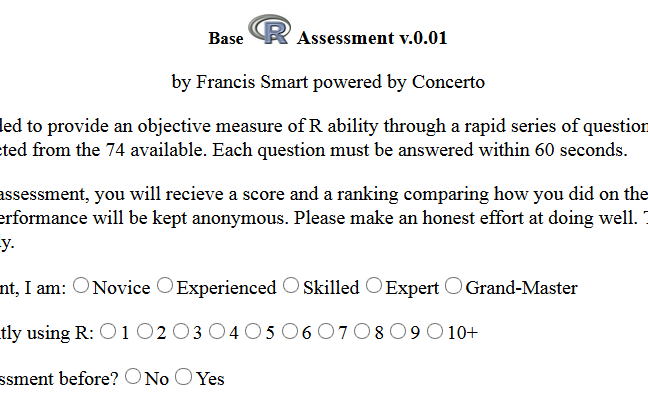
Fancy testing your R skills? There is an Base R Assessment written by Francis Smart now available. Presents a good challenge on testing your skills based on 5 different skill levels.

The tests are slightly slow at the moment but worth a go to challenge yourself.

R Test

Source: http://www.econometricsbysimulation.com/2015/02/base-r-assessment.html

Share this:

  • Share on Facebook (Opens in new window) Facebook
  • Share on LinkedIn (Opens in new window) LinkedIn
  • Email a link to a friend (Opens in new window) Email
  • Share on Pinterest (Opens in new window) Pinterest
  • Share on Reddit (Opens in new window) Reddit
  • Share on X (Opens in new window) X
  • Share on Tumblr (Opens in new window) Tumblr
  • Share on Pocket (Opens in new window) Pocket
  • Share on Telegram (Opens in new window) Telegram
  • Share on Threads (Opens in new window) Threads
  • Share on WhatsApp (Opens in new window) WhatsApp
  • Share on Mastodon (Opens in new window) Mastodon
  • Share on Bluesky (Opens in new window) Bluesky
  • Share on Nextdoor (Opens in new window) Nextdoor
Like Loading...

Rocking your skills in February

02 Monday Feb 2015

Posted by Max Hemingway in Development, Programming

≈ Leave a comment

Tags

Development, Knowledge, learning, Programming, Proving It

Microsoft have set out a challenge for February through the Microsoft Virtual Academy to Rock your skills over the month through a series of Challenges based on 8 different tracks:

  • Cloud Development
  • Game Development
  • Mobile Development
  • Web Development
  • Hybrid Cloud
  • Identity & Access Management
  • Office 365
  • Sharepoint

I have decided to opt for the Identity & Access Management stream which is 38 Hours of learning and challenges;

Take the challenge to effectively implement identity and access management solutions across diverse devices and hybrid environments that require a strong foundation of skills from enabling single sign-on to extending your domain with Azure AD

This is a good initiative from Microsoft showing how you can group the training available in MVA to a set of identifiable skills in the industry instead of the single courses.

Share this:

  • Share on Facebook (Opens in new window) Facebook
  • Share on LinkedIn (Opens in new window) LinkedIn
  • Email a link to a friend (Opens in new window) Email
  • Share on Pinterest (Opens in new window) Pinterest
  • Share on Reddit (Opens in new window) Reddit
  • Share on X (Opens in new window) X
  • Share on Tumblr (Opens in new window) Tumblr
  • Share on Pocket (Opens in new window) Pocket
  • Share on Telegram (Opens in new window) Telegram
  • Share on Threads (Opens in new window) Threads
  • Share on WhatsApp (Opens in new window) WhatsApp
  • Share on Mastodon (Opens in new window) Mastodon
  • Share on Bluesky (Opens in new window) Bluesky
  • Share on Nextdoor (Opens in new window) Nextdoor
Like Loading...

Ready for Technet Online 2015

27 Tuesday Jan 2015

Posted by Max Hemingway in Cloud, DevOps/OpsDev, Programming

≈ 1 Comment

Tags

Architecture, Cloud, Coding, CPD, Development, DevOps, learning, OpsDev, Programming

I am looking forward to this years TechDays Online 2015 which is being run between the 3rd and 5th February 2015. If you cant make the sessions then they normally appear on Microsoft Virtual Academy a few weeks later.

This is being done over 3 days with a packed agenda that you can dip in and out of as needed.

Day One Theme: Client, Devices and Mobility :

  • Day one: Devices and Managing a Mobile-First World

09:30-09:40 Overview of the Day
09:40-10:15 Delighting your business with EMS
10:30-11:05 Devices, Devices Everywhere
11:20-11:55 Windows 10 Client Innovations
12:10-12:45 KEYNOTE: What IT Pros and Devs Need to Know About the New Microsoft
13:30-14:05 Building IoT solutions today
14:20-14:55 Microsoft Azure Remote App
15:10-15:45 Microsoft Azure RMS
16:00-16:35 Azure Active Directory: Much more than a user store
16:50-17:25 Microsoft Intune/SCCM
17:25-17:30 Wrap up of day 1 – Part 1

  • Day one evening: An evening with Office 365

18:30-19:05 Migration of your mailboxes to Office 365
19:15-19:50 Keeping in touch with the online world
20:00-20:35 Building online collaboration inside Office 365
20:35-20:45 Final thoughts for the day

Day Two Theme: Server and Cloud:

  • Day two: The Journey to the Cloud-first World

09:30-09:40 Overview of the Day
09:40-10:15 What’s new Windows Server /Hyper –V – a technical preview
10:30-11:05 How to find out what’s happening in your datacentre with Azure Insights
11:20-11:55 Host your own cloud with the Windows Azure Pack
12:10-12:45 Taking scripting to the next level with Service Management / Azure Automation
13:30-14:05 A new home for your old applications ↓
14:20-14:55 20% + of Azure runs on Linux – why is this important and how to do it well?
15:10-15:45 DevOps in Microsoft Azure with Chef and Puppet for heterogeneous cloud environments
16:00-16:35 Make Azure your DMZ
16:50-17:25 Microsoft Corporate Keynote
17:25-17:35 Wrap up of Day 2

Day Three Theme: Developer

  • Day three: Multi-device, Cross-platform Development

09:30-09:40 Overview of the Day
09:40-10:25 Creating cross-platform apps with Visual Studio
10:40-11:25 How are you going to deploy that?
11:40-12:25 Microsoft Azure Machine Learning without a PhD
13:00-13:45 Debugging and Performance Tuning Web Apps and Sites
14:00-14:45 What is Roslyn and why should you care?
15:00-15:45 Building cross-platform apps with .NET and ASP.NET
16:00-16:45 Creating cross-platform cloud apps for mobile devices
17:00-17:45 Microsoft Corporate Keynote
17:45-17:55 Wrap-up of Tech.Days Online Day 3

Share this:

  • Share on Facebook (Opens in new window) Facebook
  • Share on LinkedIn (Opens in new window) LinkedIn
  • Email a link to a friend (Opens in new window) Email
  • Share on Pinterest (Opens in new window) Pinterest
  • Share on Reddit (Opens in new window) Reddit
  • Share on X (Opens in new window) X
  • Share on Tumblr (Opens in new window) Tumblr
  • Share on Pocket (Opens in new window) Pocket
  • Share on Telegram (Opens in new window) Telegram
  • Share on Threads (Opens in new window) Threads
  • Share on WhatsApp (Opens in new window) WhatsApp
  • Share on Mastodon (Opens in new window) Mastodon
  • Share on Bluesky (Opens in new window) Bluesky
  • Share on Nextdoor (Opens in new window) Nextdoor
Like Loading...

Imagine Programming

20 Tuesday Jan 2015

Posted by Max Hemingway in Programming

≈ Leave a comment

Tags

Development, learning, Programming

Following on from my post on Doctor Who: Friendly Dalek teaches you to code, Microsoft have Microsoft Imagine which is another initiative to take the younger and older generations through coding using simple tools and encourages them to develop games and applications (no Cybermen to shoot here though).

Games Development using:

  • Kodu Game Lab
  • TouchDevelop
  • Project Spark
  • SmallBasic
  • Free Tools
  • Online Learning

Apps Development using:

  • TouchDevelop
  • Windows App Studio
  • SmallBasic
  • WebMatrix
  • Free Tools
  • Online Learning

“We want to empower students of all ages and skill levels with the right tools, projects, and opportunities so that they can learn to create, code, and develop. Whether it’s a ten-year-old making her first game or a university senior building projects for their first job application, Microsoft can provide what they need, for free, today.” – Steve Guggenheimer, Microsoft

The race is on to capture the developing and programming community with new, easy and innovative ways to create games and apps.

Sources:

http://msdn.microsoft.com/en-us/imagine
http://blogs.msdn.com/b/stevengu/archive/2014/12/08/introducing-microsoft-imagine-for-student-developers-of-all-ages.aspx

Share this:

  • Share on Facebook (Opens in new window) Facebook
  • Share on LinkedIn (Opens in new window) LinkedIn
  • Email a link to a friend (Opens in new window) Email
  • Share on Pinterest (Opens in new window) Pinterest
  • Share on Reddit (Opens in new window) Reddit
  • Share on X (Opens in new window) X
  • Share on Tumblr (Opens in new window) Tumblr
  • Share on Pocket (Opens in new window) Pocket
  • Share on Telegram (Opens in new window) Telegram
  • Share on Threads (Opens in new window) Threads
  • Share on WhatsApp (Opens in new window) WhatsApp
  • Share on Mastodon (Opens in new window) Mastodon
  • Share on Bluesky (Opens in new window) Bluesky
  • Share on Nextdoor (Opens in new window) Nextdoor
Like Loading...

Doctor Who: Friendly Dalek teaches you to code

09 Friday Jan 2015

Posted by Max Hemingway in Programming

≈ 2 Comments

Tags

Coding, Development, learning, Programming

The BBC has announced a novel way to bring coding/programming to youngsters ( following the latest UK Governments initiative to bring the next generation of IT professionals)

Using a Time Lord and their most dangerous adversary to teach 6 to 12 year old’s how to code.

The BBC has unveiled a computer game called The Doctor and the Dalek, as part of the Make it Digital initiative to get more young people into computer coding.

It is voiced by Peter Capaldi and the story, starring a friendly Dalek, is written by Doctor Who series writer Phil Ford.

A browser game playable over the internet, it is aimed at six to 12-year-olds.

The coding challenges are linked to the curriculum and can be mapped against Key Stage 2 and 3 learning outcomes.

Source: http://www.bbc.co.uk/news/technology-29645991

Dr Who Game Screeshot 1

Going forward the BBC have plans to increase their footprint of bringing knowledge to the next generation under their “Make It Digital” initiative.

Alongside these BBC Learning projects we have some exciting children’s programmes coming out this Autumn that will help inspire our youngest audiences to discover the digital world and to take their journeys of digital discovery further. Dick & Dom’s Absolute Genius will become Appsolute Genius, Technobabble will look at the technology which will shape children’s lives, and Nina and the Neurons will go digital.

Source: http://www.bbc.co.uk/mediacentre/latestnews/2014/computing-coding

I have been using this with my kids to teach them some of the basics of coding and they have found the gameplay linked in with the coding tasks enjoyable. It was good to see them working round the problems presented to try and reduce the amount of commands used to match or beat the targets set.

Dr Who Game Screenshot 2

Yes I did do the challenges myself and also enjoyed it.

If you want to play the game you can find “The Doctor and the Dalek” at http://www.bbc.co.uk/cbbc/games/doctor-who-game

There is a lot of rising opportunities for the younger generations to now learn coding and computing from an early age. The UK Government has included a national curriculum for Key Stage 1 and 2.

The curriculum is available at http://www.computingatschool.org.uk/data/uploads/primary_national_curriculum_-_computing.pdf

This move should bolster entrants into the IT Industry in the future and more choosing it as a career, however also drive towards the Era of the Contextual Web. This generation of young people will develop key skills at an early age that they can just create the tools and applications that they need when they want them. Maybe they wont spend much time playing the xBox or Playstation, but coding them instead.

The next level of Innovation and entrepreneurship may just come from a 10-11 year old.

Share this:

  • Share on Facebook (Opens in new window) Facebook
  • Share on LinkedIn (Opens in new window) LinkedIn
  • Email a link to a friend (Opens in new window) Email
  • Share on Pinterest (Opens in new window) Pinterest
  • Share on Reddit (Opens in new window) Reddit
  • Share on X (Opens in new window) X
  • Share on Tumblr (Opens in new window) Tumblr
  • Share on Pocket (Opens in new window) Pocket
  • Share on Telegram (Opens in new window) Telegram
  • Share on Threads (Opens in new window) Threads
  • Share on WhatsApp (Opens in new window) WhatsApp
  • Share on Mastodon (Opens in new window) Mastodon
  • Share on Bluesky (Opens in new window) Bluesky
  • Share on Nextdoor (Opens in new window) Nextdoor
Like Loading...

Learn a Programming Language – But which one?

08 Thursday Jan 2015

Posted by Max Hemingway in Programming

≈ 5 Comments

Tags

Coding, Development, Infographic, Programming, Tools

If you want to get into the realms of programming and coding by learning a language or learn a new language, then this infographic from carlcheo.com is a good place to start.

which-programming-language-should-i-learn-first-infographic

(Click diagram for a larger version)

PDF Version available at: http://cdn3.carlcheo.com/wp-content/uploads/2014/12/which-programming-language-should-i-learn-first-pdf.pdf

Comparing coding languages as characters from Lord of the Rings, rating them on difficulty, popularity and use gives an interesting overview of each.

There are also useful links on the site (http://carlcheo.com/startcoding) to a series of training courses, books and tutorials (of which a lot are free resources) based on

  • Python
  • Java
  • C/C++
  • Javascript
  • C#
  • Ruby
  • PHP
  • Objective-C
  • For Kids

Linking this with some other training recommendations by searching on http://stackoverflow.com you will be well on the way to learning your next language.

Source: http://carlcheo.com/startcoding

Share this:

  • Share on Facebook (Opens in new window) Facebook
  • Share on LinkedIn (Opens in new window) LinkedIn
  • Email a link to a friend (Opens in new window) Email
  • Share on Pinterest (Opens in new window) Pinterest
  • Share on Reddit (Opens in new window) Reddit
  • Share on X (Opens in new window) X
  • Share on Tumblr (Opens in new window) Tumblr
  • Share on Pocket (Opens in new window) Pocket
  • Share on Telegram (Opens in new window) Telegram
  • Share on Threads (Opens in new window) Threads
  • Share on WhatsApp (Opens in new window) WhatsApp
  • Share on Mastodon (Opens in new window) Mastodon
  • Share on Bluesky (Opens in new window) Bluesky
  • Share on Nextdoor (Opens in new window) Nextdoor
Like Loading...
Newer posts →

Follow Me on LinkedIn

www.linkedin.com – Click to Follow 

RSS Feed

RSS Feed RSS - Posts

Other Publications I contribute to

https://sparrowhawkbushcraft.com/

Recent Posts

  • 35 Informative Tech Websites for 2026: Enhance Your PKMS
  • Unlocking the Benefits of Journaling
  • Mastering Engaging Presentations: Tips for Captivating Your Audience
  • The Business Value of Enterprise Architecture Explored
  • Celebrating 150+ Hours of STEM Impact

Categories

  • 21st Century Human
  • 3D Printing
  • AI
  • Applications
  • ArchiMate
  • Architecture
  • Arduino
  • Automation
  • BCS
  • Big Data
  • Certification
  • Climate Change
  • Cloud
  • Cobotics
  • Connected Home
  • Data
  • Data Fellowship
  • Data Science
  • Development
  • DevOps/OpsDev
  • Digital
  • DigitalFit
  • Drone
  • Enterprise Architecture
  • F-TAG
  • Governance
  • Health
  • Innovation
  • IoT
  • IT Strategy
  • Machine Learning
  • Metaverse
  • Micro:Bit
  • Mindset
  • Mobiles
  • Networks
  • Open Source
  • Podcasts
  • Productivity
  • Programming
  • Quantum
  • Raspberry Pi
  • Robotics
  • Scouting
  • Scouts
  • Security
  • Smart Home
  • Social Media
  • Space
  • STEM
  • Story Telling
  • Technologists Toolkit
  • Tools
  • Uncategorized
  • Wearable Tech
  • Windows
  • xR

Archives

Reading Shelf

Archives

Recent Posts

  • 35 Informative Tech Websites for 2026: Enhance Your PKMS
  • Unlocking the Benefits of Journaling
  • Mastering Engaging Presentations: Tips for Captivating Your Audience
  • The Business Value of Enterprise Architecture Explored
  • Celebrating 150+ Hours of STEM Impact

Top Posts & Pages

  • 35 Informative Tech Websites for 2026: Enhance Your PKMS
  • Unlocking the Benefits of Journaling
  • My Virtual Selfie - Avatars and Identity Security
  • Mastering Performance Under Pressure: The Importance of Training
  • A-Z of Digital – Z is for Zabeta
  • The Importance of ArchiMate and UML in Modern Organisations
  • Technology Couch Podcast – Episode 3
  • Stay Ahead of the Curve: Essential Strategies for Technologists to Stay Informed
  • 2026 PKMS Updates: Boost Productivity and Knowledge Retention
  • Lunch? No I've got a meeting!

Category Cloud

21st Century Human Architecture Big Data Cloud Data Data Science Development DevOps/OpsDev Digital DigitalFit Enterprise Architecture Governance Innovation IoT Machine Learning Mindset Open Source Podcasts Productivity Programming Raspberry Pi Robotics Security Social Media STEM Story Telling Technologists Toolkit Tools Uncategorized Wearable Tech

Tags

3D Printing 21st Century Human AI Applications ArchiMate Architecture Automation BCS Big Data Blockchain business Certification Cloud Cobot Cobotics Coding Communication Connected Home CPD cybersecurity Data Data Fellowship Data Science Delivery Development DevOps Digital DigitalFit Digital Human Drone Email Enterprise Architecture Governance GTD Infographic Information Theory Innovation IoT Journal Knowledge learning Machine Learning Metaverse MicroLearning Mindset Mixed Reality Networks Open Source OpsDev PKMS Podcasts Productivity Programming Proving It Quantum quantum-computing R RaspberryPI Robot Robotics Scouts Security Smart Home Social Media STEM Story Telling Technologists Toolkit technology Technology Couch Podcast Thinking Tools Visualisation Voice Wearable Tech xR

License

Creative Commons Licence
This work is licensed under a Creative Commons Attribution-NonCommercial-ShareAlike 4.0 International License.

Meta

  • Create account
  • Log in
  • Entries feed
  • Comments feed
  • WordPress.com

Blog at WordPress.com.

  • Subscribe Subscribed
    • Max Hemingway
    • Join 82 other subscribers
    • Already have a WordPress.com account? Log in now.
    • Max Hemingway
    • Subscribe Subscribed
    • Sign up
    • Log in
    • Report this content
    • View site in Reader
    • Manage subscriptions
    • Collapse this bar
 

Loading Comments...
 

    %d