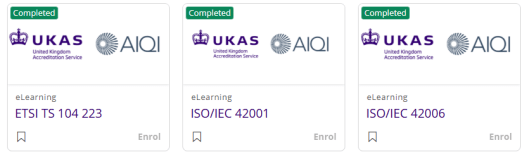
The AIQI Consortium has recently expanded its portfolio of educational offerings related to ISO standards and AI security controls. Following my previous experience with the ISO/IEC 42001 course, I have complete the next two and can recommend these to anyone wanting a greater understanding of the standards and looking to implement them.
Courses Offered
ISO/IEC 42001: Provides foundational knowledge of ISO standards specifically designed for Artificial Intelligence Management Systems. The course delves into the principles, requirements and implementation strategies necessary for compliance.
ISO/IEC 42006: Extends the learning to cover additional protocols and auditing techniques, focusing on advanced elements within the ISO framework. Learners gain exposure to practical applications and case studies relevant to complex organisational environments.
ETSI TS 104 223: Offers a comprehensive overview of the European Telecommunications Standards Institute technical specification, with a particular emphasis on AI security controls and risk management. The course equips participants with the tools to assess and enhance security measures within AI-driven systems.
Course Structure and Format
Each course is well structured, providing a good overview and understanding of the standards and ensuring a logical progression from fundamental concepts to more advanced topics. The modules are clearly organised, featuring worked examples and detailed guidance on auditing processes.
Where to take the courses
All three courses (ISO/IEC 42001, ISO/IEC 42006, and ETSI TS 104 223) are available on the UKAS website (enrollment required).
Technology may operate through flashing lights, chips, logic, algorithms and code, yet every genuine advancement starts with something innately human. Beneath every illuminated screen and every written line of code lies curiosity, the powerful, persistent force propelling us to explore, experiment and imagine.
From the first glimmer of an unconventional idea to the determined effort required to realise an improbable dream, it is our creativity, passion and curiosity that infuse technology with life and mould the digital future.
The Human Element: Asking “What If?”
Computers excel at processing information at astonishing speeds, but it is humans who pose the question “What if?”. This essential question embodies curiosity, turning technology from something functional into something truly revolutionary.
Throughout history, trailblazers have personified this spirit.:
Ada Lovelace envisioned machines that could do more than simple calculations.
Alan Turing not only deciphered codes but also laid the theoretical groundwork for artificial intelligence by asking, “Can a machine think?”
The most significant breakthroughs occur when determined individuals challenge norms and conceive solutions that no machine could ever dream up on its own.
Cultivating the Innovator’s Mindset
Innovation is not a rare secret, it is a cultivated habit. To foster it:
Embracing Radical Questions: Do not hesitate to ask “why not?” or challenge longstanding assumptions. Such straightforward questions often ignite major ideas.
Collaborating Wildly: Engage with people beyond your immediate discipline. Diverse perspectives and cross-disciplinary teamwork are powerful drivers for original solutions.
Experimenting Fearlessly: Consider every setback not as a failure but as critical data. Every test, refinement and adjustment moves you closer to a breakthrough.
Creating Safe Space for Ideas: Innovation flourishes when teams feel free to share bold, unconventional concepts without fear of criticism or judgement.
Harnessing AI as an Assistant: Leverage Artificial Intelligence (AI) to enhance your creative process. AI can help generate new ideas, identify patterns in data you might overlook and automate repetitive tasks. This can help free up more time for experimentation and bold thinking. By using AI as a collaborator rather than just a tool, you can quickly test hypotheses, prototype solutions and gain fresh insights, all while maintaining the uniquely human spark that drives innovation.
Creativity: The Catalyst for Redefinition
Creativity turns a technical obstacle into a transformative opportunity.
Steve Jobs did not invent the computer, but he reimagined it. Transforming a complex technical instrument into a sleek, intuitive device that revolutionised daily life.
The team at DeepMind redefined artificial intelligence by teaching it to learn and play games (such as Go) modelling how people master intricate subjects.
These innovators did not merely improve what already existed; they redefined what was possible by daring to adopt a fresh perspective.
AI can also act as a creative partner, from generating design concepts and composing music to suggesting code improvements. AI can spark unexpected connections and offer alternatives you might not have considered. It provides not only efficiency but also an expanded canvas for human ingenuity.
Harnessing Creative Energy
To convert curiosity into real progress:
Look Beyond Your Industry: Seek inspiration from art, nature and everyday experiences. Solutions frequently originate from unexpected analogies.
Build an Iteration Loop:Test, learn, and iterate constantly. Rapid prototyping is a practical method for asking increasingly complex “what if” questions.
Take a Strategic Pause: Occasionally, stepping away from your work is the best route to a breakthrough. Reflection and a fresh viewpoint are invaluable.
Utilise AI for Creative Exploration: Use AI-powered tools to brainstorm alternatives, simulate scenarios, and visualise outcomes. AI can help you rapidly test new ideas, uncover hidden relationships and even provide creative prompts when you feel stuck, acting as a catalyst for your next breakthrough.
The Twin Engines: Curiosity and Passion
Curiosity raises the questions; passion discovers the answers. Together, they fuel the persistence required to overcome obstacles and turn nebulous visions into concrete realities.
Tim Berners-Lee was curious about enabling information to flow effortlessly across a global network. This curiosity led to the creation of the World Wide Web. It was his passion for an open, interconnected world that ensured the idea was pursued tirelessly and ultimately shared.
To sustain these vital engines:
Never Stop Learning: Curiosity is a flame that grows with new knowledge. Pursue subjects that truly fascinate you, even if they do not relate directly to your current work. AI can support lifelong learning by recommending resources, summarising complex materials and connecting you with experts and communities worldwide.
Embrace Serendipity: Welcome surprises, fortunate accidents, and unexpected discoveries. Many innovations originate from exploring something new. AI algorithms can sometimes surface surprising insights or connections in vast amounts of information, leading to opportunities you might not have found alone.
Share Your Enthusiasm: Passion is infectious. Sharing your excitement attracts collaborators, builds momentum, and makes the lengthy process of innovation rewarding. With AI-powered platforms, it’s easier than ever to connect with like-minded peers, showcase your projects and gather feedback globally.
Conclusion
As technology advances at an unprecedented pace, one truth remains: the true engine of innovation is not the code we craft or the silicon we use – it is the human spark within us. Our creativity, curiosity, and passion fuel the discoveries that truly shape the future.
Whether you are a developer, designer, entrepreneur or simply a deeply curious individual your most powerful tool is not the technology at your disposal, but the imagination that guides it.
Artificial intelligence is a remarkable ally, amplifying our strengths and extending our reach, but it is only through human ingenuity and vision that technology becomes truly transformative.
“Keep exploring. Keep dreaming. Keep asking why. Don’t settle for what you already know. Never stop believing in the power of your ideas, your imagination, your hard work to change the world.”
― Barack Obama
Ultimately, it is people (not machines) who make technology truly remarkable. AI may assist, but it is the uniquely human qualities of curiosity, passion and creativity that turn possibility into reality.
The course is aimed at Implementation Teams and Senior Leadership, however I would recommend this course having just completed it myself to anyone interested in AI and wanting to know more about the standard.
The learning objectives set out on the AIQI website are:
Understand the structure and key requirements of ISO/IEC 42001
Identify and analyze organizational context and requirements for AI management systems
Apply the standard’s framework to implement an effective AI management system
Understand relationships and differences between the standard and other relevant AI policies
I would recommend the course to anyone wanting a greater understanding of ISO 42001 and looking to implement it. The course contains a lot of useful information and is well structured and formatted stepping through the standard and how it can be implemented. Also how the standard works with other standards and frameworks.
The course also provides a workbook that can be downloaded to help through the course, but more importantly used with your business/organisation when looking to implement the standards.
It would have been nice to see a digital badge awarded at the end, however here is a screen grab of my completion of the course.



 Max Hemingway