
Stepping onto a stage to deliver a presentation or a story, your voice is your most influential tool. Mastering the art of modulation though changing your pitch, pace and power can transform not only the way you speak but also how your message is received.
What Is Modulation?
Modulation is all about change. It is the dynamic variation in pitch (how high or low your voice sounds), pace (the speed at which you speak) and power (the intensity and emotion behind your words).
A well-modulated voice offers a pleasing rise and fall in tone, adjusts speed to match the mood and shifts intensity to suit the subject matter. This interplay of vocal elements adds colour and expressiveness to your speech, making it engaging and memorable.
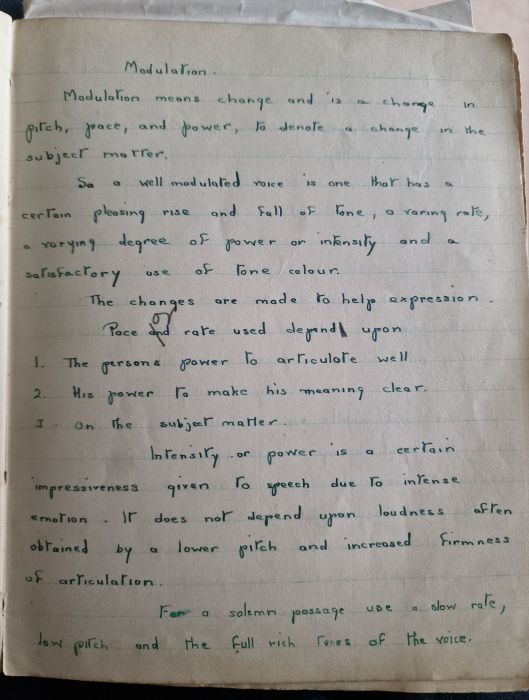
Modulation means change and is a change in pitch, pace and power, to denote a change in the subject matter.
So a well modulated voice I one that has a certain pleasing rise and fall of tone, a varying rate, a varying degree of power or intensity and a satisfactory use of tone colour.
The changes are made to help expression. Pace or rate used depend upon
- The persons power to articulate well
- Their power to make their meaning clear
- On the subject matter
Intensity or power is a certain impressiveness given to speech due to intense emotion. It does not depend upon loudness often obtained by a lower pitch and increased firmness of articulation.
For a solemn passage use a slow rate, low pitch and the full rich tones of the voice.
For great sorrow, slow rate low pitch and the tone rather heavy.
For joyful passages quick rate, high pitch and the voice rather light in quality
For descriptions or reflective pieces use a moderate rate and the middle pitch
Excerpt from my grandmothers notebook.

Why Modulation Matters
Imagine listening to someone who speaks in a flat, unchanging monotone. No matter how compelling the content, the delivery quickly becomes tedious. Modulation on the other hand, breathes life into your voice, helping you articulate clearly and convey meaning effectively. It is not just about sounding good, but making your audience feel the emotions and understand the nuances of your story or presentation.
Practical Tips for Modulating Your Voice
- Know Your Subject: Modulation should reflect changes in your content. Shift your pitch and pace to match the emotion or gravity of what you are saying.
- Articulate Clearly: The ability to enunciate well is key. Modulation can help you stress important points and clarify your message.
- Emphasise Emotion: Power or intensity in speech comes from genuine emotion, not just volume. Sometimes, a lower pitch with firmer articulation conveys solemnity far better than shouting.
Modulation for Different Moments
| Scenario | Pace | Pitch | Quality of Voice |
| Solemn Passage | Slow | Low | Full, rich tones |
| Great Sorrow | Slow | Low | Heavy, sombre |
| Joyful Passage | Quick | High | Light, bright |
| Descriptive or Reflective Piece | Moderate | Middle | Balanced, thoughtful |
Bringing It All Together
Next time you prepare a talk or craft a story, remember that your voice is a versatile instrument. With intentional modulation, your words will resonate long after you’ve spoken them.




 Max Hemingway
Leave a comment