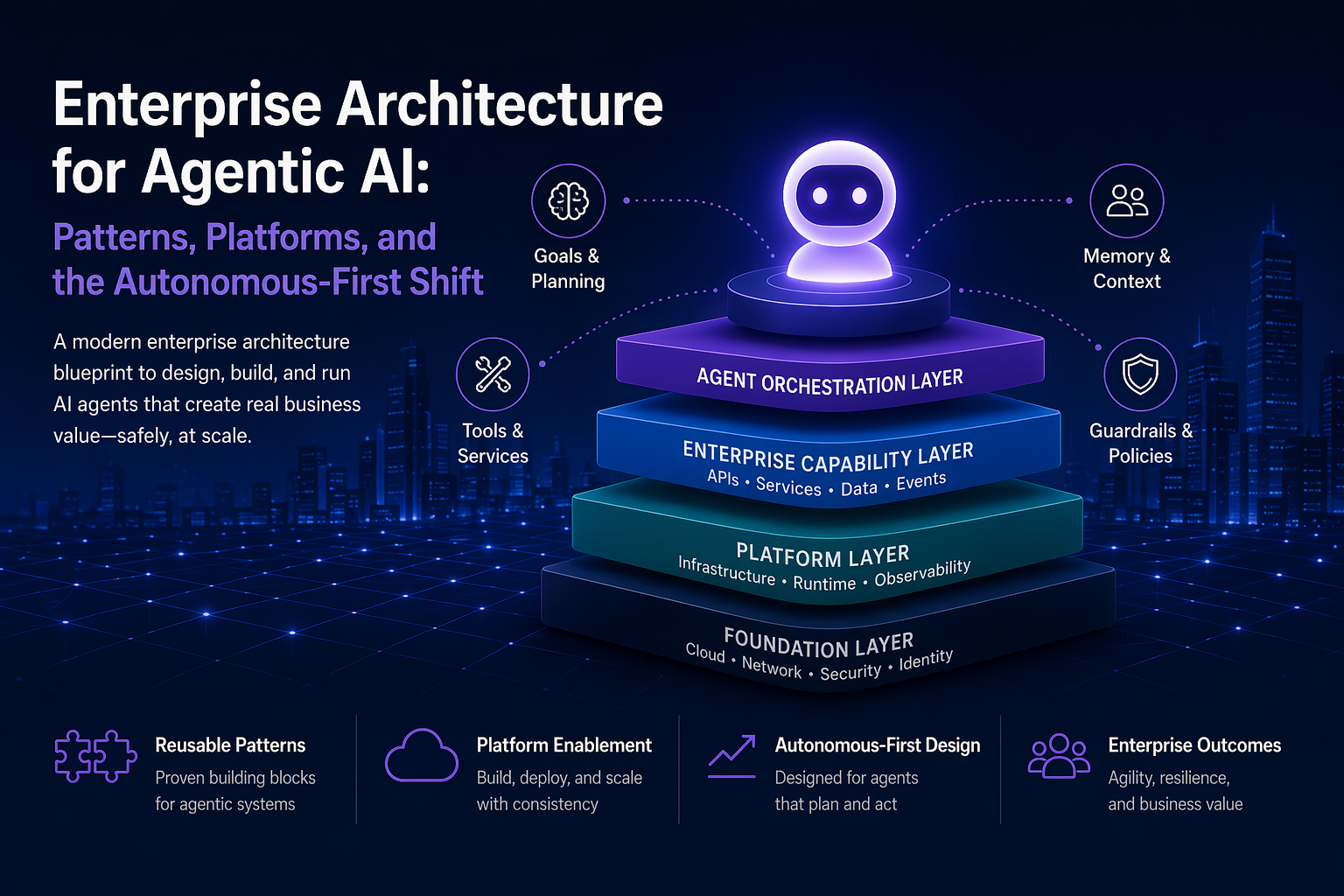
From Human Bandwidth Constraints to Agentic AI Systems
Part 1 of a two-part series
Enterprise architecture has long been designed around a fundamental constraint: Human Bandwidth.
Every workflow, approval chain and integration pattern assumed that a person would interpret context, make decisions and initiate actions. This assumption shaped decades of system design (from monolithic Enterprise Resource Planning (ERP) implementations to Service Oriented Architectures(SOA) ) all optimised for human cognitive throughput as the binding constraint.
Research indicates that this era is drawing to a close. The pace of that transition will depend on several factors, including the development and adoption of effective AI agents and tooling (many of which are already emerging) and the willingness of businesses and organisations to embrace AI-driven ways of working.
What’s certain is that the Enterprise Architecture landscape is on the brink of significant change..
- Gartner predicts that 40% of enterprise applications will feature task specific AI agents by the end of 2026, up from less than 5% in 2025.
- By 2028, an average Fortune 500 enterprise will have over 150,000 agents in use, up from fewer than 15 in 2025 – Gartner.
- McKinsey projects that agentic AI could unlock $2.6-$4.4 trillion annually in value across more than 60 use cases.
This indicates it is not incremental change, but an architectural phase transition.
“Eighty percent of CEOs expect AI to force a high to medium degree of change to their operational capabilities, shifting the focus from digital business to autonomous business.”– Source: Gartner, April 2026
The implications for Enterprise Architects are profound. Systems designed to wait for human input, route decisions through approval hierarchies and batch process information overnight cannot support agents that reason, act and coordinate in real time.
The architecture itself must become autonomous first.
➤Part 2 of this series will explore how governance becomes the runtime infrastructure that makes autonomous execution trustworthy and auditable.
The Industry Consensus
The major analyst firms have converged on a shared conclusion: Enterprise Architecture must be fundamentally reimagined for autonomous execution, though they differ on the pace and pathway.
Gartner frames this as the transition from “digital business” to “autonomous business,” urging enterprise architecture leaders and heads to adopt dynamic state architectures and autonomous technologies to build self managing systems that minimise human intervention.
At Google Cloud Next 2026, Gartner observed a coordinated shift toward “agent-centric enterprise architecture” where infrastructure, data platforms and governance are reorganised to treat agents as first class workloads.
Critically, Gartner expects agentic orchestration to redirect $550 billion in global software and services spend by 2029.
McKinsey identifies two architectural paths: incremental integration (deliberately adding agentic AI into existing systems over time) versus comprehensive transformation, requiring a complete organic overhaul to support agentic workflows.
“Unlocking the full potential of agentic AI requires more than plugging agents into existing workflows — it calls for reimagining those workflows from the ground up, with agents at the core.” – Source: McKinsey, 2026
Forrester proposes the “agentic business fabric” as the new architectural paradigm. An integrated network of six core capabilities (experience layer, agent fabric, application mesh, data/AI layer, business logic and governance) designed for autonomous operation and perpetual learning.
However, Forrester also provides a sobering counterpoint. Governance challenges will keep most organisations running deterministic automation through 2026 despite vendor pressure to adopt agentic features.
This tension between aspiration and readiness defines the current moment.
Architectural Patterns for Autonomous Execution
Several distinct architectural patterns are emerging to support autonomous execution at enterprise scale. Understanding these patterns is essential for architects designing systems that can accommodate agents as first class participants rather than afterthoughts.
The Agentic Mesh
The most significant departure from traditional integration architecture. McKinsey describes AI agents that “operate on their own or collaborate within an agentic mesh, a network where agents coordinate seamlessly with other agents, tools, and transactional systems”.
Gartner describes a complementary concept (the “real time context mesh”) enabling agents to “discover state, reason across systems and trigger actions securely at enterprise scale”.
Together, these patterns replace rigid point-to-point integrations with dynamic, context aware coordination networks.
Event-Driven Architecture for Agents
Rather than direct API calls between agents, event driven architecture replaces point-to-point connections with a publish, subscribe model centred around a message broker. Source: HiveMQ, 2026.
In practice, microservices publish domain events to a durable event broker, a streaming layer computes live state and AI agents query that live state through standard database interfaces. Source: RisingWave, 2026.
This enables agents to react to business events in real time without tight coupling to specific systems.
Execution Control Planes and Agent Gateways
The execution control plane is the operational backbone for governed autonomy. A centralised enforcement and observability layer that ensures every AI initiated action is policy-evaluated, explicitly authorised, identity bound and recorded before execution proceeds. Agent gateways provide unified registries, step-level observability, role-based access contro, and governed tool access.
➤ Part 2 of this series will explore execution control planes in depth, including the structured governance artifacts, five component reference model and algorithmic circuit breakers that provide hard stop safety.
Gartner’s Three-Pillar Approach
Gartner synthesises these patterns into an actionable framework: exposing AI-consumable interfaces, implementing a centralised AI control layer for governance, and providing access to agent-ready data. Source: Gartner/Kong, 2026.
Composable architecture supports agentic AI via multigrained back-end services and API mediation to enable multiexperience front-ends, including AI agents. Source: Gartner, 2026.
Data Architecture as the Foundation
Autonomous agents impose fundamentally different demands on data infrastructure. Agentic AI requires sub-millisecond latency, millions of transactions per second, and consistency across distributed environments. Source: Aerospike, 2026
Traditional batch-oriented data warehouses and overnight ETL processes cannot serve agents that must reason and act in real time.
“Ontologies, semantic layers, and knowledge graphs are rapidly becoming core architectural components. They provide what agentic systems lack in traditional data environments: a shared language, explicit relationships, and machine-readable context.” Source: Forrester
An AI agent operating autonomously needs business meaning made explicit, governed, and machine-readable, not embedded in the heads of the data team. Source: Salesforce
Governance: The Decisive Capability Gap
Perhaps the most critical insight emerging from industry practice is that governance for autonomous systems is not a policy document. It is runtime infrastructure.
The numbers are stark: only 21% of organisations have mature governance for autonomous AI agents, while 73% are concerned about AI security and data privacy risks.
McKinsey reports that 80% of organisations have encountered risky behaviour from AI agents
“A long-running agent doesn’t behave like a chatbot: it behaves like a distributed system, and distributed systems demand orchestration, identity, and context discipline that most companies have never built.” Source: Forrester
➤ Part 2 of this series will explore the architectural patterns for runtime governance (execution control planes, algorithmic circuit breakers, proportional governance models and decision-context logging).
The Organisational Shift
The shift to autonomous execution demands more than new technology. It requires fundamentally different organisational models.
IDC expects 60% of G2000 companies to adopt a formal Agent Development Life Cycle by 2028.
New roles are emerging rapidly. According to Forbes, citing McKinsey, Box and LinkedIn, key new positions include:
- AI Agent Architect
- Context Engineer
- Forward Deployed Engineer
- AI Governance Lead
- AI Enablement Lead
AI Engineer is the fastest-growing job title in the US for two consecutive years. Source: Forbes
These roles reflect a shift from building software to orchestrating outcomes. What practitioners are calling “outcome engineering.”
“Agentic AI requires a fundamentally different approach to process design. Not automating what exists today, but rebuilding workflows from a blank sheet.” Source: Dell CIO
This is perhaps the hardest organisational challenge, resisting the temptation to simply layer agents onto existing processes and instead reimagining how work gets done when human bandwidth is no longer the binding constraint. Source: SiliconAngle
Seven Principles for the Autonomous-First Architect
Synthesising across industry analyst guidance, practitioner experience and emerging implementations, seven principles emerge for enterprise architects navigating this transition:
| No. | Principle | Description |
| 1 | Treat governance as infrastructure, not documentation | Build execution control planes, decision-context logging, and circuit breakers before scaling agent deployments. Policy without runtime enforcement is meaningless. (Explored in depth in Part 2 of this blog series.) |
| 2 | Design interfaces for machine consumption first | APIs, data schemas, and service contracts must be optimised for agent reasoning, not human readability. This inverts decades of design priority. |
| 3 | Treat every agent as a governed identity | Each agent needs unique credentials, least-privilege access, and full logging. Just as human users do. Long running agents behave like distributed systems. |
| 4 | Compress planning cycles radically | Foundational architectural choices must now be made in months, not years. Adopt iterative architecture practices and accept that the target state will evolve continuously. |
| 5 | Invest in semantic infrastructure | Knowledge graphs, ontologies, and semantic layers provide the machine-readable context that agents need to reason effectively. Without explicit business meaning, agents cannot operate autonomously with confidence. |
| 6 | Choose your transformation path deliberately | Incremental approaches preserve institutional knowledge but accumulate technical debt; comprehensive transformation sets up long-term success but creates short-term vulnerability. Most enterprises will need a hybrid approach. |
| 7 | Redesign workflows from first principles | Ask: if human bandwidth were unlimited and decisions could be made in milliseconds, how would this workflow be designed? That is the architecture autonomous agents require. |
Connecting to Optionality
In my earlier post Designing for Optionality in Enterprise Architecture, I argued that architects should design systems that preserve future choice rather than optimising for a single predicted outcome. The autonomous execution imperative amplifies this principle dramatically.
When agents can reason, coordinate and act independently, the combinatorial space of possible system behaviours expands exponentially. Architecture must provide the guardrails and governance that keep this expanded possibility space productive rather than chaotic. Optionality is no longer just about preserving human choice — it’s about designing the boundaries within which autonomous systems can safely explore and execute.
Conclusion
Enterprise architecture stands at an inflection point comparable to the shift from mainframe to client-server or from on-premises to cloud. The move from human bandwidth centric to autonomous first architecture is not optional. It is being driven by economic forces (trillions in potential value), competitive pressure (compressed planning horizons) and technological capability (agents that can reason, coordinate and act independently).
The enterprises that will thrive are those that recognise this transition demands architectural courage. Not merely adding agents to existing systems, but reimagining how systems, data, governance and organisations work when autonomous execution becomes the default mode of operation.
The window for deliberate architectural choice is measured in months, not years. Enterprise architects who act now, building governance infrastructure, designing agent consumable interfaces and reshaping organisational models, will define the autonomous enterprise. Those who wait will find themselves governing systems they no longer understand.
The rate of adoption will depend on the interplay of push and pull.
- From above: market forces, business appetite, regulatory pressure and competitive threat compressing decision timelines.
- From below: EA practitioner demand for better tooling, clearer career pathways and demonstrable influence over outcomes.
The gap between these forces is closing fastand the organisations caught in the middle without a deliberate position will find adoption happening to them rather than through them.
➤ Part 2 of this series will explore how governance becomes the runtime infrastructure that makes autonomous execution trustworthy and auditable.
References and Further Reading
- “Gartner Predicts 40% of Enterprise Apps Will Feature Task-Specific AI Agents by 2026,” – Gartner
- Six Steps to Manage AI Agent Sprawl – Gartner
- Deploying Agentic AI with Safety and Security – McKinsey
- “80% of CEOs Say AI Will Force Operational Capability Overhauls” – Gartner
- Lessons for Enterprise IT Leaders: Google Cloud Next – Gartner
- “Agentic Orchestration Emerges As $550B AI Control Plane” – Gartner
- Rethinking Enterprise Architecture for the Agentic Era – McKinsey
- Seizing the Agentic AI Advantage – McKinsey
- The End of Business Apps As We Know Them Is Here – Forrester
- Predictions 2026: Automation at the Crossroads – Forrester
- Reimagining Tech Infrastructure for Agentic AI – McKinsey
- Agentic AI Integration: Why Gartner’s Context Mesh Changes Everything– Kong/Gartner
- Benefits of Event-Driven Architecture for AI Agent Communication – HiveMQ
- Event-Driven Architecture in 2026 – RisingWave
- How to Enable Agentic AI via API-Based Integration – Gartner/Kong
- Adopt Composable Architecture to Support Agentic AI Transformation – Gartner
- Real-time AI Needs High Performance Data Infrastructure – Aerospike
- Why Semantics, Ontologies, and Knowledge Graphs Matter for Agentic AI – Forrester
- Build Trusted Semantic Layers for AI Agents – Salesforce
- Trust in the Age of Agents – McKinsey
- The State of Agentic AI in 2026: Companies Are Chasing, Few Are Catching – Forrester
- Agentic AI Deployment: A Leadership Framework for Executives – IDC
- The 20 New Agentic AI Jobs Box, McKinsey, and LinkedIn All See Coming – Forbes
- Navigating Agent Management and Enterprise Skills Gap – SiliconAngle




Leave a Reply