
Many executives have been told that alignment between business and IT is the hallmark of good governance. Slide decks celebrate it, maturity models reward it and transformation programmes promise it. But many organisations that pride themselves on “strong alignment” can consistently make slow, risk-averse and low-quality decisions.
The uncomfortable truth is this: alignment is often a weak (and sometimes dangerous) proxy for good governance.
Good governance is not about everyone agreeing. It is about making high-quality decisions under uncertainty with the right trade-offs made explicit and owned.
The Seductive Myth of Alignment
In executive settings, alignment usually means:
- Stakeholders appear to agree
- Conflict is minimised
- Decisions pass smoothly through committees
- Messaging is consistent
This looks healthy and feels efficient. It is also frequently illusory.
Alignment, when treated as a primary objective often produces:
- Lowest-common-denominator decisions
- Suppression of dissenting expertise
- Risk deferral rather than risk management
- Architecture by compromise instead of intent
Chris Argyris in his HBR article Teaching Smart People How to Learn describes this as defensive routines. Organisational behaviours that avoid embarrassment or threat at the expense of learning and decision quality.
In other words: False consensus is not alignment. It is avoidance.
Governance Exists to Manage Tension, Not Eliminate It
Effective governance systems are designed to hold productive tension between competing forces:
- Speed vs control
- Innovation vs stability
- Cost vs resilience
- Local optimisation vs enterprise coherence
When governance optimises for alignment, it collapses these tensions prematurely.
By contrast, high-performing enterprises institutionalise disagreement:
- Architecture reviews surface trade-offs, not approvals
- Investment decisions force explicit prioritisation
- Risk discussions separate risk appetite from risk perception
The TOGAF Standard explicitly frames architecture governance as decision rights and accountability, not consensus-building. Similarly, Gartner has long emphasised that effective governance “enables informed decision-making rather than enforcing compliance
Alignment Optimises for Comfort. Governance Optimises for Outcomes
From an executive perspective, the distinction is critical:
| Alignment Focus | Governance Focus |
| Agreement | Decision quality |
| Harmony | Explicit trade-offs |
| Consensus | Clear accountability |
| Smooth process | Strategic outcomes |
| Risk avoidance | Risk ownership |
It is important to reinforce this by positioning architecture as a decision support discipline and not a consensus mechanism connecting:
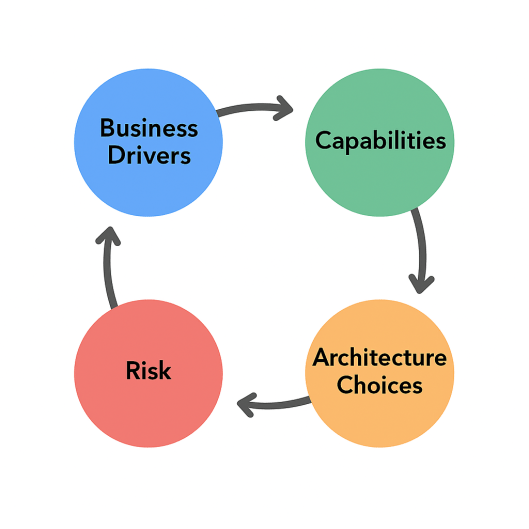
Executives should ask at each conjuction phase :
- Business Drivers → Capabilities: “Which capabilities matter most and which are we de-prioritising?”
- Capabilities → Architecture Choices: “Which architectural principles are we enforcing or violating?”
- Architecture Choices → Risk: “What risks are we intentionally accepting?”
- Risk → Drivers: “Does this change our strategy or risk appetite?”
Why False Alignment Degrades Decision Quality
False alignment creates three systemic failures:
1. Silent Risk Accumulation – When disagreement is discouraged, risks don’t disappear, they go underground. (See NIST’s guidance on risk-informed decision-making: https://www.nist.gov/cyberframework)
2. Architecture by Negotiation – Instead of principled design, architectures emerge from stakeholder bargaining.
3. Accountability Dilution – Consensus decisions often lack clear ownership. When outcomes fall short, responsibility is diffused making learning and correction difficult.
Decision effectiveness correlates more strongly with clarity of decision rights than with agreement levels.
Better Governance Questions for Executives
Instead of asking, “Are we aligned?”, executives committed to high-quality governance should focus on questions that probe the robustness and transparency of decision-making. Examples include:
- What are the key trade-offs we are making, and who owns them?
- Where do knowledgeable stakeholders disagree and how are we surfacing and addressing those disagreements?
- How explicit are we about the risks we are accepting, and how are those risks being monitored and managed?
- Who is accountable for the outcomes of this decision, both positive and negative?
- How will we review and learn from the results of this decision, regardless of whether it succeeds or fails?
These questions shift the governance conversation from comfort and superficial agreement to clarity, learning, and value creation.
True governance is not about eliminating friction, but about harnessing it for the good of the organisation.
References and Further Reading
- Argyris, C. Teaching Smart People How to Learn, Harvard Business Review
- Harvard Business Review, Deciding How to Decide
- TOGAF® Standard, 10th Edition – Architecture Governance
- Gartner IT Governance Definition
- NIST Cybersecurity Framework – Risk-Based Governance



 Max Hemingway
Leave a comment